
Semiconductors are surpassing oil as the linchpin of the dollar’s global reach, demonstrating U.S. technological might but also revealing a less stable foundation, according to Deutsche Bank.
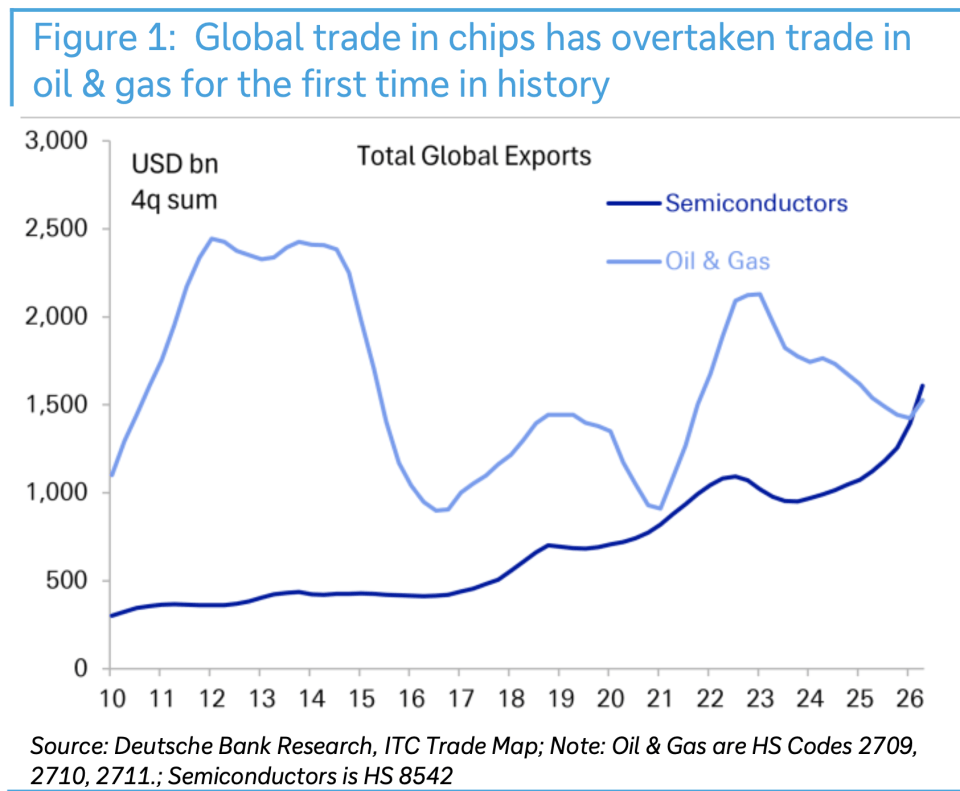
In a note last week, foreign exchange strategist Mallika Sachdeva pointed out that for the first time in modern history, global trade in chips now exceeds trade in oil and gas. Excluding China, Asia’s surplus in the chip trade matches petroleum-related surpluses in the Persian Gulf, she added.
That’s as AI hyperscalers keep ramping up capital expenditures, which are expected to top $1 trillion next year, further propping up chip trade flows.
“The rise of chips as a driver of dollar dominance can be seen as a symptom of change in the ultimate source of U.S. power — from geopolitical to technological leadership,” Sachdeva wrote, adding that the so-called petrodollar is quickly being superseded by the new “chip-dollar.”
The petrodollar regime goes back to a deal struck in 1974 when Saudi Arabia agreed to price its oil in dollars and invest surpluses in U.S. assets, especially Treasury debt. In return, the American military ensured security in the region and free navigation in the Strait of Hormuz.
And because oil is a core input to global manufacturing and transport, supply chains have a natural incentive to dollarize. Indeed, Mideast oil and gas are used to make petrochemicals, fertilizer, and even helium.
But the underpinnings of the petrodollar are breaking down due to the Iran war as Tehran exposes the limits of the U.S. military, while the AI boom is sending a tsunami of capital from Asia to the U.S.
This time around, rather than Mideast kingdoms recycling oil-trade surpluses into U.S. debt, Asia’s chip behemoths are recycling chip-trade surpluses into U.S. stocks. In fact, South Korean households have 90% of their equity exposure in the U.S., according to Deutsche Bank. Overall, foreign purchases of U.S. equities are now more than double that of Treasuries.
“The emerging chip-dollar regime is one where US technology leadership is motivating global savings to be reinvested in U.S. companies — providing funding for the US corporate sector to make enormous investments in new technology such as AI,” Sachdeva explained.
Chip dominance begets dollar dominance
Just like how oil penetrated industrial supply chain, chips are embedded in the digital economy as inputs in consumer electronics, automobiles, computers, communication devices, and AI systems. She estimated chips account for more than 50% of the capex for a data center.
And despite Asia’s dominance in chipmaking, 70% of the industry’s profits flow to U.S. firms. In addition, the key countries in the supply chain of advanced chips are friendly with Washington, namely Japan, South Korea and Taiwan.
“The potent combination of U.S. control over key upstream technologies and intellectual property, alongside a supply chain located in U.S. allies has given the U.S. enormous control over chips,” Sachdeva added.
At the same time, chips ensure continued dollar dominance in global trade, payments, capital markets, and private sector savings, while also supporting America’s AI buildout, she pointed out.
But Deutsche Bank cautioned that the new currency regime has a “circularity” risk because capital flowing from Asian chip hotspots provides financing to U.S. companies driving the AI boom. That means if consumer demand for compute can’t support AI investments, earnings for tech companies would come down—as well as chip demand.
The focus on stocks over debt means more instability too. U.S. stocks overall are three times as volatile as Treasuries—and tech stocks are up to 10 times as much, Sachdeva noted.
“A dollar driven by chips, AI and private capital connections should be inherently riskier,” she warned.
That risk was on display in recent weeks as tech stocks sold off sharply on fears the AI boom was about to go bust. And although Jensen Huang’s return to Nvidia on Monday sparked a big rebound, the Trump administration is cracking down on foreign access to U.S. AI technology, potentially curbing the chip trade.
Dollar vs. yuan — Coke vs. Pepsi
To be sure, threats to the dollar’s status as the global reserve currency have come and gone over the decades. More recently, the proliferation of U.S. financial sanctions has given countries more reason to diversify away from the dollar.
But no credible alternatives have emerged yet, despite China’s aggressive efforts to internationalize the yuan.
China facilitates its use among firms in more than a hundred countries and across a growing array of commodity markets. Beijing also promotes “China prices,” or yuan benchmarks on domestic commodity exchanges. Chinese banks have more than doubled their yuan lending to overseas borrowers since 2023, and the central bank has reached currency swap agreements with dozens of peers.
But Zongyuan Zoe Liu, senior fellow for China studies at the Council on Foreign Relation, argued in Foreign Affairs last month that Beijing doesn’t actually want to replace the dollar on the world stage.
“Placing a respectable second, or even a consequential third, would suffice to break the dollar’s effective monopoly and constrain the United States’ ability to impose financial sanctions unilaterally, while saving China the effort and cost of sustaining currency supremacy,” she wrote.
“From Beijing’s perspective, the mission is to establish the renminbi as the Pepsi to the dollar’s Coca-Cola: never the market leader, but serviceable in a pinch and more than capable of keeping the dominant incumbent honest.”