
Good morning. On Fortune’s radar today:
- Congress briefed on China spy links to Nvidia.
- Cold feet? Silicon Valley CEOs are calling their divorce lawyers for prenups and NDAs after Jensen Huang scandal.
- “The economy is super strong right now, but the Fed is about to kill it.”
- Markets: The flight from tech.
- Data center construction is crowding out residential homebuilding.
- How Fanatics CEO Michael Rubin went from being a bankrupt teenager to building a $14 billion empire.
ONE BIG THING
Congress receives briefing on links between Jensen Huang’s affair partner and Chinese intelligence agency
Officials from the FBI, CIA and the Office of the Director of National Intelligence briefed staff members of the House and Senate intelligence committees on some of what they know about Alice Huang, Megaspeed, and their links to China’s Ministry of State Security, according to the NYT:
- “The intelligence officials told the group there was no evidence she was directed by that agency to initiate an affair with Mr. Huang, though they did not dispute that she passed intelligence back to the agency after the affair began.”
- “The briefers told the congressional staffers that the man who was often introduced as Ms. Huang’s husband, Kang Wei, was a more significant figure. He had been, at least at times, an MSS [China Ministry of State Security] asset and had more significant contacts with the Chinese spy agency, the briefers said.”
Prenup-chills: Silicon Valley divorce lawyers see surge of CEO calls for prenups and partner NDAs after Nvidia scandal
Silicon Valley divorce lawyers are seeing a surge in outreach from CEOs, founders, and high-net-worth employees who are citing the Nvidia scandal as the reason for their calls, according to Fortune’s Emily Forlini.
The revelation of Jensen Huang’s affairs is a “precautionary tale for other CEOs,” said one lawyer who has been involved in the high-profile divorces of some of the tech industry’s most famous CEOs.
Jensen and Lori Huang have been married for 41 years, and reportedly do not have a prenuptial agreement. Jensen Huang is one of the richest people in the world, with a net worth of roughly $137 billion. If Lori leaves, a huge chunk of Jensen’s net worth would potentially transfer to her.
In addition to pursuing prenuptial agreements, many are interested in drafting nondisclosure agreements (NDAs) for their significant others, which is a new trend, says Monica Mazzei, a partner in Buchalter’s San Francisco family law office.
- At what price is Anthropic stock a buy? Wall Street analysts and investors weigh in - Morgan Chittum
- Jensen Huang says he still does not believe in succession planning - FT
- ‘Anflopic’ bodes badly for OpenAI’s IPO prospects - FT
- AI debt worries grow as Nvidia rebound masks Big Tech spending squeeze - CNBC
MORE FROM FORTUNE
Exclusive: Meta and Amazon discuss ending Muse shopping bot blockade, as ads, search emerge as key issues - Sebastian Herrera
Europe has spent $15.9 billion trying to win the quantum race. Is it enough? - Sam Birchall
Nvidia degrades U.S. national security as Chinese military snags its chips - Jeffrey Sonnenfeld, Stephen Henriques, and Steven Tian
Backed by Samsung, SK Hynix, and the Korean government, Rebellions CEO Sunghyun Park wants to prove sovereign AI pays off - Nicholas Gordon
Best Buy’s new CEO inherits its fastest sales growth in five years and a 49% stock rally - Fernanda Tronco
Walmart’s shopper base is shifting: High earners lead its gains as low-income shoppers turn to Amazon - Lena Borrelli
Ukraine’s biggest steelmaker has battled years of Russian bombardment—now it faces a new threat - Kamal Ahmed
Going home for Thanksgiving? For a record 25.2 million young adults, that just means walking downstairs - Catherina Gioino
FUD
On Wall Street, recession fears grow despite AI boom: “The economy is super strong right now, but the Fed is about to kill it”
Fed chairman Kevin Warsh will almost certainly add another 0.5% to U.S. interest rates in December, according to the CME FedWatch futures index, and Wall Street is angsty that the move will cause a recession. “The Fed will put the U.S. and [the] world in recession if it continues to raise rates in a failed attempt to drive inflation to 2%,” Bill Ackman said recently.
He’s not alone.
“The economy is super strong right now, but the Fed is about to kill it,” Jamie Cox of the Harris Financial Group ($1.5 billion AUM) told Fortune.
The problem is that inflation—which at 3.7% is high above the Fed’s 2% target—is being driven by the price of oil (which the Fed can do nothing about) and the price of computer chips and tech equipment (which the Fed can also do nothing about).
If the Fed increases interest rates, it may derail areas of the economy that are sensitive to higher borrowing costs while doing nothing about the roaring trade in oil. AI is increasingly dependent on debt funding, and higher rates could kill off that liquidity.
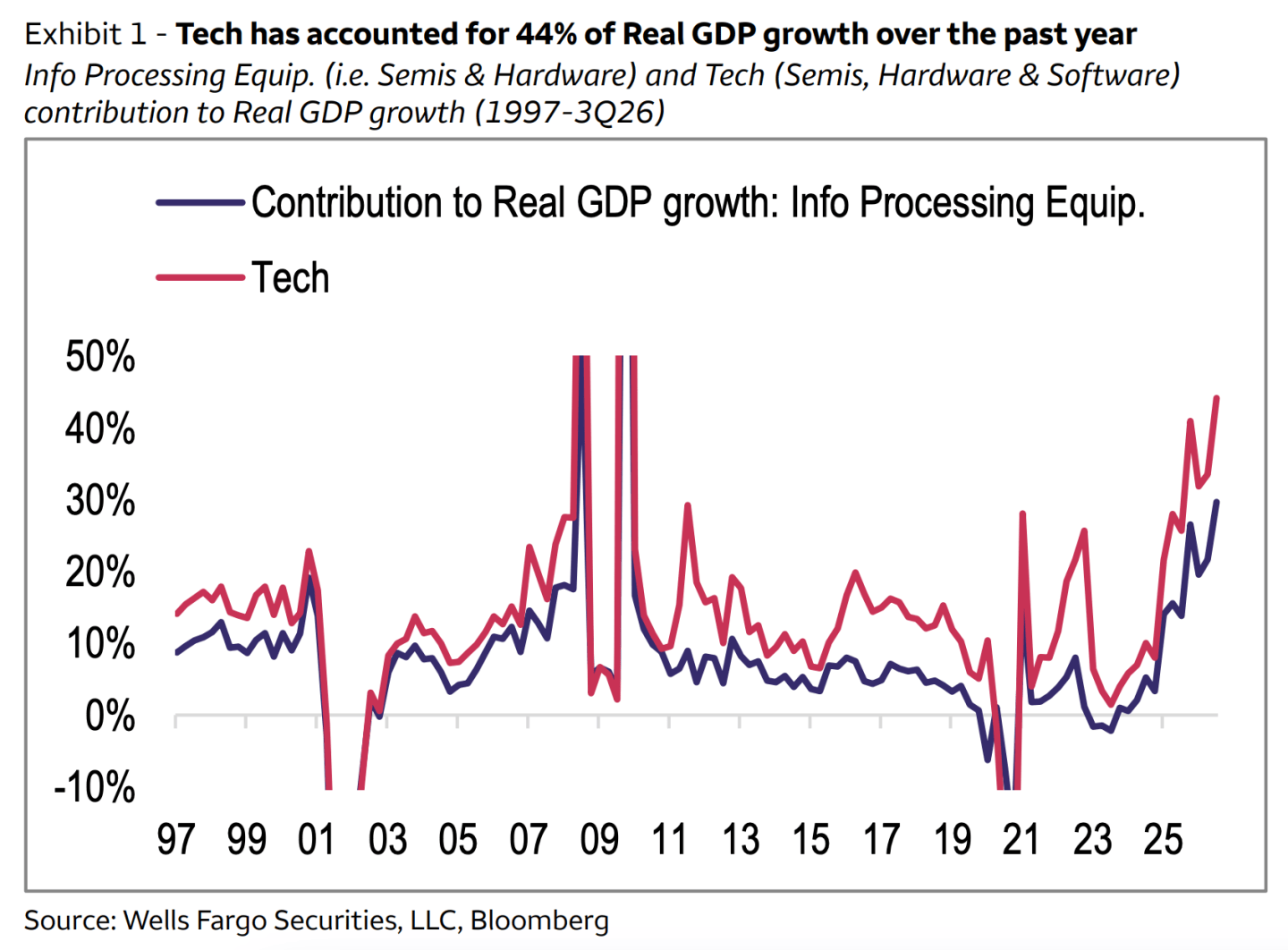
“Tech drove 44% of GDP growth [in the last 12 months], leaving growth vulnerable as capex slows,” according to Wells Fargo’s Ohsung Kwon. “The fear is hikes into a slowdown, and an overly hawkish Fed could potentially drive recession fears.”
Obviously, the situation with Iran is out of the Fed’s control. But as Fortune’s Ellie Pringle noted yesterday, if Warsh continues to “look through” oil-driven inflation then bond investors will start questioning the Fed’s credibility.
“The path of the war is crucial for the Fed's path,” Kwon said in a note.
THE MARKETS
The return of “risk-off”: Sellers dominate the market in flight from tech stocks
Investors have continued to dump tech stocks over the past 24 hours on continued worries about the stability of the AI trade and a report that the Trump administration was proposing a new set of trade tariffs on China, Europe, and 14 other countries. S&P 500 futures moved lower ahead of the open in New York.
“The risk-off tone has returned over the last 24 hours,” Jim Reid and his team at Deutsche Bank said this morning.
At UBS, Paul Donovan said: “The concern is the impact on U.S. inflation, and thus U.S. interest rates. Reports suggest U.S. importers will face only modest tariffs on goods from several countries. There is less certainty about goods from China, but U.S. importers became adept at avoiding those tariffs. A 10% tariff on a finished good translates into around a 4% consumer price increase, as tariffs occur early in supply chains.”
The tech sector saw the worst losses. The tech-heavy Nasdaq Composite fell 1.48% yesterday, much farther than the broader market. In fact, the equal-weight S&P 500—a notional index that values each stock equally—rose 0.53%, suggesting buyers in a range of non-tech stocks.
S&P 500 futures were down again this morning, but Nasdaq 100 futures slipped even farther: down 2.39%, another big step down for an index of its size.
- S&P 500 futures were down 1.37% this morning. The index fell 0.5% yesterday.
- In Europe, the Stoxx 600 was up 0.25% in early trading, and the U.K.’s FTSE 100 rose 0.42% before lunch.
- Asia: South Korea’s KOSPI was down 6.16%. Japan’s Nikkei 225 was down 2.78%. India’s Nifty 50 was up 1.85%. China’s CSI 300 fell 1.65%.
- Brent crude was $91 per barrel.
- Bitcoin fell to $59,011.
The S&P won’t enter a bear market unless this thing happens that everyone expects will happen, Deutsche Bank says
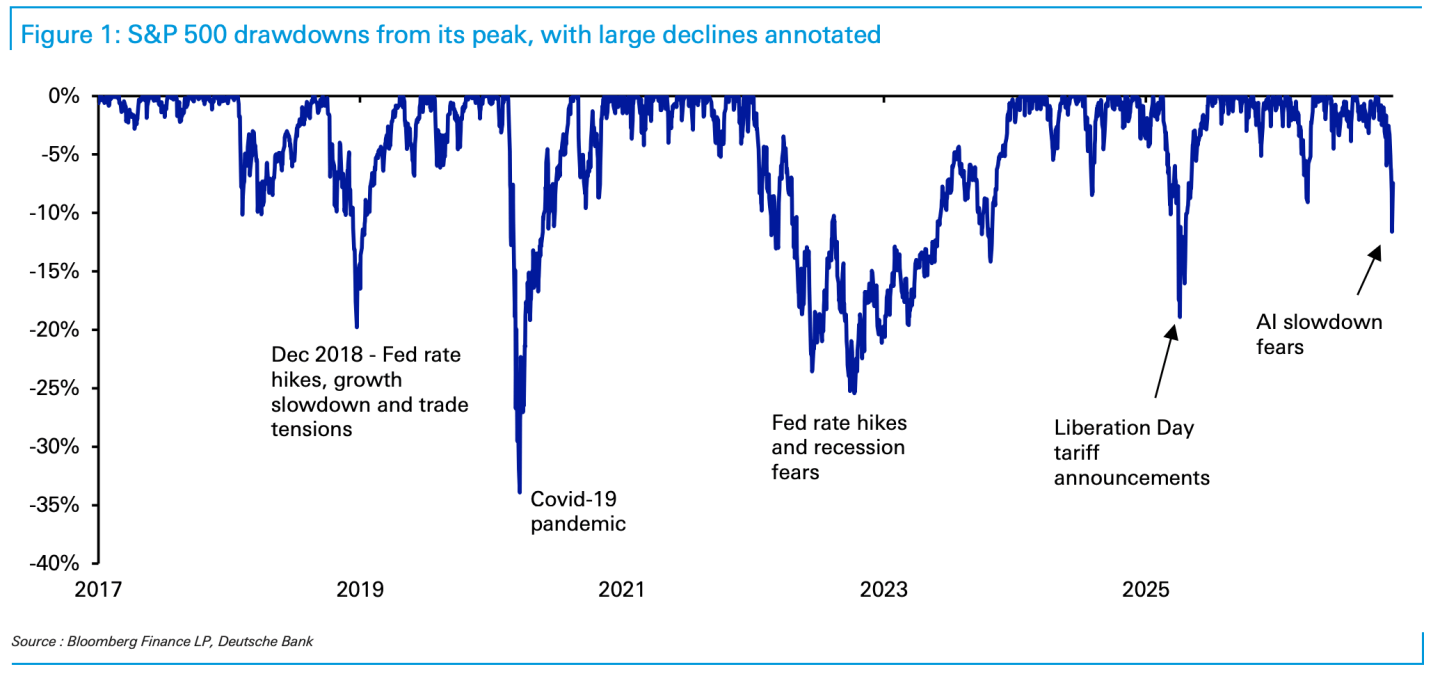
The S&P 500 may have flirted with a downward “correction” around the Nvidia drama, but it’s nowhere near an official bear market, defined by a decline of 20% from the peak. In fact, a bear market is unlikely to happen, according to Deutsche Bank’s Henry Allen. The bank’s official forecast is for the S&P 500 to hit a heady 9,000 by the end of next year.
“It’s worth bearing in mind that the outright bear markets of the last 50 years (S&P 500 down 20% or more) have previously occurred when there was at least one of (1) a recession, (2) widespread expectations of a recession, or (3) after a Fed tightening cycle with multiple hikes.”
Note to self: We will officially be in a tightening cycle if the Fed raises interest rates in December, which it is widely expected to do.
CHART OF THE DAY
Data center construction is poaching workers away from residential homebuilding
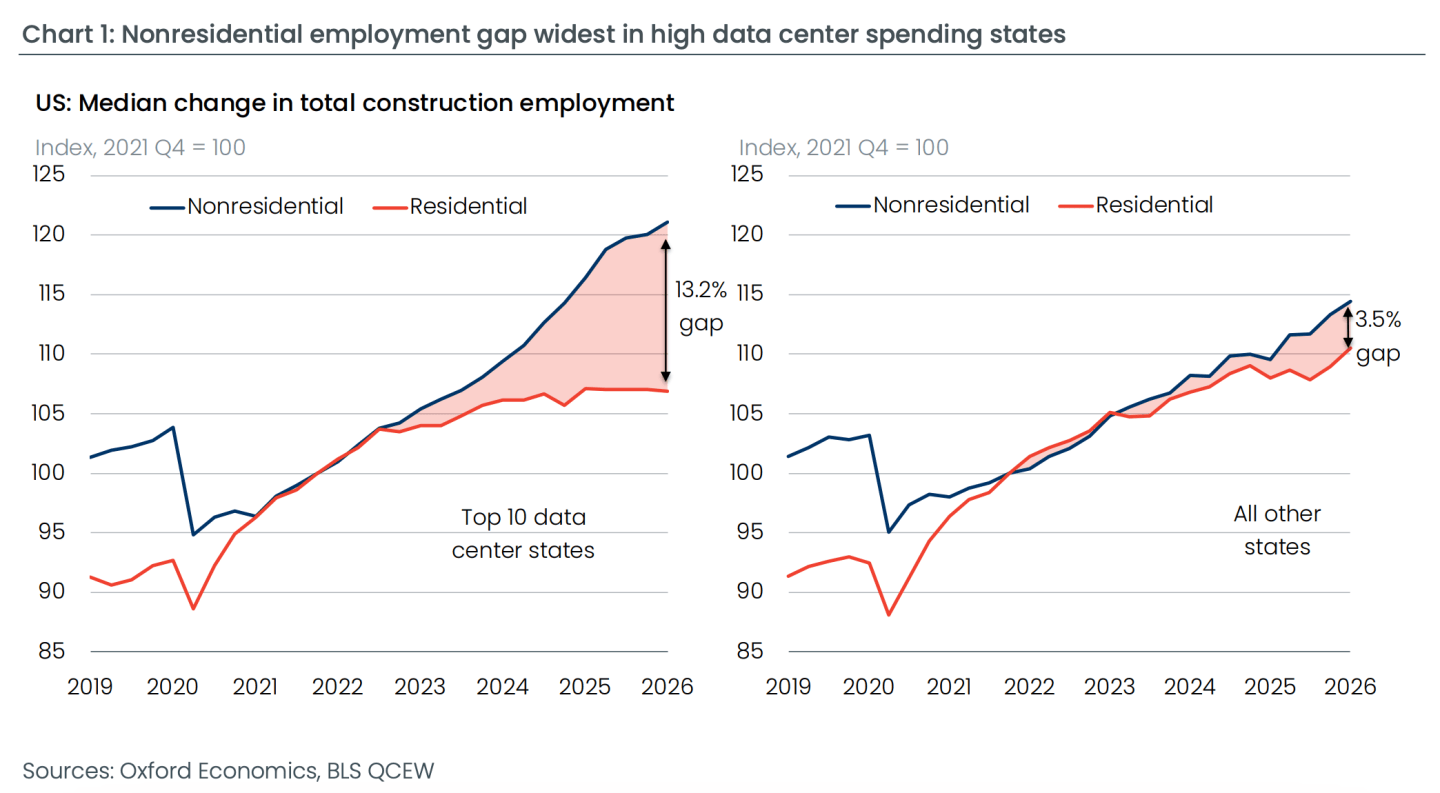
“Since Q4 2021, nonresidential construction employment has outgrown residential by 13.2% in the typical state among the 10 with the highest data center spending, versus 3.5% elsewhere,” according to Matthew Martin of Oxford Economics.
“If these 10 states had followed the rest of the country, up to 45,000 more workers would be in residential construction – about 24,000 of them in specialty trades,” he noted.
NUMBER OF THE DAY
~$300 per kilogram
The price at which lifting an AI data center into orbit will fall below the cost of building one on Earth, if Elon Musk’s SpaceX can achieve routine and rapid rocket reuse, according to an estimate by ARK Invest’s Tasha Keeney. The price is currently $1,000 per kilo.
THE FRONT PAGES TODAY
Donald Trump shelves plans for business deals with Russia - FT
Ukraine tells Putin to ‘stop complaining’ over oil refinery attacks as Russia promises retaliation - CNBC
AI employees sound alarm: models too powerful to ever release - Axios
Worse Than the Dot-Com Crash: What an AI Bust Could Mean for the Economy - WSJ
China Dismisses US Tariff Prospect as ‘Political Maneuvering’ - Bloomberg
ONE MORE THING
If life gives you lemons, go into the closeout merchandise business
Fanatics has become a one-stop shop for sports fans looking to rep their favorite teams and athletes, and now generates roughly $14 billion in annual revenue. For cofounder and CEO Michael Rubin, however, the road to building that empire nearly ended before he turned 20.
When Rubin was just 13, he started a business selling ski equipment out of his parents’ basement in Pennsylvania. A year later, he opened his own storefront. He was making money quickly—and even bought a Porsche before he could legally drive.
But around 1988, there was an unusually warm winter, and so his customers weren’t coming. “It didn’t snow that year,” Rubin recalled recently. “End of the year, I had $200,000 of bills, $80,000 of inventory, and I was sitting right in front of bankruptcy.”
To dig himself out, he negotiated his debts down to $35,000, borrowed money from neighbors, and used the proceeds from a new venture in the closeout business to repay his loans. Five years later, at 21, Rubin was generating $150 million in sales buying and selling closeout merchandise.
“I went from death in its eyes, bankrupt, thought I was a complete failure, giving up on entrepreneurship, to five years later, doing $150 million, making $10 to $15 million a year as a kid,” Rubin said. “And so to me, each disaster, if you learn from it, leads to your next success.”
- ➡️ Would you like to sponsor this newsletter? Contact advertising@fortune.com for details.
- ➡️ If you would like to receive this information in your inbox every morning before the markets open in New York, sign up here.