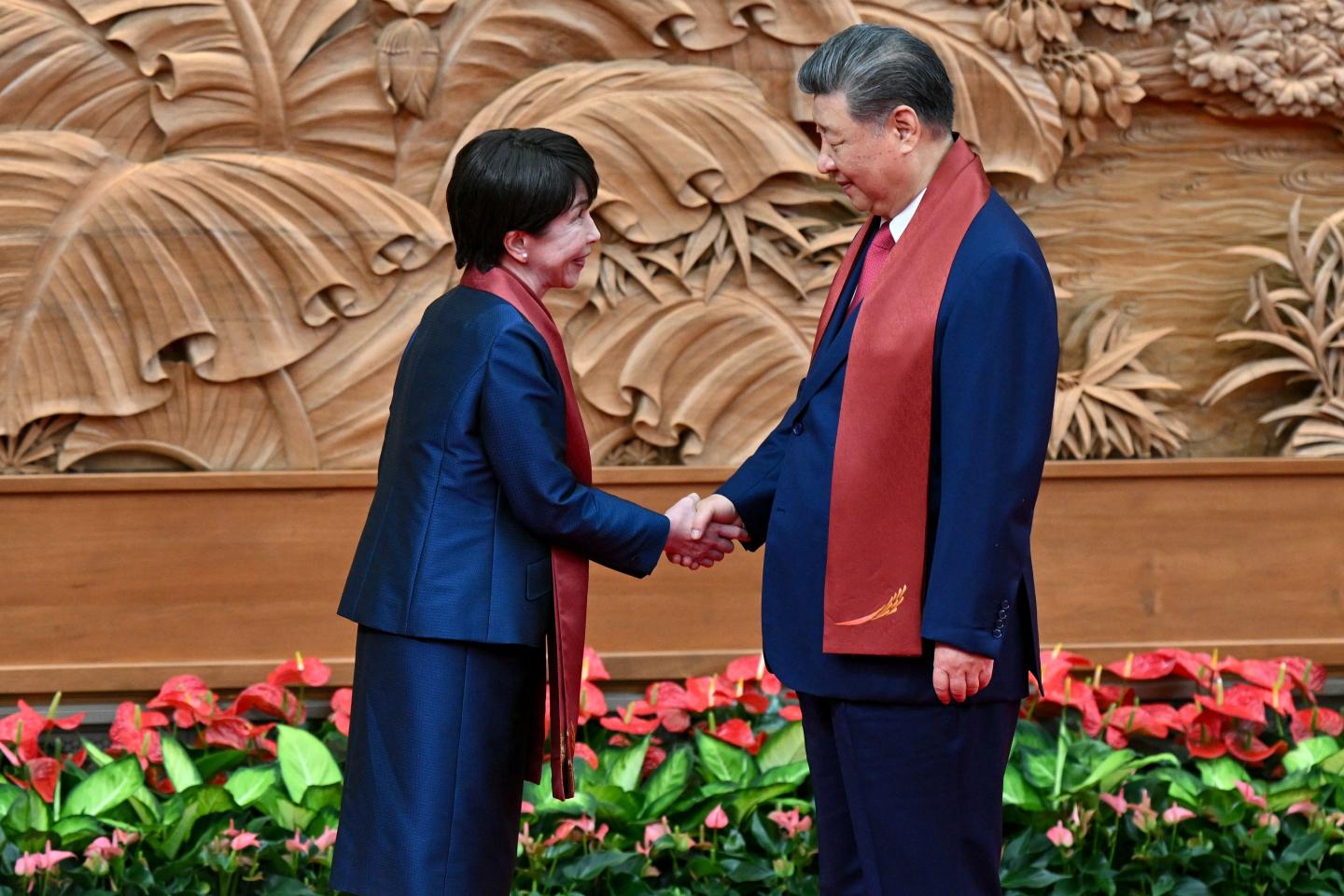
Japanese Prime Minister Sanae Takaichi shook hands with Chinese President Xi Jinping in Shenzhen last week, the closest thing to a thaw in China-Japan relations since late last year.
The encounter, on the sidelines of the Asia-Pacific Economic Cooperation (APEC) leaders’ meeting, was brief. Takaichi shook hands with Xi and his wife, Peng Liyuan, as they greeted arriving guests. Yet apart from a few other brief interactions, Xi and Takaichi held no official meeting.
Observers believe that Takaichi’s brief handshake with Xi reflects a relationship now driven more by security than by trade. Complicating matters is U.S. President Donald Trump’s relationship with Beijing, which Tokyo fears may drive a wedge between Japan and its closest ally.
Why are China and Japan at odds?
Relations between Tokyo and Beijing deteriorated sharply in November 2025, when Takaichi told Japan’s parliament that a Chinese attack on Taiwan could prompt Japan to deploy its Self-Defense Forces if the conflict posed an existential threat.
That same month, Beijing demanded that Takaichi retract her comments, calling them “egregious.” Foreign Ministry spokesperson Lin Jian warned that Japan “must bear all consequences.” He also said that if Japan intervened militarily in a Taiwan Strait conflict, China would “strike back decisively.”
China advised its citizens to avoid traveling to Japan shortly after Takaichi’s comments in November 2025. It also imposed export restrictions on dual-use technology, including rare earth elements, permanent magnets, and other critical minerals used in defense technologies, according to the Center for Strategic and International Studies, a Washington-based think tank.
Tensions rose again in March, when a 23-year-old Ground Self-Defense Force officer was arrested after he entered the Chinese embassy in Tokyo while carrying a 7-inch knife. Japan called the incident “regrettable” and said that the government would take measures to prevent it from taking place again.
In response, Chinese foreign ministry spokesperson Lin Jian said that the incident had “seriously threatened the safety of embassy personnel and damaged its dignity.”
In Shenzhen, Takaichi said Japan’s position on Taiwan had not changed since the 1972 Japan-China Joint Communiqué, which established relations between the two countries.
China considers Taiwan part of its territory and has not ruled out the use of force to bring the island under its control.
Takaichi received a more subdued welcome than other APEC leaders, including South Korean President Lee Jae Myung. Bloomberg reported that Japanese officials asked Beijing to guarantee that Xi would treat Takaichi like other leaders, as a condition of her attendance.
“The Chinese go out of their way to treat the South Koreans and Lee Jae Myung far more warmly than they do Takaichi, a contrast not lost on the Japanese media and government,” Daniel Sneider, a Stanford University professor who specializes in Japan’s foreign policy, says.
What has the tension cost Japan’s economy?
China was Japan’s largest trading partner in 2025, with two-way goods trade totaling about $304 billion, according to Japanese government figures.
But with Tokyo and Beijing increasingly viewing each other through a security lens, trade may serve less as a stabilizing force.
“Previously economic relations provided steadying ballast in the overall relationship but now both nations view the relationship more through the security angle and business leaders don’t have the influence they once had,” Jeff Kingston, a Temple University professor who focuses on Japan’s relations with Asia, says.
“Her comments on Taiwan antagonized China and it [Beijing] is not backing down,” he adds.
Still, Japan’s tourism industry has largely held up despite a sharp drop in Chinese arrivals. Local media reported that foreign visitors spent $30.4 billion in the first half of 2026, and October brought in about 3.9 million visitors.
However, visitor numbers from January to October fell 2.5% year on year, to 34.6 million, according to the Asahi Shimbun, citing numbers from the Japan National Tourism Organization. In 2025, Japan welcomed 42.7 million visitors.
Where does the U.S. fit in?
Takaichi and Trump met in October 2025, when Trump praised Japan’s first female prime minister and the two countries announced trade and rare-earth agreements.
Still, Sneider suggests that, while the U.S. remains a close Japanese ally, Tokyo is closely watching Washington’s engagement with Beijing. “We saw during Xi’s visit to Washington, the Chinese are eager to remind Trump and Americans of the wartime alliance of the U.S. and China against Japan, comments which were strangely echoed by Trump,” he says.
When Trump and Takaichi met in March, Trump compared U.S. strikes on Iran with Japan’s 1941 attack on Pearl Harbor, which killed more than 2,000 Americans. When asked about why he hadn’t informed allies about his war plans, Trump said: “We wanted [a] surprise. Who knows better about surprise than Japan? Why didn’t you tell me about Pearl Harbor?”
Japan views Trump’s meetings with Xi and Russian president Vladimir Putin last week as a “means to isolate Japan and drive wedges between Japan and its ally,” Sneider says.
Takaichi did have one important bilateral meeting in Shenzhen. On Nov. 18, she met with Putin on the sidelines of the summit. Reuters reported that Takaichi raised two issues with Putin: the detention of a Japanese journalist in Russia and the protection of Japanese companies.