Lotus F1 Team (Lotus) surprised many observers with its performance when it entered Formula One (F1) in 2012. Driver Kimi Räikkönen placed third overall (out of twenty-five drivers), and Lotus placed ahead of Mercedes (which later won the F1 championship from 2014 to 2021).
Lotus won its place despite having an annual budget of only around $180 million, which was slightly less than average and significantly less than the most competitive teams. Rather, the team understood that just throwing money and technology at the competition was no guarantee for success.
Toyota learned this the hard way during its eight-season F1 stint: it failed to score a single victory (in 140 races) in spite of outspending all other teams ($446 million in 2008 alone).
To succeed in racing requires many ingredients: top drivers, skill, technology, fast learning, a sufficient budget, and, of course, a team culture that puts the pedal to the metal on experimentation.
Lotus’s former technical director explained the challenge: “We try to gain about one and a half seconds per lap speed each year. To do that, you need a completely new chassis and aerodynamics. But that’s not enough. You also need to continue developing the car during the season. We produce around thirty-thousand design changes per year.”
How does an F1 team make 30,000 annual design changes while competing at the highest level? The answer is a culture that embraces continuous experimentation—night and day. That includes smart testing through computer simulation, digital twins, wind tunnels, driving simulators, and on-track trials. (Today, AI tools process and analyze the massive amount of F1 data even faster, which can influence design and racing decisions.)
By 2013, in fact, F1 regulators knew that large-scale experimentation gave teams an advantage over their competition and placed strict limits on testing: forty hours of computer simulation, after which teams had to stop for sixty hours; fifteen wind tunnel tests per day; twelve days of pre-season track testing, and so on. Getting more learning and improvement out of each testing hour, therefore, was a source of competitive advantage for F1 teams.
Drivers, for example, had to give engineers precise feedback on the car’s behavior after a design change had been made. This helped with the formulation of better hypotheses, which were challenged and honed with deep questions. The feedback led to more experiments, requiring more feedback, learning, and improved hypotheses to make the car faster.
Lotus’s CEO described the approach: Before the season starts and before each race, we load racetrack and car characteristics into the in-house, full-scale driving simulator to reproduce as much as possible the actual car dynamics during the next race. We can reproduce the effect that a part change will have on the car. After racing the car in the simulator, the driver gives us feedback, and we try to modify the part accordingly. Rules limit on-track testing time, so the simulator is key to understanding how the driver feels in the car.
Being fast and flexible is essential in winning races. Teams learn how to assemble and disassemble the car in record time, departments ensure performance data flows in real time across their desks, and production systems accommodate design changes up to the last minute.
Some races are only a week apart, requiring operations to be torn down and rebuilt thousands of miles away in record time. Damaged parts must be remanufactured, shipped internationally, and cleared through customs in only a few days. In some cases, components are made the day before the qualifying race deadline and hand-delivered by plane just in time.
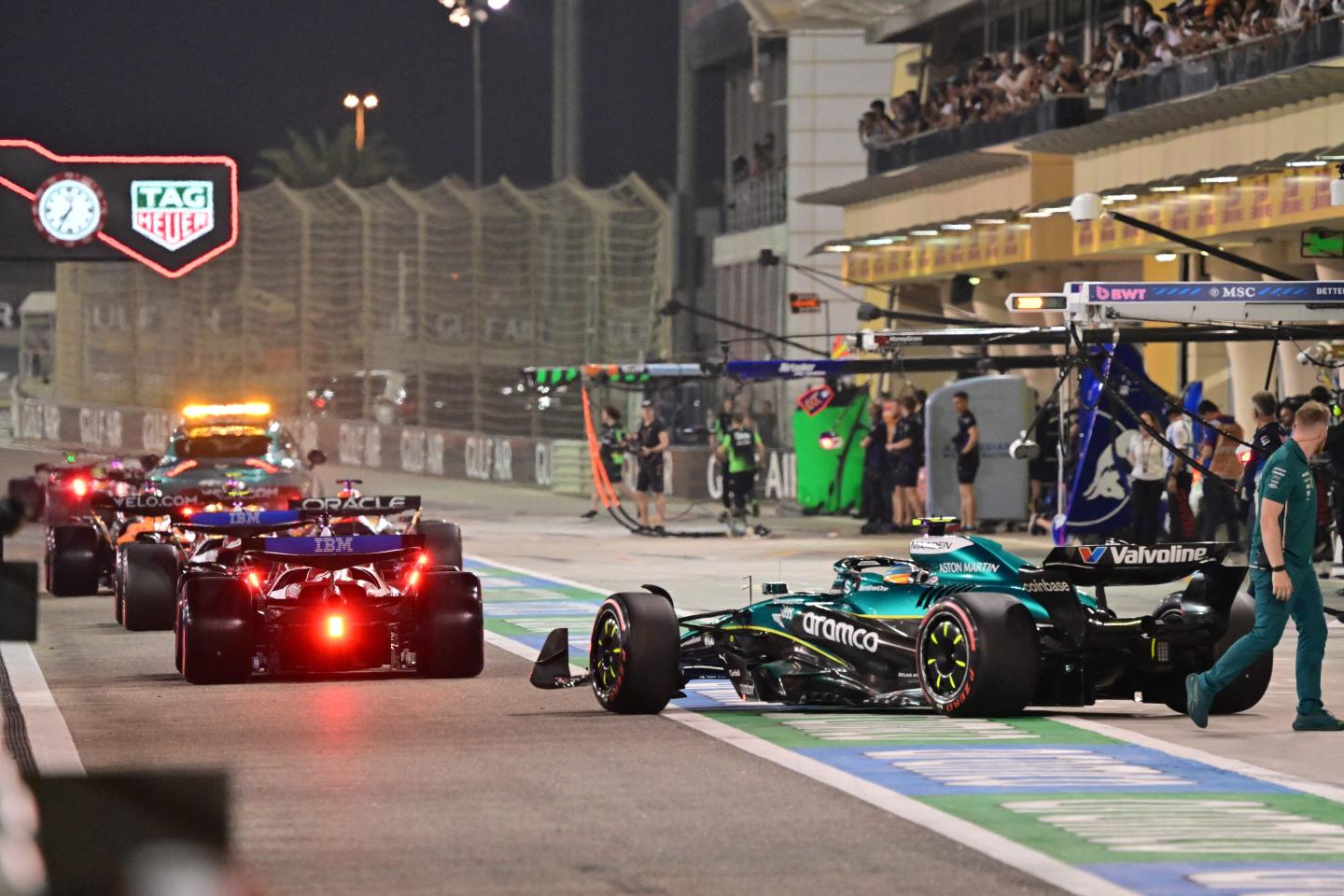
During a race, tire changes have to be completed in 2 to 2.5 seconds, with the pit crew beginning its choreography before the car fully stops.
Not surprisingly, a culture defined by organizational silos, slow decision-making, and low morale is a recipe for defeat in the fast-paced world of F1. “To be fast on the track,” Lotus’s CEO told me, “you have to be fast off the track.”
Business leaders should heed that advice. In a recent interview with Harvard Business Review, Amazon CEO Andy Jassy noted that “speed is a leadership decision,” but further noted that to achieve it, you need to build the right culture.
Even so, some leaders simply can’t help undermining their work environments. It’s not so important whether any one experiment succeeds or fails; what matters is how decisions are made. Developing a scientific mindset requires organizations to empower curious and skeptical people, not discourage them through fear, uncertainty, and doubt. Unfortunately, some leaders can’t help (unintentionally) getting in their own way.
Editor’s note: Lotus F1 Team was bought by Renault in 2016 and races today as Alpine. Toyota left Formula One after the 2009 season. A version of this case study appeared in Thomke’s 2020 book, Experimentation Works.
Adapted from: The Scientific Mindset: How Thinking Scientifically Drives Better Business Decisions by Stefan Thomke. Copyright © 2027 Stefan Thomke. All rights reserved. Reprinted by permission of Harvard Business Review Press.