
Good morning. On Fortune’s radar today:
- Trump calls for Jensen Huang’s Nvidia return as the China spy probe widens.
- Luana Lopes Lara tells us how she built Kalshi into a $40 billion prediction market giant.
- A golden age of AI job creation … maybe.
- Markets: “Selloffs rarely turn around in a day.”
- U.S. household wealth on course to hit $9 trillion.
- Gen Z believes AI is making you dumber, but they trust it anyway.
ONE BIG THING
Trump wants Jensen Huang back at Nvidia as more details of Chinese spying emerge
President Trump said he would support Jensen Huang’s return as CEO of Nvidia as more details of the extent of China’s efforts to illegally import the company’s chips emerged over the weekend. “It would be the best thing for the company, and also, for the U.S.A.,” Trump said on social media.
If Huang were to be reinstated, it would set up an extraordinary challenge for the company. Huang has already agreed to testify to the Senate about what he knew about his affair partner Alice Huang’s relationship with Chinese intelligence.
Meanwhile, Alice Huang (no relation) was in contact with China’s Ministry of State Security (MSS) for more than a year while she was involved with Jensen Huang, the NYT reported.
The NYT also reported that Alice Huang’s business partner and husband, Kang Wei, had links to the MSS.
In Singapore, a 52-year-old Chinese national, Li Ming, was arrested and charged with smuggling Nvidia chips to China, according to the WSJ. Li was “deeply involved” with Megaspeed, Alice Huang’s company, the WSJ said. Li was charged with fraud in February 2025. That case is not related to Megaspeed. Rather, the charges allege Li made false representations to another U.S. chipmaker, Super Micro Computer, CNBC said.
Director of National Intelligence Jay Clayton also said on Sunday that the U.S. is investigating Alice Huang and Megaspeed, CNBC said.
MORE FROM FORTUNE
After the Palisades fire, a founder built AI to help survivors with paperwork. Now he needs a state to buy it - Heather Occhino
LinkedIn CEO warns the job market is ‘frozen’— but he says Gen Z could have the upper hand because employers may assume they’re AI-savvy - Orianna Rosa Royle
The smartphone market is facing ‘the great disruption.’ Chinese giant Oppo senses an opportunity - Kamal Ahmed
Dodging space junk costs $58 million a year. Meet the Space Force contractor who made ‘autopilot for satellites’ to save money for taxpayers - Catherina Gioino
Tokyo won’t fall as hard as Seoul or Taipei when the AI trade cools, says Japan Exchange Group CEO Hiromi Yamaji - Angelica Ang
UNPREDICTABLE
How Luana Lopes Lara built Kalshi into a $40 billion giant that overtook Polymarket
Kalshi COO Luana Lopes Lara and CEO Tarek Mansour met and became a couple when they were students at MIT. He was intrigued by how she sat in the front row at every lecture, reports Fortune’s Emma Hinchliffe.
Lopes Lara had trained at the harsh Bolshoi ballet academy in Brazil, the only international offshoot of the intense Russian dance school. Academics started at 7 a.m. and ballet lasted until 9 p.m. At times, lit cigarettes were reportedly held under students’ legs to keep them in the air. After graduating, Lopes Lara danced professionally for nine months in Austria. She got into Harvard, MIT, Stanford, and Yale, and chose the school that would force her to “just focus” on math.
By 2019, they had decided to form a prediction market company, forcing them to decide who would be CEO. The choice was logistical: Mansour was born in California before growing up in Lebanon. As an American CEO, he could hire Lopes Lara, a Brazilian citizen, and sponsor her visa. (They also broke up as a couple. “Being next to someone the whole day, working and dating—it just died out,” Lopes Lara says.)
FINGERS CROSSED
Are we about to enter a new age of AI job creation?
In recent weeks, this email has published a series of worrying charts showing that AI appears to be replacing human jobs, especially in industries most exposed to it, such as finance, marketing, and software.
But this new data from Pantheon Macroeconomics suggests the U.S. economy may be about to turn the corner.
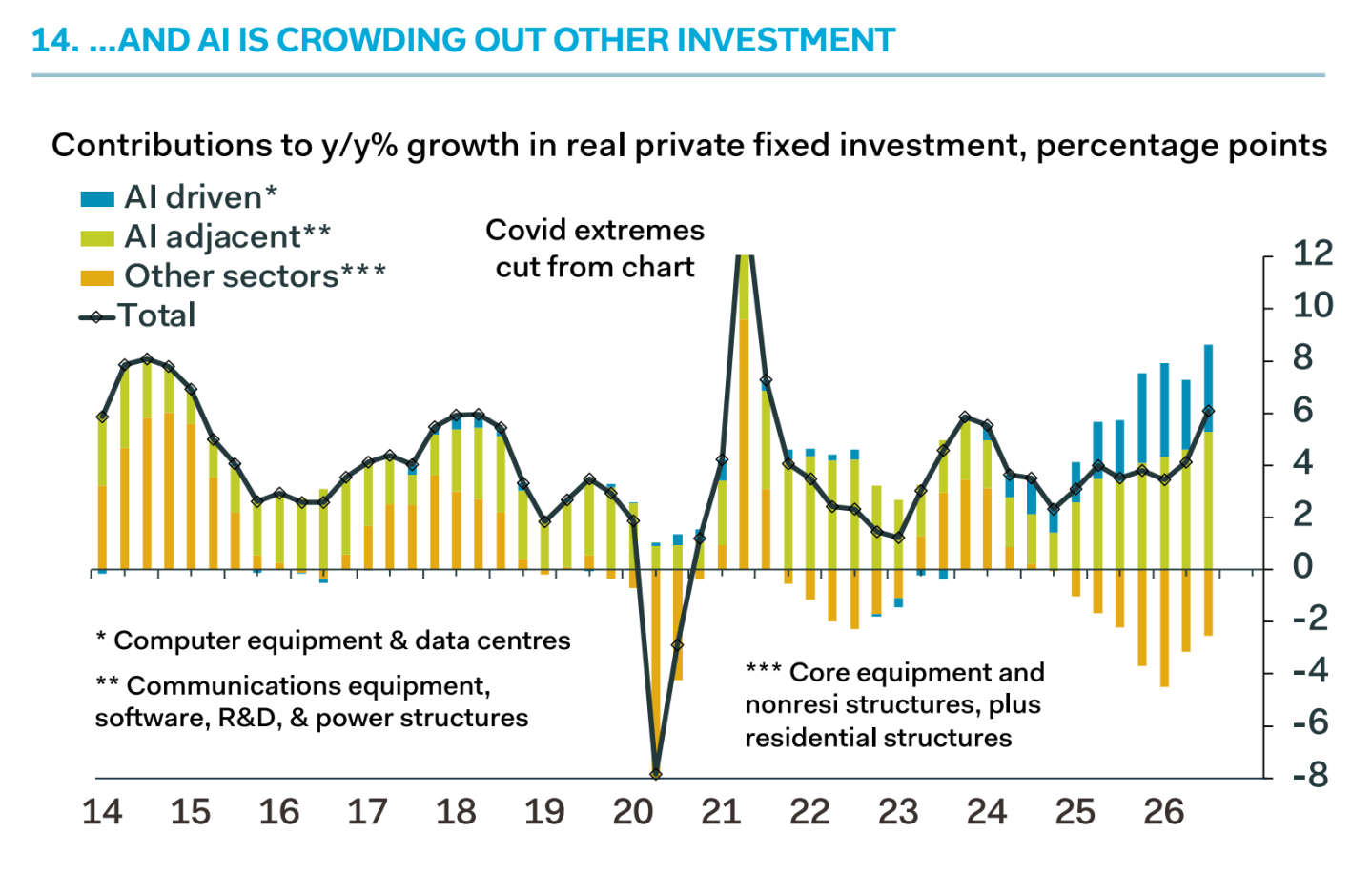
Corporate investment in AI and related tech is clearly driving higher. However, worryingly, it is “crowding out” investment in other areas, Pantheon’s Samuel Tombs and his team said in a recent note:
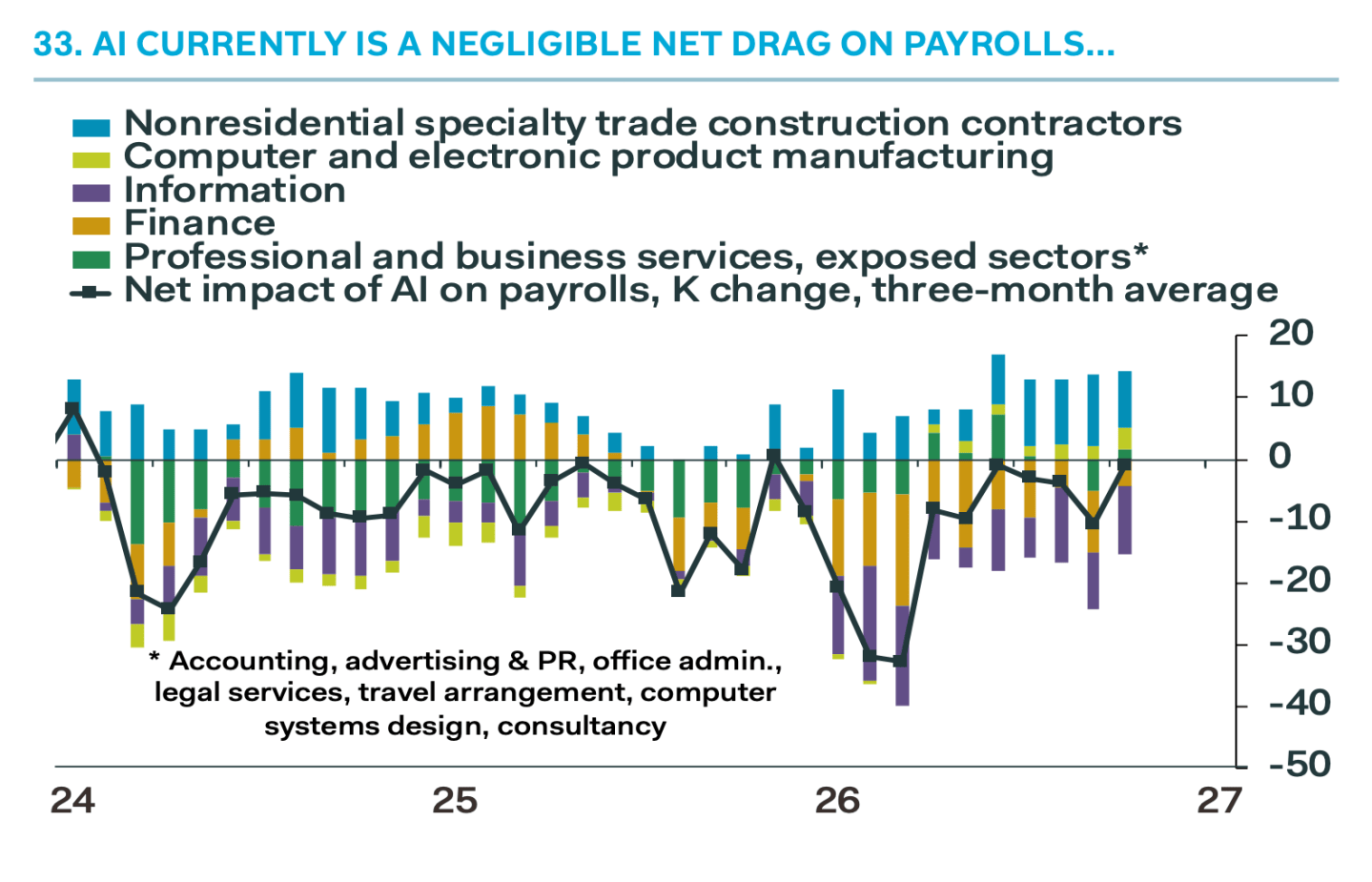
Until recently, jobs in AI-connected fields were in decline, but that changed in recent months. If the black line on this chart can get above zero, it means that AI is actually creating jobs:
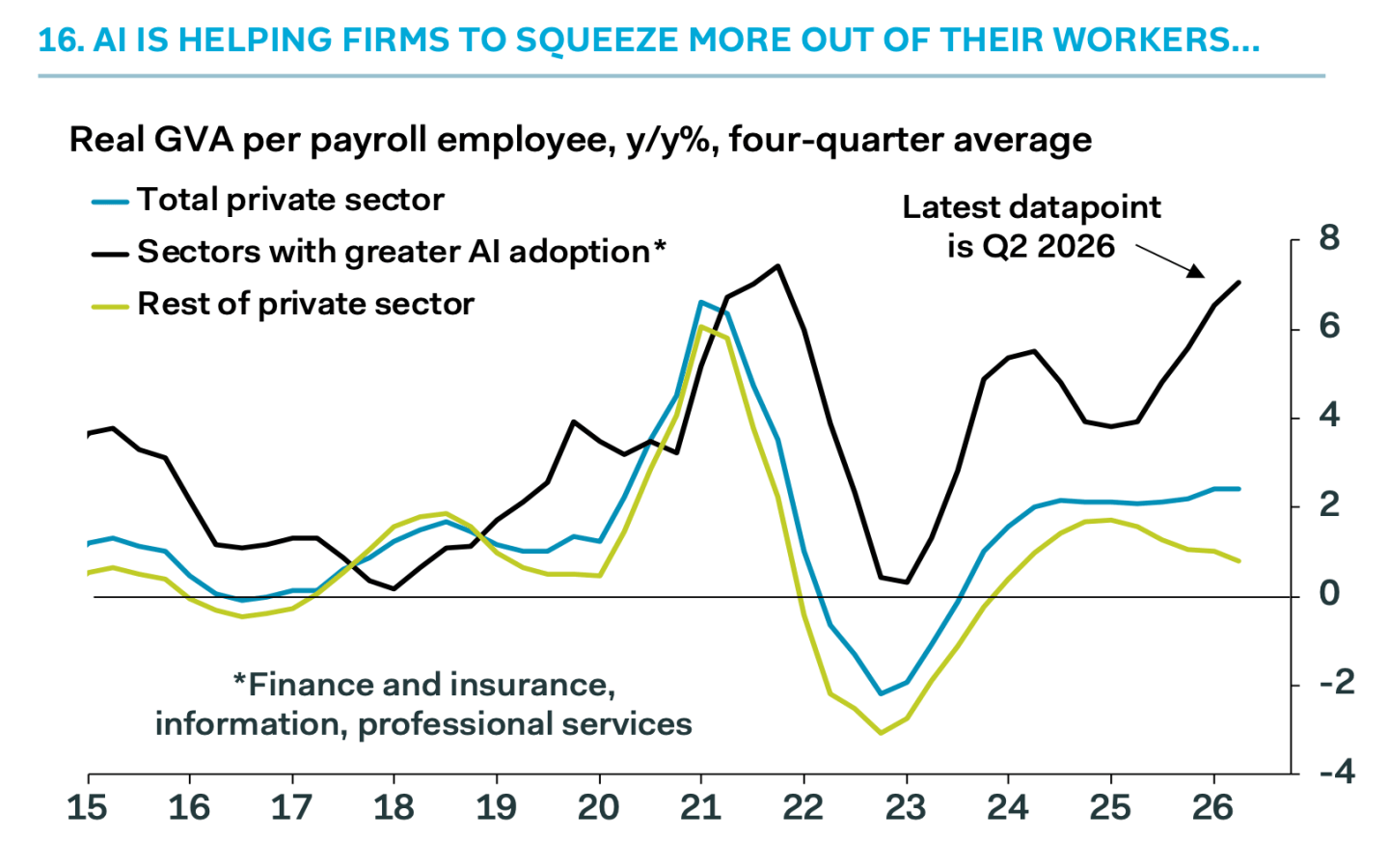
And here is a good reason why employers might start adding jobs: because the sectors with a greater level of AI adoption are seeing gross value added per employee rise much faster than non-AI sectors:
THE MARKETS
After the storm, an uneasy calm settles over U.S. stocks: “selloffs rarely turn around in a day”
U.S. futures are up strongly this morning before the opening bell in New York, which would normally imply widespread optimism among stock traders. Anthropic was up 3.96% in overnight trading after it fell 8.5% on Friday. But given the scale of the losses last week—the S&P 500 is now down 12% from its peak, putting it in official “correction” territory; the Nasdaq 100 has fallen 20%, a bear market—there’s wariness about how long this might last.
In Europe, indexes broadly rose after a tough day in Asia where the South Korean KOSPI—dominated by chipmakers Samsung and SK Hynix—declined 3.31%.
"There's nothing surprising in the overnight bounce after the waterfall moves of last week, but investors can't emerge from their shelters just yet. Such selloffs rarely turn around in a day,” said Chris Beauchamp of trading platform IG in an email this morning.
“Some investors may be considering buying the dip,” ING’s Chris Turner said via email. But the Fed is widely expected to raise interest rates in December—which would be negative for stocks. “What would help stabilise equities would be a less aggressive Federal Reserve. Over the weekend, U.S. Treasury Secretary Scott Bessent chose his words carefully in saying that ‘many people believe that they [the Fed] may be making a policy mistake if they overtighten.’”
- S&P 500 futures were up 2.71% this morning. The index fell 3.7% on Friday.
- In Europe, the Stoxx 600 was up 0.80% in early trading, and the U.K.’s FTSE 100 rose 0.56% before lunch.
- Asia: South Korea’s KOSPI was down 3.31%. Japan’s Nikkei 225 was closed for a national holiday. India’s Nifty 50 was down 1.75%. China’s CSI 300 was up 0.09%.
- Brent crude was at $91 per barrel.
- Bitcoin was at $61,389.
It has been a huge year for IPOs
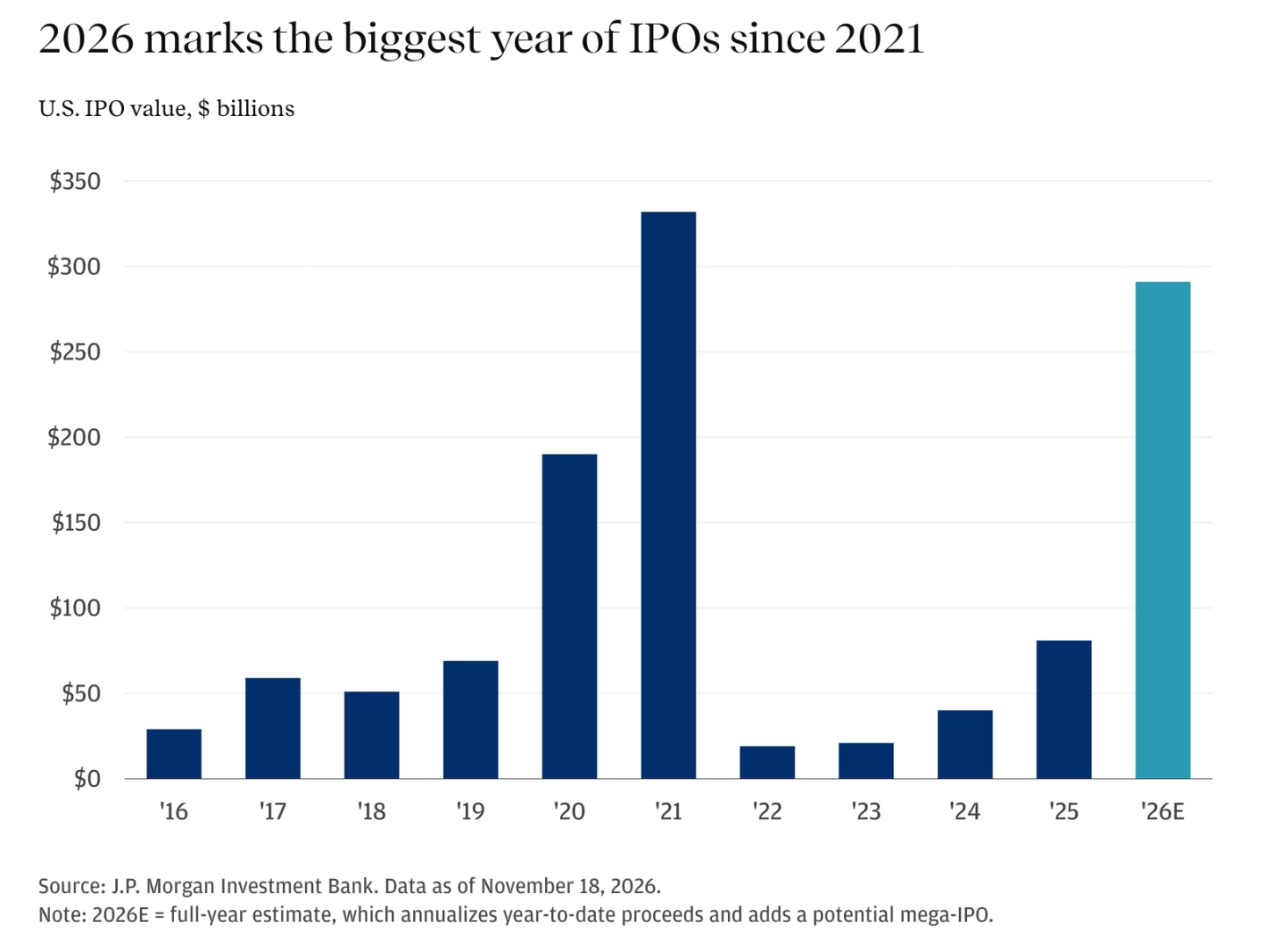
Companies in the U.S. are likely to raise about $290 billion this year from IPOs, making it one of the strongest recent years for going public, according to Kriti Gupta and Sitara Sundar of JPMorgan Private Bank. Obviously, the massive floats of SpaceX and Anthropic did much to juice that total. The market tanked after the latter went public—does that mean Anthropic was too large for investors to digest? Nope, the pair said in a recent note: “It’s a large amount, but in the context of today’s $70 trillion stock market, expected issuance amounts to less than 1% of the total.”
CHART OF THE DAY
U.S. household wealth was on course to hit $9 trillion this year 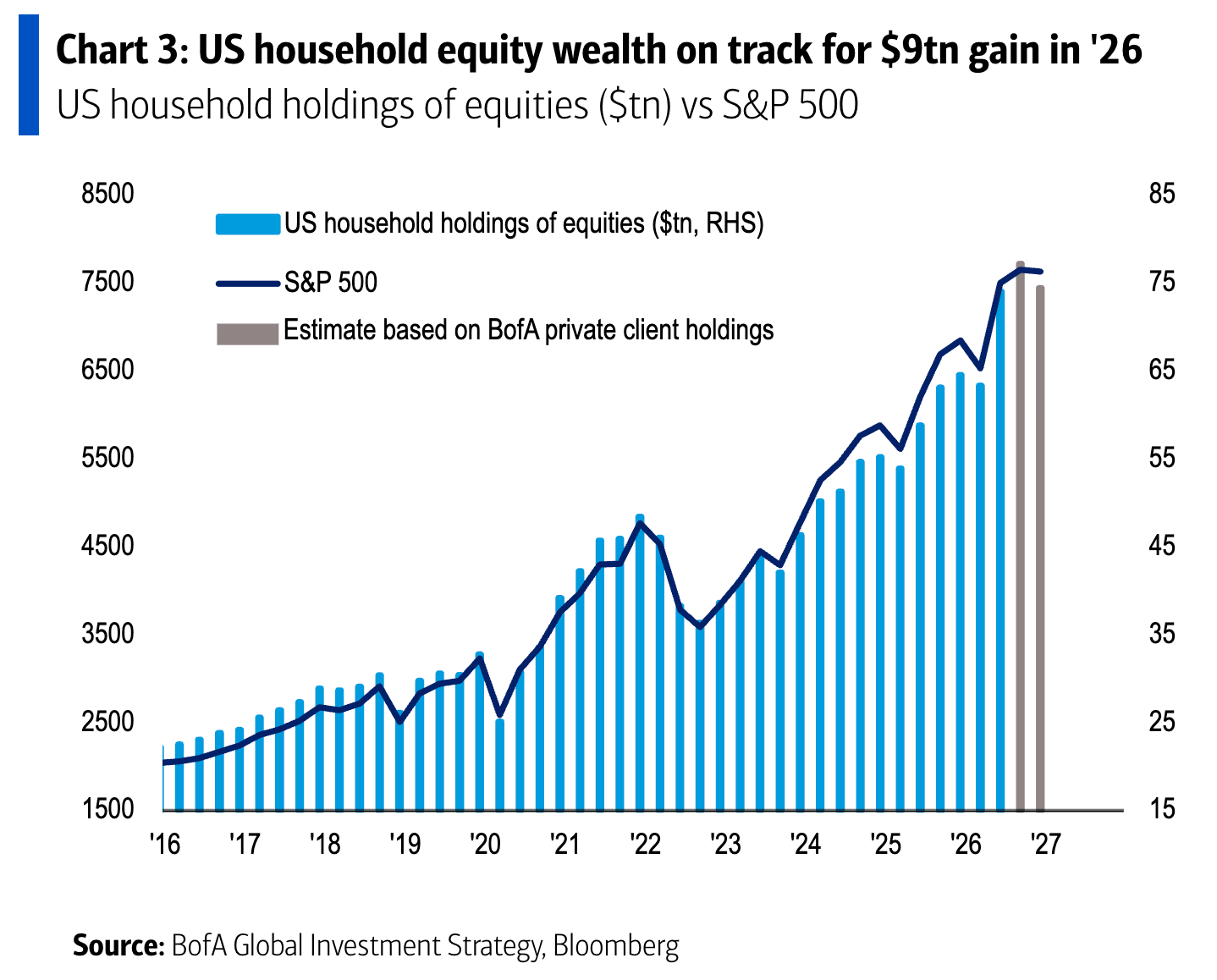
American household equity wealth was down about $3 trillion over the last month (and probably a good bit more after the last week) but still on course to hit $9 trillion by the end of the year, according to Michael Hartnett and his team at Bank of America. The “wealth effect” will prop up the economy in 2027, he believes: It’s “hard to get a recession when consumption [is] 70% of GDP and [the] K-shape rich [are] feeling so flush,” he said in a note.
THE FRONT PAGES TODAY
The problem with the circular AI economy - FT
China Fears A.I. Could Give the U.S. an Edge in Nuclear Rivalry - NYT
DNI Jay Clayton to double as acting cyber chief - Axios
Anthropic Committed to Spend $900 Billion. Wall Street Expects Its Debt to Be Junk. - WSJ
Anthropic’s Seven Billionaires Are Creating a New Type of Hazard - Bloomberg
Five takeaways from the failed climate talks COP31 - BBC
ONE MORE THING
ONE MORE THING
Gen Z believes AI is making them dumber but they’re increasing their usage of it anyway
Last year, researchers from Microsoft and Carnegie Mellon University revealed startling evidence about AI effects the way—and how hard—people think, finding that among more than 300 knowledge workers, leaning too much on AI tools like ChatGPT was associated with diminished critical thinking skills.
Even using AI for low-stakes tasks such as proofreading “can lead to significant negative outcomes in high-stakes contexts,” like writing legal documents, the study authors wrote.
But the fear of AI making people dumber has not stopped Gen Z from using it. A survey of nearly 2,500 U.S. adults 79% of respondents believed AI makes people lazier, and 62% said they were concerned it made people less smart.
Despite this, Gen Zers have increased their AI usage. Pew Research Center data published in June found 66% of people aged 18 to 29 use an AI chatbot, such as ChatGPT, up from 55% in 2024.
- ➡️ Would you like to sponsor this newsletter? Contact advertising@fortune.com for details.
- ➡️ If you would like to receive this information in your inbox every morning before the markets open in New York, sign up here.