
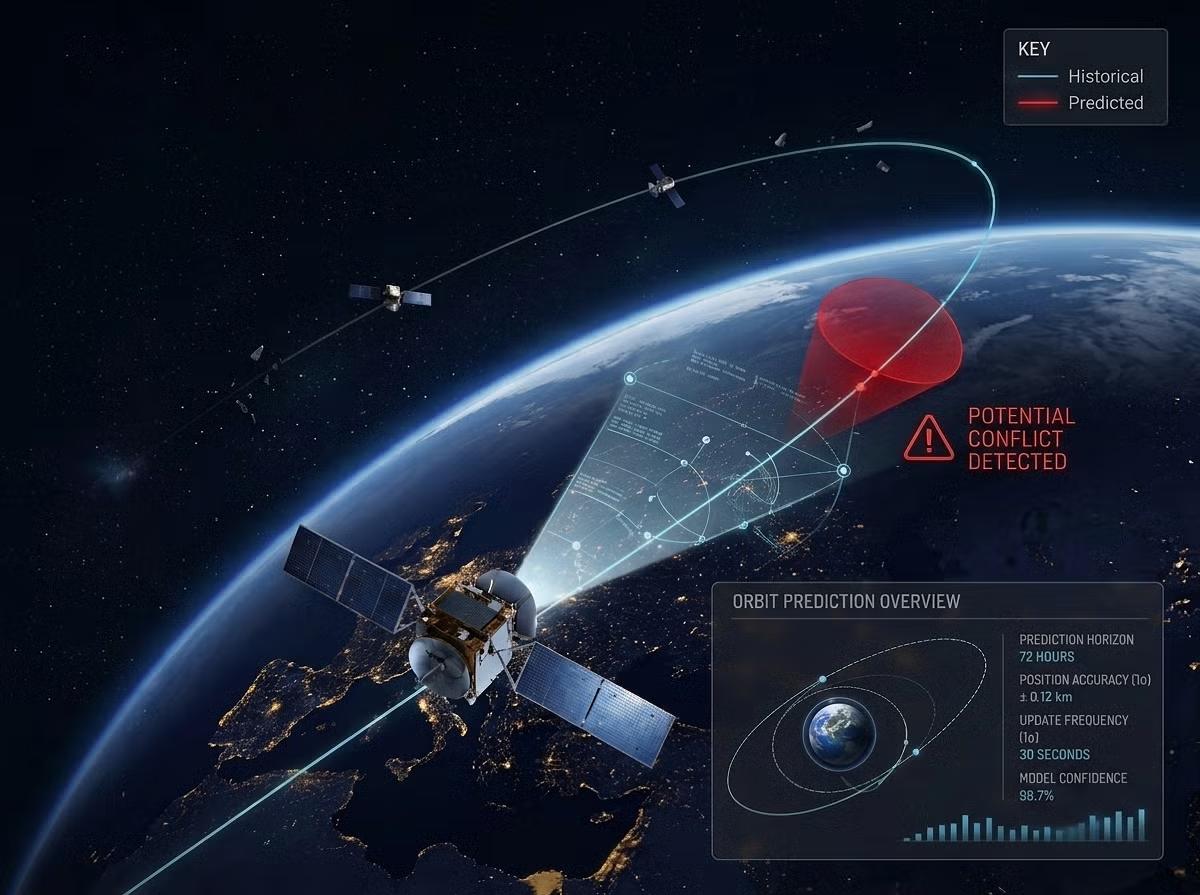
Every time a satellite swerves around a piece of space junk, it can burn about $1 million worth of fuel, according to NASA. Across U.S. satellites, NASA says the cost of debris is about $58 million a year, most of it borne by military and civil spacecraft that taxpayers pay for.
That is what BQP—a Syracuse, N.Y., simulation company that began in India in 2020 and now works for the Space Force—is trying to solve. Earth orbit is filling up faster than Washington can decide who should police it. BQP says its software, which founder and CEO Abhishek Chopra calls “autopilot for satellites,” can cut that bill by letting spacecraft decide on their own when to move.
“It’s completed the ground testing successfully,” Chopra said of a test on a partner company’s hardware. “It’s actually flying to International Space Station to be tested in the real space environment.”

A crowded orbit
There’s a long history of spacecraft turning into trash—and authorities trying to enforce some accountability.
When NASA’s Skylab space station crashed over Western Australia in 1979, the Shire of Esperance fined the agency $400 for littering, but NASA never paid. And bills have only gotten bigger. In 1978, a Soviet satellite, Cosmos 954, scattered radioactive debris across Canada’s Northwest Territories. Canada billed Moscow about 6 million Canadian dollars and settled for 3 million. But the FCC didn’t fine a company over space debris until 2023, when it charged Dish Network $150,000 for parking a dead satellite in the wrong orbit.
Air travel faced its own reckoning. In 1956, two airliners collided over the Grand Canyon, killing all 128 people aboard, and Congress responded with the law that created what is now the Federal Aviation Administration.
But that authority is lacking in orbit, Chopra said, with the closest thing to an air traffic controller being the U.S. military. The Space Force tracks about 60,000 objects and sends collision warnings free of charge to satellite operators worldwide.
The Commerce Department has a pilot program for a civilian version, called TraCSS, which has cost almost $200 million. The White House is proposing to shelve it again this year, as Senate appropriators this month proposed $50 million to keep it running.
Today, most satellite traffic is watched by people. “You literally have a human who’s monitoring your asset, and a human can monitor only so many,” Chopra said. “We’re still writing down on paper.”
The risk grows as companies launch tens of thousands more satellites. An operator who suspects a collision must choose between burning scarce fuel on a maneuver that may be a false alarm, or doing nothing and risking a spacecraft Chopra said can cost hundreds of millions of dollars. “What if a bad actor, some other country, has put an unknown thing? Nobody is tracking that,” Chopra said.
Chopra said current tools would take about 40 days to simulate every object in orbit. BQP’s software does it “under 30 minutes,” he said. Its speed against Orekit, a widely used open-source orbit tool, has risen from the 250 times BQP announced in September to up to 2,000 times, according to Chopra.
Quantum-inspired approach
At Rensselaer Polytechnic Institute, where Chopra earned a PhD in aerospace engineering, he spent six months running one simulation of turbulence behind part of an aircraft, on 250,000 computers working at once. “I was like, ‘Who is this going to be even useful for?’” he said.
He then moved old simulation code onto Nvidia graphics chips and found it used only about 15% of their power, because the math was still written for computers of the 1980s. “You are only getting 15 cents worth of work, and this is true even today,” he said. The company calls its approach quantum-inspired: it borrows methods from quantum computing but runs them on the chips customers already own.
In July, BQP won its first federal contract, a small-business research award from SpaceWERX, the Space Force’s innovation arm. Chopra said that first phase is complete, and BQP is now trying to persuade Space Force units to back a second phase. He said BQP used the first award to bring its product to market, which he called “a great use of public money.”
“Once you get a phase two contract, you are basically inside the systems,” he said, “working with the war fighters to be able to make this as an operational capability.”
IBM Ventures invested in September, bringing BQP’s total funding to $8 million. Chopra called it “almost like a stamp of approval” that has helped BQP close contracts faster. He said at least one more corporate investor has since joined the round, and that BQP’s contracted and committed revenue is up 8x since its 2025 seed.