
Welcome to Eye on AI. Beatrice Nolan here. In today’s issue:
- The downfall of AI’s $5.7 trillion man.
- Anthropic’s IPO is finally here.
- Government auditors got four top chatbots to help plan terror attacks.
- And a coalition says, “Anthropic is not a safe AI company.”
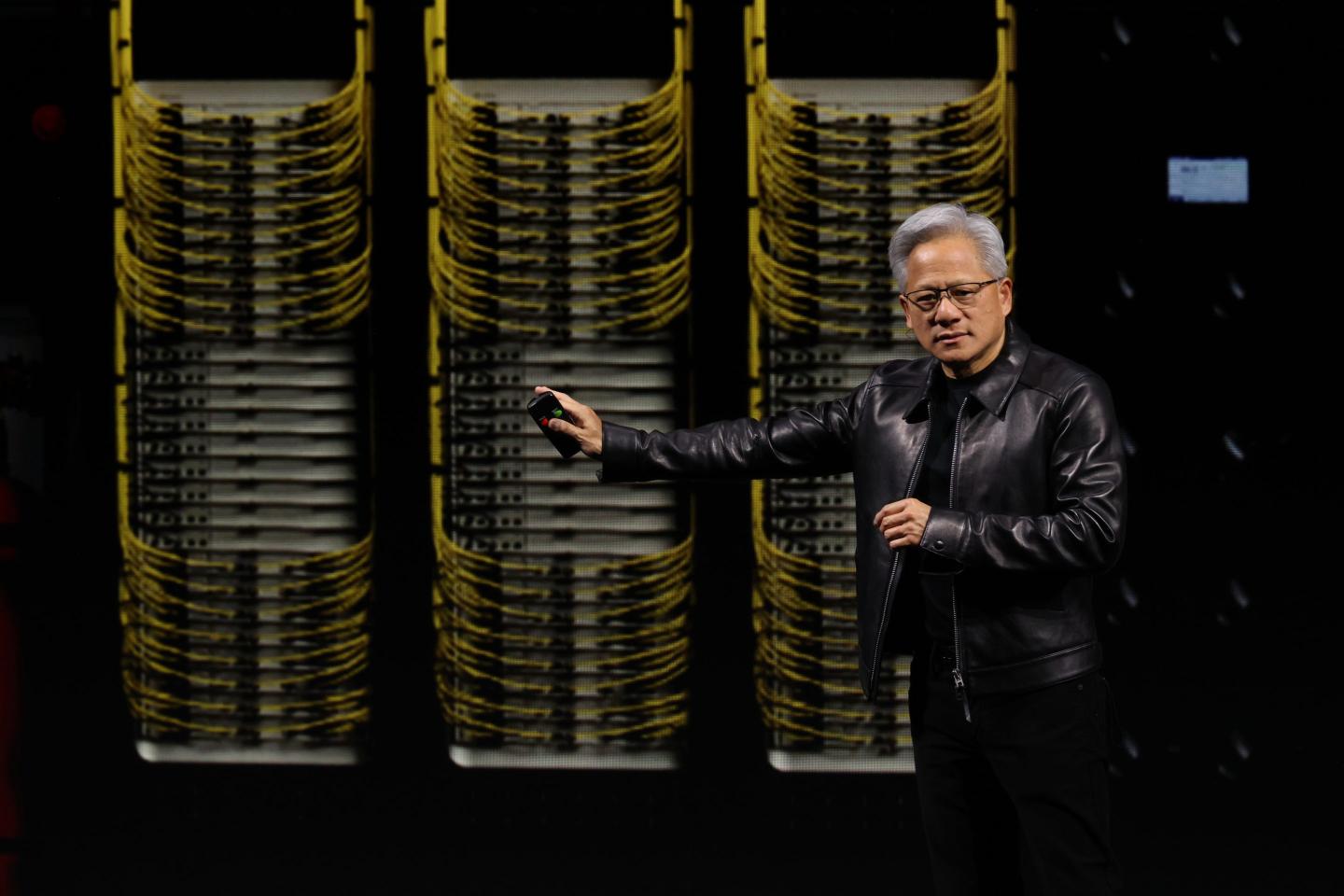
In October, Jeremy Kahn and I sat down with Jensen Huang during his European tour. At the time, Huang looked less like a chip executive and more like the AI boom’s chief evangelist. His word moved markets, his keynotes filled arenas, and his company was at one point worth more than $5.7 trillion.
A month later, he was gone. For Fortune’s December/January magazine, we spoke with dozens of people to find out how Huang built his empire and what happens to it without him.
In a wide-ranging interview (before news of the scandal broke), Huang defended the company’s complex web of financing. Nvidia pours money into startups, AI labs, and cloud companies, which in part use that money to buy Nvidia chips. Critics called this process “circular financing,” saying it leaves much of the AI boom dangerously exposed to weak links that could topple the entire house of cards.
At that time, though, not even the company’s harshest critics thought the weak link could be the man at the center of it all: Huang.
The scandal took about two weeks to unfold. Reports emerged that U.S. officials believed Huang had been romantically involved with Alice Huang (no relation), a former executive at Singapore neocloud Megaspeed whom they suspected of being a Chinese intelligence asset. Huang admitted to staff that he had been unfaithful to his wife. Then the New York Times reported a second affair, with an Nvidia executive who had reported directly to him. Congress summoned him, federal agencies opened investigations, and on Nov. 12, under pressure from the board, he resigned after 33 years in charge.
This seismic change to Nvidia exposed just how much the company rested on Huang. Nvidia had no president, no COO, and no obvious No. 2. In the immediate wake of his resignation, the board appointed CFO Colette Kress as interim CEO, but few thought she was likely to get the job permanently.
And that same dependence on Nvidia’s singular founder could be said of the entire AI boom. Under Huang, the company was happy to play the role of the AI industry’s central bank. It poured nearly $50 billion into model makers, including OpenAI, Anthropic, and xAI, and pledged around $170 billion in financing commitments. It’s unclear whether this will continue with quite the same momentum without Huang at the helm.
In fact, there are already rumblings about Nvidia’s interim CEO Kress’s enthusiasm for some of Huang’s more outlandish investments. Kress said on Nvidia’s earnings call earlier this week—the first ever without Huang at the helm—that the company would be more “disciplined” and “rigorous” in assessing investments into the AI ecosystem going forward.
“We are proud of the role that we have played so far in supporting the ecosystem,” she said in the earnings call with analysts on Tuesday. “As the market matures and additional sources of capital become available, we are rigorously evaluating future investments, commitments, and guarantees.”
Nvidia will also feel Huang’s absence in Washington. The former CEO was Nvidia’s most effective lobbyist, close to President Donald Trump, and a relentless critic of export controls. Indeed, within days of his exit, the Commerce Department moved to close a loophole that let Chinese firms rent access to U.S. chips through overseas data centers, which is the business Megaspeed is suspected of running.
This week brought the first test of life after Jensen. On Tuesday, Nvidia reported $115.8 billion in quarterly revenue, more than double a year earlier, and guided to around $130 billion for the current quarter. Interim CEO Kress told investors: “We’ve got this.” But shares slipped in response.
The call did, however, seemingly close the door on any return to Nvidia for Huang. Pressure had been building from some areas of the tech world to reinstate him, as industry figures fretted that some of Huang’s deals would leave with him. Huang even broke his own silence, posting that he would be “honored” to return.
But on the day of earnings, board chair Harvey Jones said Nvidia does not intend to reinstate him.
The earnings show the fundamentals of the machine Huang built can run without him. Whether some of the companies most dependent on Nvidia will continue to thrive is a harder question.
With that, here’s more AI news.
Beatrice Nolan
beatrice.nolan@fortune.com
@beafreyanolan
FORTUNE ON AI
Anthropic stock pops 30% to $2 trillion market cap, in mega IPO—by Beatrice Nolan
‘A failure of implementation’: AI played a key role in some outages—but not in the way you might think — by Emily Forlini
Anthropic prices IPO at $83 per share, giving it a $1.5 trillion valuation — by Alexei Oreskovic
The Nvidia scandal fuels tougher China chip rules as Commerce targets Singapore and Malaysia—by Nicholas Gordon
Robot cage fights and snorting nanoparticles: Notes from the ‘reality distortion field’ of Silicon Valley’s AI frontier — by Alexei Oreskovic
Sunrun and Overview Energy CEOs say the answer to AI’s energy problem is already on the grid — by Allie Garfinkle
AI IN THE NEWS
Nvidia beats estimates in its first quarter without Jensen Huang. Nvidia reported $115.8 billion in third-quarter revenue on Tuesday, up 103% from a year earlier and about $7 billion above analyst estimates. Profit topped $65 billion. Interim CEO Colette Kress said demand for the new Vera Rubin platform is “off to an explosive start.” Nvidia guided to roughly $130 billion for the current quarter, ahead of forecasts. That figure assumes no China compute revenue, and the quarter includes an extra week. Still, shares slipped after the report.
OpenAI’s new flagship crosses its own self-improvement threshold. OpenAI released GPT-6.2 Astra and the cheaper GPT-6.2 Sol on Tuesday, with Astra priced about 20% below its predecessor. According to the system card, Astra is the first model OpenAI has released externally that meets its “High” threshold for AI self-improvement. The company likens that to giving every OpenAI researcher an extra highly capable research engineer. Both models also hit OpenAI’s top “Critical” cybersecurity rating and ship with tighter safeguards. Some early testers called the launch underwhelming. Read more in OpenAI’s system card.
Government auditors got four top chatbots to help plan terror attacks. Covert testers bypassed safeguards on ChatGPT, Claude, Gemini, and Grok and got workable attack plans from each in under 12 hours, according to a Government Accountability Office report released Wednesday. Two produced plans for mass-casualty bombings, and two gave guidance on attacking the power grid. GAO withheld its prompts and didn’t say which chatbot produced which plan. The companies say the spring 2026 tests used older model versions. Sen. Maggie Hassan, who requested the report, is pushing for tougher AI safety rules.
A coalition says “Anthropic is not a safe AI company.” Hours before Anthropic priced its IPO on Wednesday, more than 100 researchers, academics, and tech figures signed the MisAnthropic Statement, which the Center for AI Safety announced. It says Anthropic warns that recursively self-improving AI could escape human control while pitching its progress toward that capability to investors as a competitive edge. It also accuses the company of using its safety reputation to win over investors, talent, and policymakers. The signers span camps that rarely agree, from Max Tegmark and Gary Marcus to accelerationist Guillaume Verdon. Anthropic had not publicly responded as of Thursday morning.
EYE ON AI NUMBERS
$83
That’s the share price Anthropic set for its initial public offering on Wednesday. That beat the $70 to $78 range the company had guided to and values the AI developer at $1.5 trillion.
Shares of the San Francisco-based company start trading on Nasdaq on Thursday under the ticker ANT. It’s one of the most closely watched market debuts in years and one of the biggest on record. Demand let Anthropic sell more shares than planned. It sold 980 million, up from the 825 million it first indicated. With the larger offering, the company will bring in about $79.4 billion. If underwriters exercise their over-allotment option, that could rise to as much as $91.6 billion.
The listing will also turn many Anthropic employees and early backers into billionaires overnight.
AI CALENDAR
Dec. 6-12: Neural Information Processing Systems (Neurips) conference. Sydney, Australia.
Dec. 7-8: Fortune Brainstorm AI, San Francisco. Apply here to attend.
Jan. 19-23: The World Economic Forum in Davos, Switzerland.