
Good morning. On Fortune’s radar today:
- Anthropic will launch its $1.5 trillion IPO today.
- Nvidia’s $500 billion AI funding deal was vaporware.
- Markets: Struggling to find the floor.
- Why the Fed won’t deliver a 0.5% rate hike in December.
- Counties with data centers do better than those without.
- Palmer Luckey: “Steve Jobs ruined everything.”
ONE BIG THING
Anthropic prices IPO at $83 per share, giving it a $1.5 trillion valuation
Anthropic priced shares for its initial public offering on Wednesday at $83 apiece, above its initial guide range of $70 to $78 per share, and valuing the AI company at $1.5 trillion.
Anthropic’s stock will begin trading at around midday today on the Nasdaq exchange under the ticker ANT, marking one of the most highly anticipated IPOs in years as well as one of the largest ever.
The San Francisco-based AI company said Wednesday that it increased the number of shares sold in the offering to 980 million, instead of the 825 million shares it initially indicated it would sell. The expanded float means Anthropic will raise roughly $79.4 billion in the IPO—and as much as $91.6 billion if the deal’s underwriters choose to exercise an over-allotment option.
MORE FROM FORTUNE
Kelly Loeffler Defends SBA Cuts, Tariffs and the Green-Card Loan Ban | Fortune Daily
iPhone designer Tony Fadell’s next big thing: Bringing AI to fashion in hopes of saving H&M $100 million a year - Jim Edwards
‘70% chance’ we’re already in an AI bubble: The economist who said ‘not yet’ in January now sees all four horsemen of the bubble apocalypse - Nick Lichtenberg
I left a demanding job to save my marriage—and lost both. Less work doesn’t always cure burnout - Troy W. Norris
I tested an AI startup that claimed it could beat Wall Street earnings estimates. It won 40 out of 50 times - Jeff John Roberts
EA cofounder once compared interview questions with Amazon’s Andy Jassy—Jassy’s was so ruthless that no instant answer ends the interview - Orianna Rosa Royle
‘45 is the new 60’: Thailand’s Kasikornbank is paying staff to retire early as it prepares for AI - Angelica Ang
Why Gap has a chief entertainment officer, and why your company might need one too - Emma Hinchliffe
Sunrun and Overview Energy CEOs say the answer to AI’s energy problem is already on the grid - Allie Garfinkle
Indonesia signs partnerships for $71.8 billion in Chinese investment, more than an entire year’s worth of FDI - Jay Ganglani
If Indonesia wants 8% growth, it needs to give investors confidence that contracts won’t change on them - Brian McFeeters
MUST-READ:
Nvidia’s $500 billion AI funding deal turned out to be scotch mist
AI bubble watchers will gulp nervously at this scoop from the WSJ. It goes back to August, when Nvidia’s then-CEO Jensen Huang persuaded Apollo, Blackstone, BlackRock, Brookfield, Goldman Sachs, and KKR to offer $500 billion to various AI service companies and startups to fund their growth (and, by implication, their demand for Nvidia’s chips).
But as the WSJ reports: “The promise was short on substance. To date, no capital has actually been deployed, according to people familiar with the matter. And investors are increasingly skeptical that the program will reach its lofty ambitions now that Huang has been ousted over a sex and suspected spy scandal that has engulfed Nvidia.”
- To state the obvious: If investors are underestimating the amount of money washing around in AI by hundreds of billions—then that’s a real problem.
“If that banking function, that guarantor function, gets taken away, access to capital for a large number of neoclouds is going to disappear,” Apollo CEO Marc Rowan said.
THE MARKETS
“Markets are still struggling to find a floor”
U.S. futures were up before the opening bell in New York, after another depressing day for the S&P 500, which declined before yesterday’s close. “Markets are still struggling to find a floor under the selloff, as the S&P 500 (-0.23%) posted a fifth consecutive decline yesterday,” Deutsche Bank’s Jim Reid told clients.
Nvidia shares were down 2.89%, but rose 1.64% in overnight trading. Tech stocks as a whole, however, moved independently from the troubled chipmaker: The tech-heavy Nasdaq Composite rose 0.42% yesterday.
Asia and Europe were mixed this morning.
- S&P 500 futures were up 0.97% this morning. The index fell 0.23% yesterday.
- In Europe, the Stoxx 600 was up 0.15% in early trading, and the U.K.’s FTSE 100 fell 0.16% before lunch.
- Asia: South Korea’s KOSPI was up 1.39%. Japan’s Nikkei 225 was up 0.71%. India’s Nifty 50 was up 1%. China’s CSI 300 was flat.
- Brent crude rose to $92 per barrel.
- Bitcoin declined to $63,769.
There is almost no chance of the Fed delivering a 0.5% rate hike in December
The normally reliable Fed funds futures market currently puts the chance of a U.S. base interest rate hike of 50 basis points at just 9%. But some on Wall Street have convinced themselves that the central bank is so far behind the curve in its fight against inflation that the Fed will be forced to go up by half a point in December. It won’t happen, according to Macquarie’s Thierry Wizman: “Can the Fed really hike by 50bps on December 9 if the U.S. stock market is still wrestling with AI-driven uncertainty and growth fears at that time? We don't think that it should, or will. The longer the stock market slide endures, the likelier that a +50bp hike in the Fed funds rate target will be completely off the table,” he said in an email.
Volatile and in decline: The state of the market in one chart
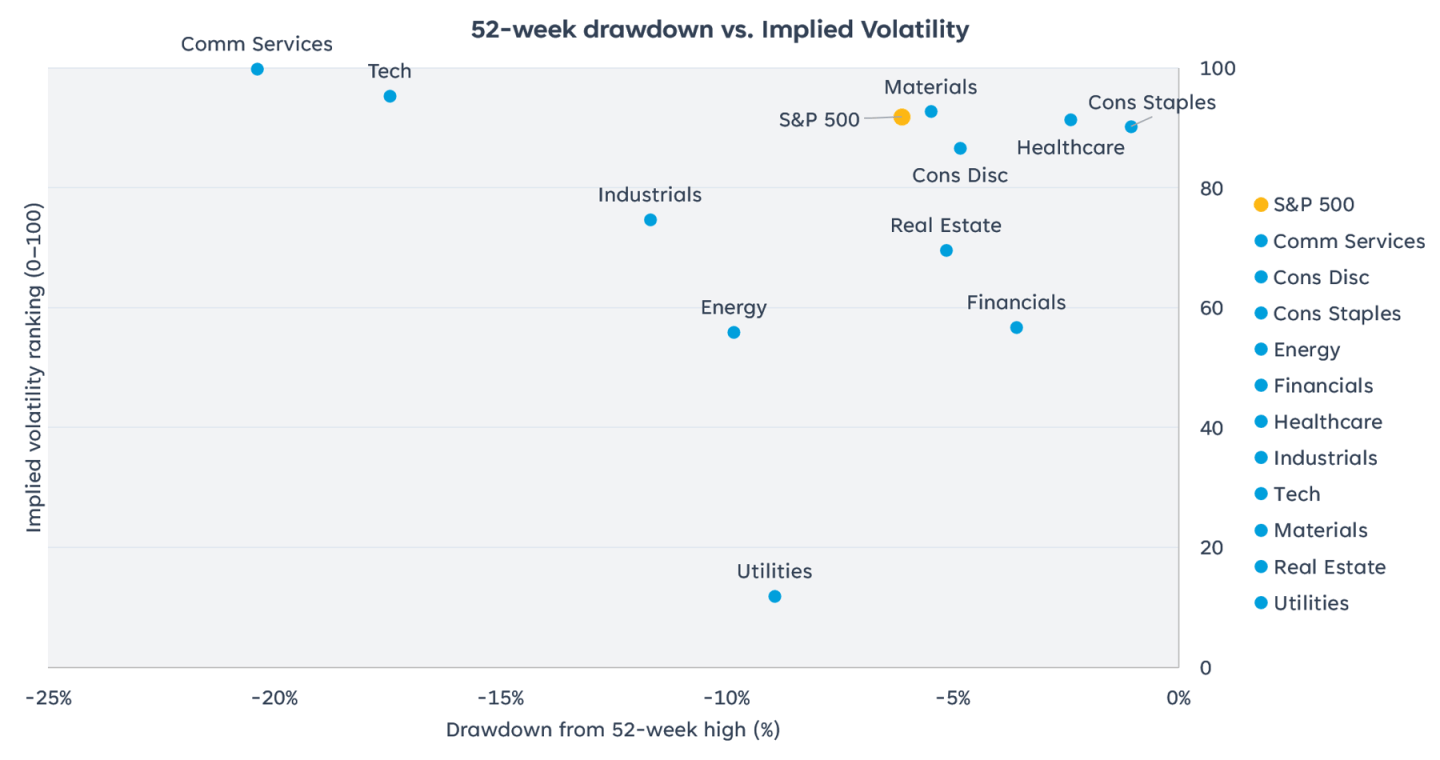
This chart shows stock sectors ranked by how volatile they are and how far off from their most recent peak price they were. As you can see, tech and communications are the worst performers: highly volatile and way down from their all-time highs.
“While both sectors have suffered significant technical damage recently, oversold conditions and extreme implied volatility suggest considerable uncertainty is already priced in. If downside momentum stabilizes, mean reversion in volatility and sentiment could provide a potential tailwind for a recovery,” Adam Turnquist of LPL Financial told Fortune.
CHART OF THE DAY
“Reality: data centers bring significant economic benefits,” Wells Fargo says
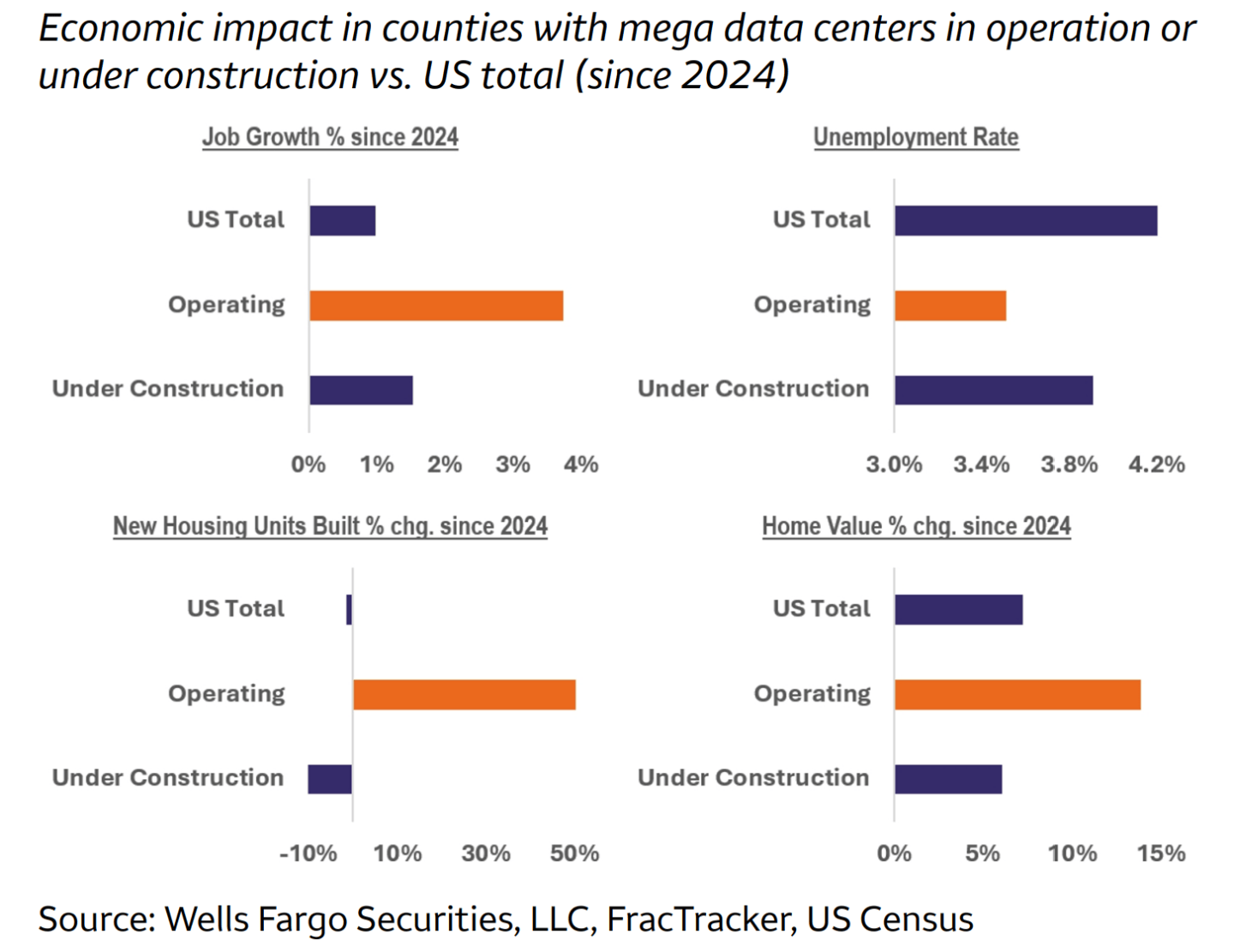
Ohsung Kwon and his team at Wells Fargo track data from roughly 200 data centers in the U.S. that are 500 megawatts or more in size and found that in counties that have data centers, jobs go up, and unemployment goes down. Kwon expects political opposition to AI data centers to eventually recede: “Texas is the most important state to watch, accounting for 27% of the country's planned GW capacity.”
QUOTE OF THE DAY
“Nvidia is the Jenga tower of the whole AI trade, and that is not a compliment. In our view, this is one of those times when, where there is smoke, there will inevitably be fire.”
—Richard Reyle, chief investment officer of Questar Capital Partners ($1.3 billion in AUM). “A week ago, we thought this was a pedestrian story about a CEO whose ego got the best of him. Then we found out there was no clear succession plan, and poor corporate governance, with no chairman until this scandal came to light,” Reyle said in a note to Fortune.
“The fact that Nvidia’s 10-Q has not been released yet is a red flag, as it's out of character from its previous releases. We believe there are significant questions about where Nvidia has been selling its chips. We suspect Nvidia may be working with counsel on how to handle the possibility that Jensen Huang obscured where the company was selling its chips.”
THE FRONT PAGES TODAY
Elon Musk Feels Foolish for Midterms Spending, Says ‘I’m Not MAGA’ - WSJ
Crew of Mike Lynch’s Bayesian superyacht were unaware of risks, probe finds - FT
Islam to become world's largest religion by 2035, Pew says - Axios
Trump’s Greenland Deal to Take Effect After Bitter Standoff - Bloomberg
How Anthropic’s I.P.O. Valuation Stacks Up With the Biggest Tech Debuts Since the ’80s - NYT
Trump blasts Vance-negotiated Iran deal as a ‘waste of time’ - NY Post
ONE MORE THING
Palmer Luckey: “Steve Jobs ruined everything with the iPhone”
Palmer Luckey has a complaint about the iPhone, and he took it to Steve Jobs’s biographer. “Steve Jobs ruined everything with the iPhone,” Luckey, the Oculus inventor and Anduril cofounder, told Walter Isaacson in an episode of Isaacson’s podcast The Builders. “We’re still suffering the impacts of his incredible product design.”
Luckey, worth an estimated $5.9 billion, offered an argument about skill: The iPhone made technology so easy to learn that there’s nothing left to get good at, and every product since has copied it.
“The problem with the iPhone is that it simplified everything to a degree where, yes, you could learn to use it in less than a minute,” Luckey said. In his telling, you learn everything it can do in about 10 minutes, and then you hit the ceiling on skill and productivity. “The problem is that everything has become the iPhone,” he said. “Every application is now the iPhone. Every product is the iPhone. Every virtual reality headset is the iPhone.”
Products are built to be learned in one minute and mastered in 10, and “there is no provision made for the man who will spend 1,000 hours, 10,000 hours, 50,000 hours learning his art.”
- ➡️ Would you like to sponsor this newsletter? Contact advertising@fortune.com for details.
- ➡️ If you would like to receive this information in your inbox every morning before the markets open in New York, sign up here.