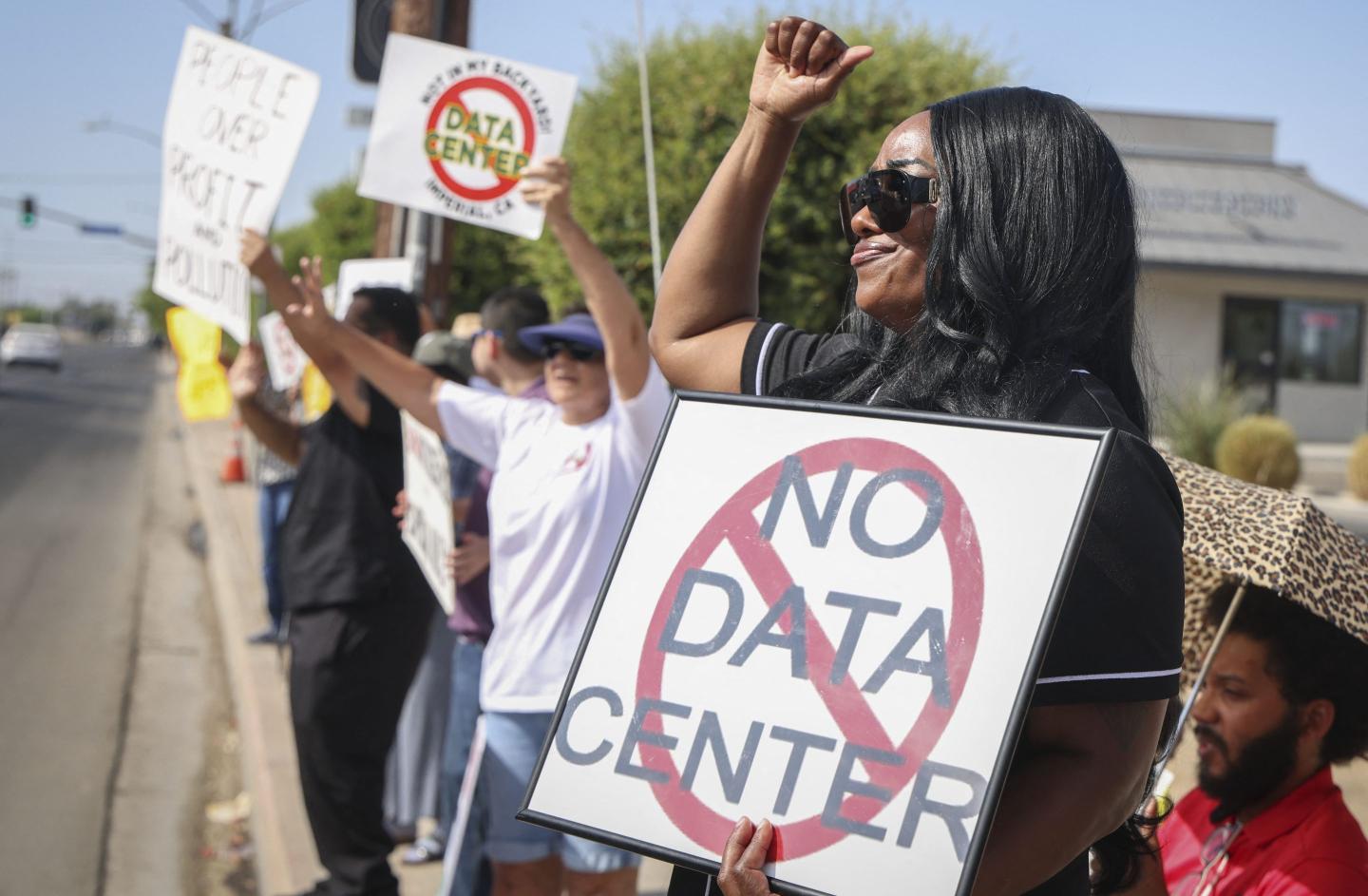
People spoke, and their voices boomed from coast to coast. They do not like data centers and they expect AI to do more harm than good. The numbers are not even close. Voters faced 41 local ballot measures on data centers across 10 states on Tuesday and sided against the industry in every one of them except a single vote in Harwood, North Dakota. In most of those contests, the margin cleared 70 percent. Roughly three quarters of voters told the NBC News exit poll they oppose a data center in their own community, and more than half said AI and data centers were a major factor in their vote. The polls had been saying this for months. Gallup found seven in ten Americans opposed to an AI data center in their area, and Pew finds that Americans who expect AI to hurt society outnumber those who expect it to help by more than two to one.
So what does this mean for what the industry has been calling an unstoppable technology? My personal read is an AI slowdown, at least for now.
Increased regulation
When the new Congress is seated in January, expect a wave of regulation. Some of it will be needed, some of it will be onerous on the industry for no good reason. Mandatory testing of frontier models against government-set standards is worth defining and achieving. We should also expect stronger whistleblower protections for the people inside these labs who see something dangerous and bring it to the public’s attention.
I predict there will also be an attempt to write today’s Executive Branch review of frontier models into statute. We need transparent incident reporting and independent verification organizations. We may also see federal liability, possibly strict liability, with product liability framing and CFAA additions aimed at AI agents. There will be attempts at export controls widening from chips to the equipment that makes them, plus funded chip geolocation.
The change most apparent to the ordinary citizen will be action on surveillance pricing. Surveillance pricing is the use of AI and individual consumer data like browsing history, purchase habits, or location to set a personalized price for each shopper. The FTC moved in August with a proposed enforcement policy stating that undisclosed personalized pricing likely constitutes an unfair or deceptive practice, and states have begun moving on their own. Expect Congress to try to write that into law. Reining this in would bring real relief to the bank accounts of Americans.
We also need a serious debate on pacing. At least two bills already filed, Ro Khanna’s Human Control Over AI Act and the Sanders and Casar superintelligence bill, would prohibit recursive self-improvement outright. Congress will pass a good chunk of this. For the next two years, Trump and his veto pen remain the wild card.
Are we handing the AI race to China?
This view is too alarmist. The United States still leads in chips, capital markets, talent, and open research. A slower, costlier buildout narrows the lead. It does not surrender it. The 10 to 15 gigawatts that analysts say “may never come online” by 2027 is a pacing problem, and a real one. But the cost of the fix is minuscule next to the cost of leaving it unaddressed.
There are terms that even data center opponents will accept, and they are easy wins: pay your own grid upgrade costs, sign longer contracts, publish water and energy use, and flex load at peak hours. If these centers want approval from a public that will not be fooled, they have to pay their own way. Duke University’s Nicholas Institute estimates the existing grid can absorb roughly 76 gigawatts of new flexible load at a 0.25 percent annual curtailment rate. The capacity exists. It will go to the companies willing to accept these terms.
Texas as a data center test lab
States and local governments weighing data centers need to study Texas. Greg Abbott courted the industry harder than any governor in America, then reversed course in August with a pause on new grid connections once the polling turned. It was not enough. Gina Hinojosa, who campaigned on a data center moratorium and a seat at the table for local communities, unseated a three-term incumbent who had never won the office by less than double digits. The pattern held elsewhere. Sherrod Brown won back a Senate seat in Ohio after casting his opponent as a cheerleader for data centers, and Keisha Lance Bottoms won the Georgia governorship while backing a pause on new construction. The lesson for every other state is that once the public turns, a late conversion does not save you. The open question is whether the industry will accept terms that put the costs it expected to share with the public squarely on its own shoulders.
Who wins the slowdown
Another way to lessen the load is shifting AI to distributed hosting, meaning AI processing moves out of a few massive centralized data centers and is split across a coordinated network of smaller regional facilities, edge devices, and on-premises hardware. Training frontier models still requires giant clusters, but inference can live closer to the user at lower peak load.
“My prediction: a more distributed AI map, with many smaller data centers built where spare power already sits, wired together by fiber like a nervous system,” says Andrej Danis, head of digital infrastructure at AlixPartners. “Fewer superclusters may actually give us a more resilient network, and a better one for physical AI. This summer, our survey had sites of 50 megawatts or less as the players most likely to be left behind. A permitting squeeze on the biggest campuses may flip that.”
“Every fully permitted data center under construction just got more valuable,” Danis says. “But many advanced projects do not have their ducks in a row on power, water, and operating permits. Those deserve a hard second look, because after Tuesday a missing permit can kill or delay a project. Tight real estate will also speed up the chip refresh. If you cannot build new halls, you swap in newer chips faster, and the older ones move to other countries where export rules allow. Part of the US slowdown gets exported.”
The part worth arguing about
The industry spent two years telling the public that AI is an existential risk to humanity, and people believed it. That fear campaign now puts the entire technology at risk in the United States. Sam Altman signed a 2023 statement declaring that mitigating the risk of extinction from AI should be a global priority alongside pandemics and nuclear war. OpenAI’s own researchers wrote that superintelligence “could lead to the disempowerment of humanity or even human extinction.” Dario Amodei told the Axios AI+ DC Summit: “I think there’s a 25% chance that things go really, really badly and a 75% chance that things go really, really well, with not much space in between.” If the pilot told you there was a 25% chance your plane would crash, would you get on it?
These AI companies made this mess. It is their job to clean it up. In my estimation, that looks like more payouts in the form of community benefit agreements, revenue shares, tax commitments, and grid upgrades paid in full by the company doing the building. Money alone will not solve this. Communities need the data and resources to make their own decisions, and they will no longer allow their governments to take a check from big tech and shove a data center down their throats. That was made very clear at the ballot box, and it was already visible in last year’s Virginia, New Jersey, and Georgia results.
What compute, AI, and data storage need now is a social contract. The terms are simple. The company pays the full cost of its grid connection, publishes its water and power use, flexes load when the grid is stressed, and shares revenue with the host community. In return, the community gives it a permit, a timeline, and a fair hearing. Companies that treat energy, siting, water, and community economics as strategy will build, because they will work with a community’s citizens, not only its leadership. Those that don’t will have to find a patch of dirt in the middle of absolutely nowhere, or not build at all.
There will be an AI and data-center slowdown. There is no doubt about that. But I am betting on the resilience of the greatest minds in this country to solve the problem and find a way to keep innovating and leading the world. It’s what we’ve always done. It’s what we must do now.
The opinions expressed in Fortune.com commentary pieces are solely the views of their authors and do not necessarily reflect the opinions and beliefs of Fortune.