
• Home
  • Latest
  • Fortune 500
  • Finance
  • Tech
  • Leadership
  • Lifestyle
  • Rankings
  • Multimedia

Trendingnow

1

Billy Evans’ ‘Theranos 2.0’ startup has patents, investors, and a missing CTO—but no product

2

Airbnb CEO Brian Chesky warns two types of people won’t survive the AI era: ‘pure people managers’ and workers who resist change

3

Palantir CEO Alex Karp says neurodivergent workers will thrive in the AI era. An autistic psychologist says he has a point
EconomyChina

Trump said China was headed for ‘big trouble’—instead, its economy is growing faster than the U.S. and its deficits are moving in the right direction

Eleanor Pringle
By
Eleanor Pringle
Eleanor Pringle
Senior Reporter, Economics and Markets
Down Arrow Button Icon
Eleanor Pringle
By
Eleanor Pringle
Eleanor Pringle
Senior Reporter, Economics and Markets
Down Arrow Button Icon
October 26, 2026, 7:44 AM ET
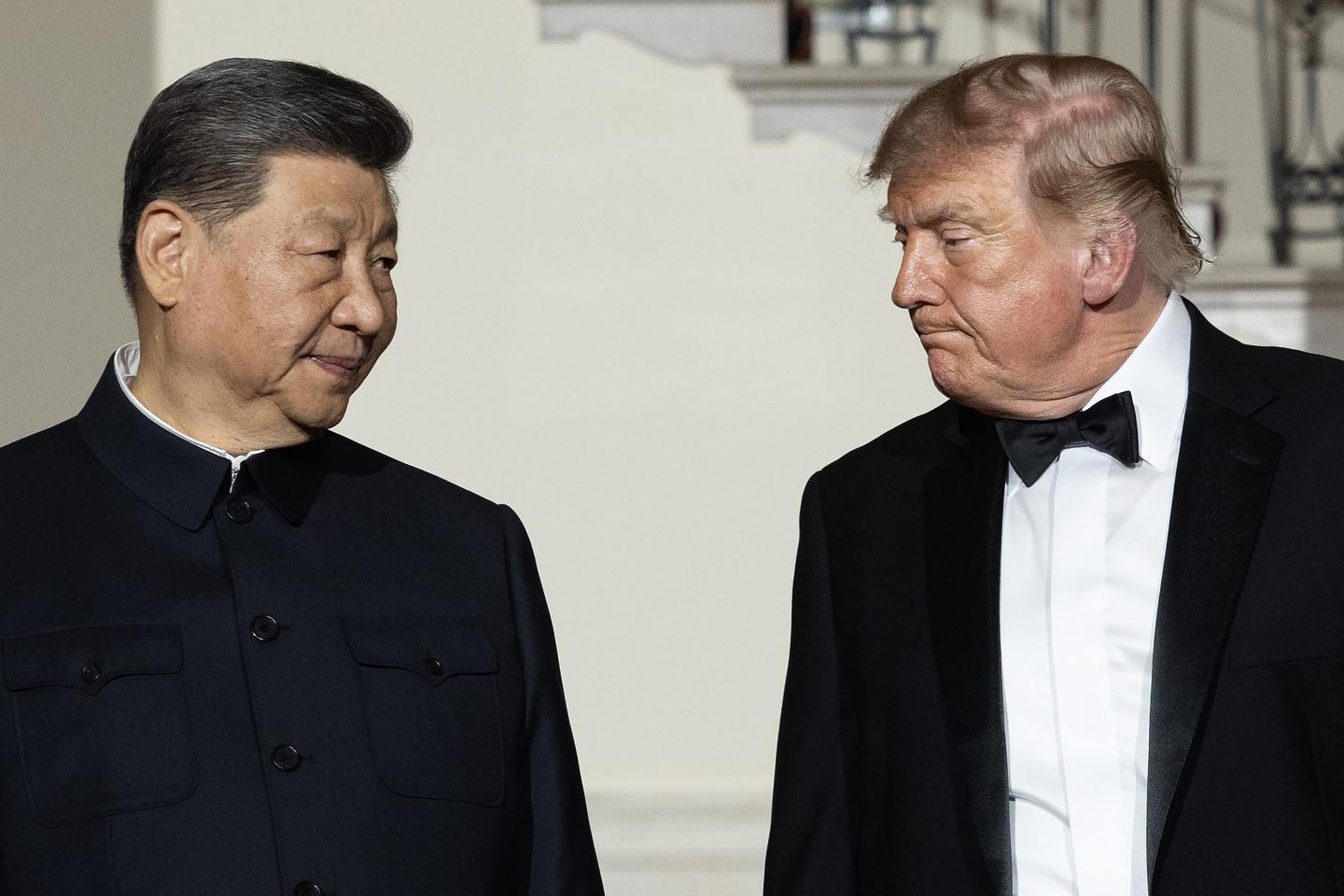
Chinese President Xi Jinping (L) looks to U.S. President Donald Trump as they descend the grand staircase before a state dinner in the East Room of the White House on September 24, 2026 in Washington, DC.
Chinese President Xi Jinping (L) looks to U.S. President Donald Trump as they descend the grand staircase before a state dinner in the East Room of the White House on September 24, 2026 in Washington, DC. Kevin Dietsch - Getty Images
Google source logo
Add Fortune on Google for similar content.

When President Trump announced his tariff plan 18 months ago, he made it clear who he hoped would pay for the sharp end of the scheme: It wouldn’t be U.S. consumers; it would be foreign exporters who would “eat” the increased costs.

Indeed, following the tit-for-tat trade war between the U.S. and fellow economic superpower, China, President Trump warned the rival force was headed for “big trouble” if it didn’t engage in a “two-way street” of trade.

Yet while 100% of U.S. exports to China are reportedly subject to tariffs—and a respective 88.8% of Chinese exports are subject to U.S. tariffs—the world’s second-largest economy has continued to grow ahead of expectations, and has seemingly grown its export business with the rest of the world.

Goldman Sachs’s Hui Shan noted over the weekend that China’s Q3 real GDP grew 4.5% year-on-year, slightly above the consensus expectation of 4.4%. Shan added that September activity data were firmer than expected, with industrial production growth accelerating to 5.5% on a year-on-year basis, and retail sales above expectations.

Recommended Video

The growth target of 4.5% to 5% appears on track, noted Shan.

Those are the sort of numbers that growth agenda economists in the U.S. can only dream of—especially when policymakers are advocating a plan to grow the economy out of any fiscal unease due to the nation’s $40 trillion national debt burden. U.S. GDP for the first and second quarters came in at 2.5% and 2.2%, respectively, per the Bureau of Economic Analysis.

That said, data analysts would highlight that while the headline figures between the U.S. and China leave something to be desired on the Western side, the U.S. remains the largest economy in the world and has a GDP per capita that dwarfs China’s. The International Monetary Fund (IMF) reports China’s GDP per capita is $15,370, while the U.S. is in excess of $95,000.

On deficits, China also appears to be making some moves in the right direction—though from a more unbalanced starting point. Shan notes: “Contrary to our expectation of moderate fiscal loosening at the beginning of the year, fiscal data have shown effective tightening. In the first nine months of this year, combined revenues from the general public budget and government managed funds increased by 1.4% yoy, whereas expenditures fell by 3.5% yoy.”

“Our estimated augmented fiscal deficit (AFD) narrowed from 11% of GDP in December 2025 to 9.4% in September 2026 on a 12-month moving average basis.”

Unlike the U.S., China seems to be reducing its budget deficit as a share of GDP. However, while U.S. policymakers have yet to agree on targets to reduce deficits as a share of GDP, they are already operating from a smaller basis: The CBO’s long-term budget projections show total deficits averaging 7.2% of GDP over the next three decades (2026-2056). 

Shan adds: “Although we expect a notably looser fiscal stance in Q4 given the recent policy announcements, we have lowered our 2026 full-year AFD estimate to 10.0% of GDP (vs. 11.5% previously).”

The trade balance

While the effective tariff rates between the U.S. and China have come down from their peaks during the trade wars, the levies between the two are still significantly elevated compared to years ago.

Chinese tariffs on U.S. exports sit at 31.9% as of August 2026, per the most recent data from the Peterson Institute for International Economics (PIIE). The levy is 35.2% on Chinese imports into the U.S.

However, according to data released by the Chinese government earlier this month, the nation’s exports leaped by 36.3% in September compared to a year prior—their fastest rate of growth since February. While Census Bureau data suggest U.S. imports from China are down compared to 2024, before tariffs were introduced, levels have once again been ticking up since their February 2026 low.

Fortune Daily breaks the traditional barrier between audience and newsroom. The show transforms Fortune’s trusted reporting into actionable, conversational, and entertaining insights for an emerging class of business leaders. Watch here.
About the Author
Eleanor Pringle
By Eleanor PringleSenior Reporter, Economics and Markets
LinkedIn icon

Eleanor Pringle is an award-winning senior reporter at Fortune covering news, the economy, and personal finance. Eleanor previously worked as a business correspondent and news editor in regional news in the U.K. She completed her journalism training with the Press Association after earning a degree from the University of East Anglia.

See full bioRight Arrow Button Icon
Google source logo
Add Fortune on Google for similar content.

Latest in Economy


Most Popular

Fortune Secondary Logo
Rankings
  • 100 Best Companies
  • Fortune 500
  • Global 500
  • Fortune 500 Europe
  • Most Powerful Women
  • World's Most Admired Companies
  • See All Rankings
  • Lists Calendar
Sections
  • Finance
  • Fortune Crypto
  • Features
  • Leadership
  • Health
  • Commentary
  • Success
  • Retail
  • Mpw
  • Tech
  • Lifestyle
  • CEO Initiative
  • Asia
  • Politics
  • Conferences
  • Europe
  • Newsletters
  • Personal Finance
  • Environment
  • Magazine
  • Education
Customer Support
  • Frequently Asked Questions
  • Customer Service Portal
  • Privacy Policy
  • Terms Of Use
  • Single Issues For Purchase
  • International Print
Commercial Services
  • Advertising
  • Fortune Brand Studio
  • Fortune Analytics
  • Fortune Conferences
  • Business Development
  • Group Subscriptions
About Us
  • About Us
  • Press Center
  • Work At Fortune
  • Terms And Conditions
  • Site Map
  • About Us
  • Press Center
  • Work At Fortune
  • Terms And Conditions
  • Site Map
  • Facebook icon
  • Twitter icon
  • LinkedIn icon
  • Instagram icon
  • TikTok icon
  • YouTube icon

    Recommended For You

    © 2026 Fortune Media IP Limited. All Rights Reserved. Use of this site constitutes acceptance of our Terms of Use and Privacy Policy | CA Notice at Collection and Privacy Notice | Do Not Sell/Share My Personal Information
    FORTUNE is a trademark of Fortune Media IP Limited, registered in the U.S. and other countries. FORTUNE may receive compensation for some links to products and services on this website. Offers may be subject to change without notice.