
It’s one of the most urgent problems of the AI age: How to tell if the person you’re chatting with on the Internet is real, or a clever bot pretending to be human. In recent years, the inability to distinguish bots from humans has led to billions of dollars of fraud as AI agents trick companies into providing goods and services. In the most extreme cases, crooks have deployed deep fakes of corporate executives in order to trick employees into sending fraudulent wire transfers. But now a solution may be at hand.
On Sunday, a company called World—which makes an orb device that uses iris scans to create a “proof of humanity“—announced that video conferencing service Zoom, as well as several big financial companies, are adopting its technology to keep out malicious bots. The verification tool is part of a broader suite of services called World ID.
“World ID for Zoom is designed to protect sensitive, high-stakes conversations by proving that a real and unique human is present. The integration uses cryptography to confirm that the person behind the screen is a verified human,” said World, which was co-founded by OpenAI CEO Sam Altman, in a statement.
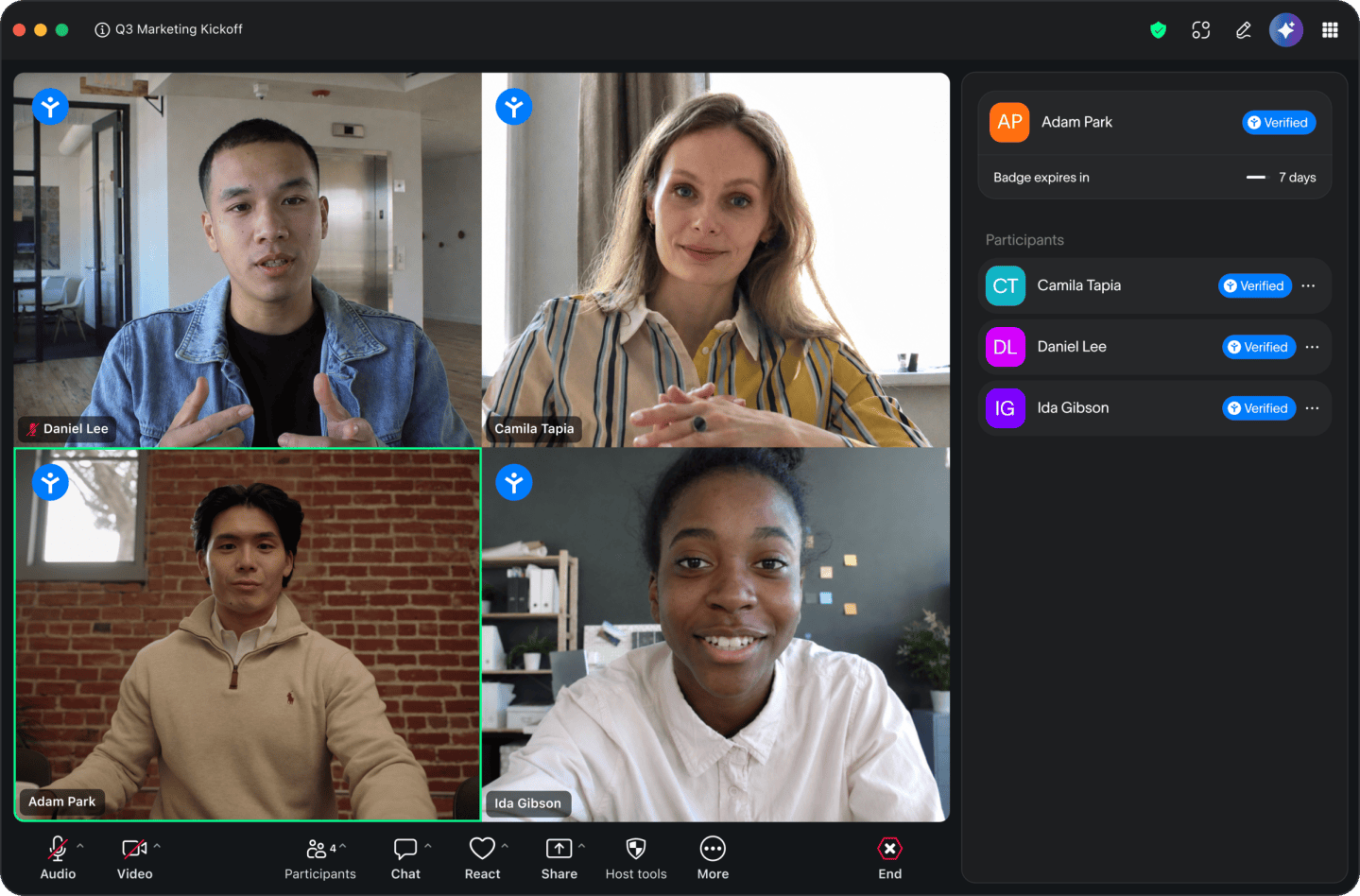
In the case of Zoom calls, the way it works is that people on the video call who have cleared World ID’s security hurdles will appear on-screen with a little blue badge that signals they are human, and that they are the person who they claim to be. The following screenshot, supplied by World, shows how the badge appears on a Zoom call:

Companies can, of course, decide when such proof is required, and reserve this level of scrutiny for sensitive calls.
The technology underlying World ID’s verification system is controversial, but its advocates say it is effective from both a security and a privacy perspective. It is tied to an orb device that captures an image of people’s irises—a biometric identifier that is distinct to every individual—and creates a permanent and tamper-proof record of their identity.
World’s orb devices, which are roughly the size of a football, may strike some people as a form of sci-fi dystopia. The devices, however, rely on a type of advanced cryptography that does not create a central database of individuals, but instead encrypts the identity of those it scans in a way that can’t be read by the company. When it comes time for an individual to verify their identity on Zoom or another platform, they use their phone camera and an app that cross-checks against the encrypted orb record.
According to World’s Chief Product Officer, Tiago Sada, consumer reaction to the orb has been similar to the introduction of past biometric security measures that took time to gain trust. Sada compared the orb’s use of iris scans to when Apple first introduced Touch ID and then facial verification for the iPhone. Those iPhone features provide a convenient form of security, but many people greeted them with suspicion when they were first rolled out.
Sada also pointed out that the protocol underlying World ID’s technology is built on open source code that can be used by anyone, including competitors. This may help to ease the concerns of privacy advocates who are uneasy not just with the technology, but with the fact it is tied to OpenAI CEO Sam Altman.
“People understand you don’t have to give Sam or any of us your photo … Everything is open source and auditable,” said Sada. He added that World ID uses blockchain technology to facilitate decentralization and encryption, noting that “I think 90% of the crypto space is BS, but 10% is profound.”
A tipping point for AI agents
Zoom is not the only big company turning to World’s verification tool to stop deep fakes. On Sunday, World also announced that a host of big financial firms—including Bain Capital and VanEck Funds—are adding the tool to their workplaces. A company spokesperson explained that the financial firms will be keeping orb devices in their offices in order to sign up employees who have not previously used one to scan their irises.
The spokesperson also emphasized that not every verification process requires an eye scan, and that World ID offers three tiers of verification using its app. The lowest of these, known as “Proof of Attributes” verifies a person’s identity based on scanned government documents, while a second-level “Proof of Presence” tier requires a selfie. The highest security setting, “Proof of Human”, requires a person to prove who they are using their World app and a selfie, which is checked against the biometric record registered with the orb device.
These various security tiers reflect how, in an online world increasingly dominated by bots, it will become necessary to verify that we are human before engaging in a wide variety of activities—ranging from video calls to dating apps to shopping.
In the case of online shopping, some large companies, notably Amazon and JPMorgan, have already begun to block bots altogether. Such “block all bots” tactics may prove an effective way to ensure only humans can carry out transactions on their websites but, according to World’s Sada, it will limit the companies’ ability to compete in the fast growing world of agentic commerce.
To this end, World is also supplying tools that allow users to assign their verified status to an agent under what Sada compares to a power-of-attorney type of arrangement. Sada stressed that World users will only be able to assign credentials to a single, trusted agent that merchants can treat as their alter-ego.
World, which was formerly known as WorldCoin, is not the only company trying to solve the problem of how to provide credentials to trusted agents. In August, the online security firm Cloudflare announced an agent ID tool of its own as well as a wallet designed for those agents to use. According to the company’s Chief Strategy Officer, Stephanie Cohen, the new products coincide with an evolution in the digital world where bots, which have historically been regarded as a menace, are now also treated as a major business opportunity.
It remains to be seen how quickly tools like “Proof of Human” gain real world traction but, as bots continue to proliferate at an ever-growing rate, it feels they will in time become a permanent part of the digital infrastructure.