
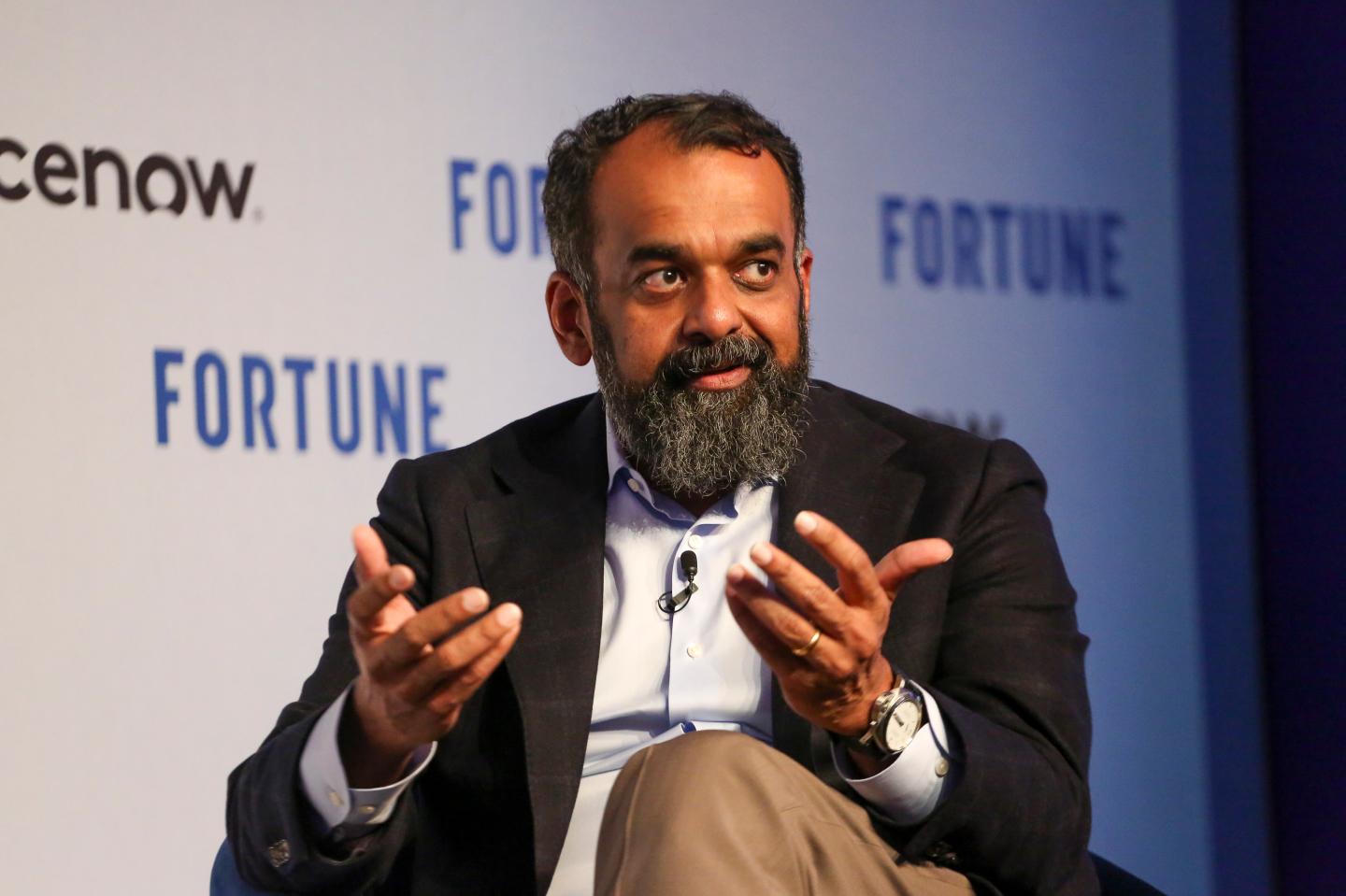
Honeywell Technologies’ new AI platform can run in three modes: manual, semi-autonomous and autonomous. The company’s chief technology officer hasn’t switched on the third.
“We have not opened up an autonomy right now,” Suresh Venkatarayalu told Fortune in an interview ahead of Wednesday’s launch of Forge Cognition. The platform, built with technology from Nvidia and Dell, puts AI agents and digital twins on top of the systems that heat, cool, secure and power buildings. Honeywell’s launch announcement says the agents can “autonomously coordinate actions across existing systems.” Venkatarayalu says people will stay in the loop for now. “Maybe we will start running in this mode for probably next two to three years,” he said. After that, customers decide when to make the switch.
“For me, I wouldn’t deploy these agents without my control system in place,” he said.
That gap between what the software can do and what Honeywell will let it do is the bet. Forge Cognition is the first major product from the slimmed-down Honeywell, which spun off its advanced-materials and aerospace businesses over the past year and now sells automation for buildings, factories and process plants. It is also an early test of a question facing every company putting AI agents into physical operations: how much control do you give software that runs equipment people depend on? Venkatarayalu calls the platform “a brain behind a building.” For now, that brain advises, and the operators decide.
Nvidia’s 90-day test
The project started with a challenge at CES in January. As Venkatarayalu tells it, Nvidia’s leadership heard Honeywell’s pitch for autonomous buildings and asked the obvious follow-up: “Who is your lighthouse customer?” In other words, where’s the real building that proves it works?
“We don’t believe in just POCs,” Venkatarayalu said, meaning proofs of concept. Honeywell CEO Vimal Kapur turned the question around and asked Nvidia, “Why can’t you be my lighthouse customer?”
Nvidia took the challenge. Within 30 days, Venkatarayalu was in Santa Clara pitching Nvidia’s operations and real estate team. The two companies then set a 90-day target: show meaningful results at Voyager, Nvidia’s roughly 750,000-square-foot headquarters building, in time for Honeywell’s investor day in June.
Nvidia’s head of operations and real estate, Scott Ekman, wanted more than a demo, Venkatarayalu said. He had his own business objectives. The teams agreed on five performance targets, measured where the building stood, and tracked progress week by week across about 900 pieces of equipment. By late April, Honeywell had enough to show investors a three-minute live demonstration.
The first target was alarms. Building systems are designed to err on the side of caution, so they flag everything. In Voyager’s security and access-control system, Venkatarayalu said, close to 90% to 95% of alarms were false, and Nvidia had eight or nine people per shift clearing them. Honeywell took Nvidia’s open-source Nemotron model and trained it on Honeywell’s own engineering knowledge to sort real alarms from noise. Honeywell says the result at Voyager is up to a 90% reduction in unnecessary alerts related to the Building Management System.
Operators can check every call the agents make. Operators can open each alarm the system classified and mark whether they agree. “That’s all about bringing in an operator in the loop,” Venkatarayalu said, so the operator can learn to trust it.
The second target was energy. The agents broke Voyager’s utility bill down by floor, zone, and peak and off-peak hours, then flagged a pattern in how the building was heated.
Venkatarayalu said they looked at how many zones in the building were running the heating system at a standard, “something like 58 degrees throughout the year, “and then it wasn’t really sensing the external temperature that goes beyond 58. Why should I be running the heating system?”
“We have identified close to 10% of energy efficiency,” he said. That figure is potential savings Honeywell and Nvidia have identified through more intelligent understanding and optimization of operating conditions; it hasn’t been achieved yet.
Talking to a building
In its simplest mode, Forge Cognition is a chatbot for infrastructure. “Can I talk to the building? Can I talk to a physical asset?” Venkatarayalu said. Operators can ask about performance and trends, then click into a digital replica of Voyager, built with Nvidia’s Omniverse simulation software, down to a single floor, zone or machine. Dell supplies the servers that run it on site.
Venkatarayalu frames the shift as a change in what the system does. Traditional building automation could “see and act”: sensors collected data, and operators responded. The new version adds “think” and “learn”: AI models trained on Honeywell’s installed base and engineering documents interpret what the sensors pick up, and operator feedback improves them over time.
“Autonomy for me is automation plus plus,” he said.
The learning works differently from site to site. At Honeywell’s campus in Bangalore, the goal was energy savings. At Voyager, Venkatarayalu said, Nvidia’s leadership told him, “For me, comfort is more important.” The agents have to learn what each operator is trying to achieve as well as how the equipment behaves.
He sets a high bar for moving to full autonomy. Before a customer makes that call, he said, the system should have “10 out of 10 accuracy all the time.”
The skills gap
Venkatarayalu presents the product as help for operators. “At least I do not think as replacement,” he said. “In an industrial environment, I need a co-pilot that aids and directs me and helps me to do my job better.” In the U.S., he sees a labor shortage. Elsewhere, it’s a shortage of skilled operators.
He said Nvidia’s operations chief described the same problem. As Venkatarayalu tells it, Scott said the system now performs on par with his best-trained building operators, a team he spent 10 to 15 years building. As Nvidia adds more large, complex buildings, Scott told him, it won’t be able to hire and train that talent fast enough.
Predicting equipment failures matters for the same reason. Some replacement parts take six to 18 months to arrive, Venkatarayalu said, so knowing early what will fail is how operators plan ahead.
Nvidia also wants its own people trained. According to Venkatarayalu, Nvidia will sign a service contract only after Honeywell’s forward-deployed engineers train its operations team and chief engineer to keep giving the models feedback.
“Physical AI is bringing new intelligence to the complex systems that run our buildings and industrial facilities,” Deepu Talla, Nvidia’s vice president of robotics and edge AI, said in the launch announcement.
A new brain for an old business
The launch comes four months after Honeywell finished dismantling its conglomerate. Advanced materials became Solstice Advanced Materials in October 2025, and aerospace began trading separately in June 2026. The remaining company, Honeywell Technologies, focuses on automation. The breakup followed a portfolio review and pressure from activist investor Elliott Management.
Honeywell says its existing portfolio spans 350,000 sites. That is the market Forge Cognition could reach; the company hasn’t said how many sites will adopt it. Honeywell traces its roots to a furnace regulator patented in 1885, and selling the brain that sits on top of the building’s controls is its next step.
What’s next
By August, Venkatarayalu said, the Voyager project had reached “a critical point.” The next step is turning Nvidia into a paying customer. “It’s no more a pilot or a POC,” he said. Getting to a commercial deal means Honeywell’s services team sizing the deployment and running operations. Nvidia is now selecting more buildings for the platform, possibly two or three more in the U.S. and one in Berlin, he said, though nothing is final.
Honeywell is also piloting Forge Cognition at the Fairmont Hotel in Dubai, NEX Mall in Singapore, and its own campuses in Bangalore and Richardson, Texas, and says customers can begin scoping deployments now. Over the next six months, Venkatarayalu said, it has picked 12 test sites in 12 different industries, including a customer’s plant operations in Nigeria. Each new industry means retraining the models for different problems and different goals, he said.
The autonomous mode stays off until those customers decide to turn it on.