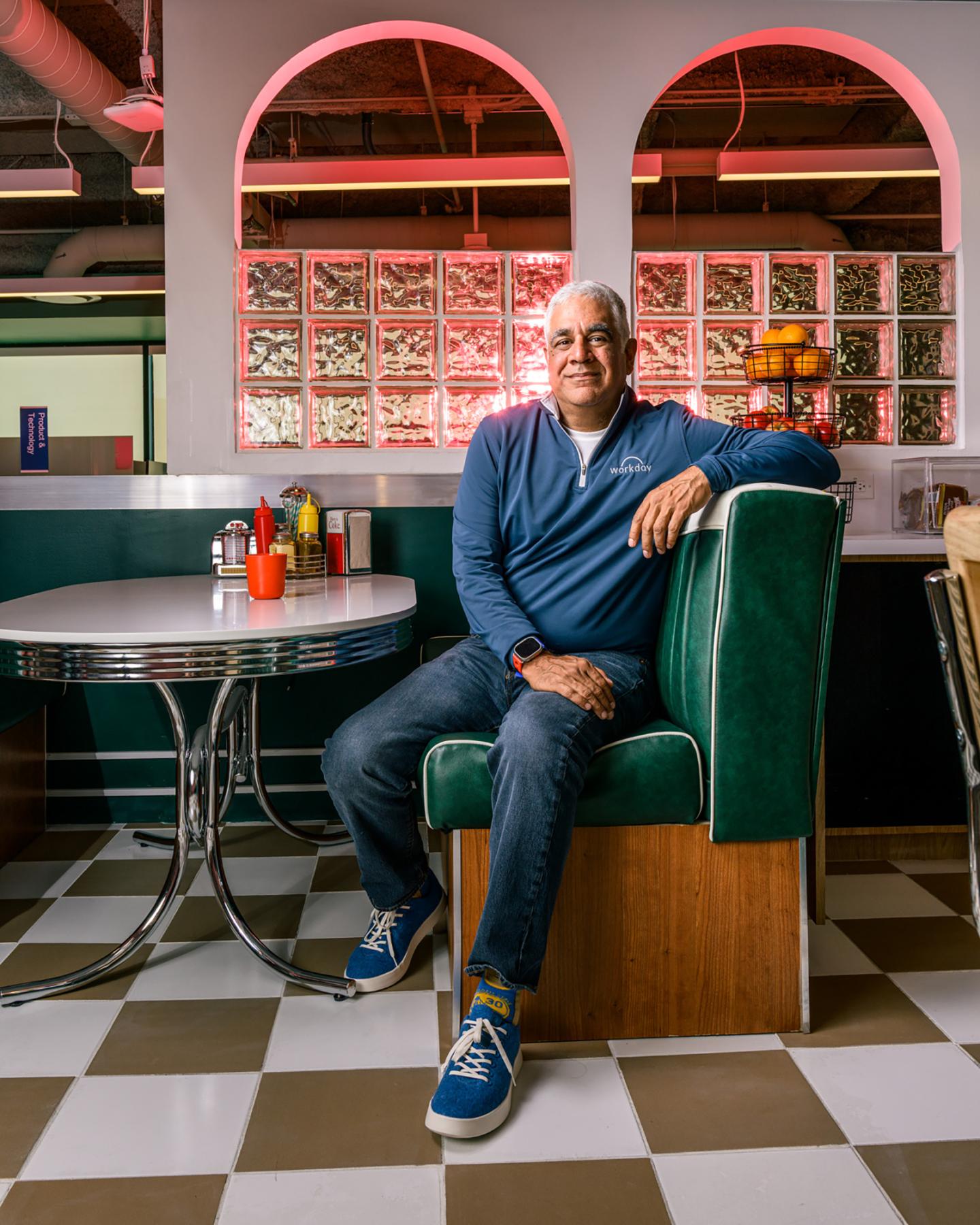

Aneel Bhusri, slumping his shoulders and clasping his hands in his lap like he’s waiting to be called into the principal’s office, sits on a hard chair under hot stage lights and tries, to no avail, to make himself more comfortable. He shifts his weight to the right, and then to the left. He folds and refolds his hands. The Workday CEO gives fleeting acknowledgement to the hundreds of people in the audience before him, but it’s clear that he’s far more relieved to train his attention—and the audience’s—on the single executive seated directly opposite. That man, Sana founder-CEO Joel Hellermark, leans back into his chair and smiles, throwing one leg over the other with the nonchalance of a man half Bhusri’s age. (Indeed, at 30, he is exactly that.) They talk about the future of artificial intelligence.
Bhusri may not be keen on soaking up the limelight, preferring instead to deflect it to one of his young mentees. But make no mistake, he is happy to be here, at the annual customer conference for Sana, the Swedish agentic AI startup Workday acquired six months prior for more than $1 billion. He has good reason to be. Fifteen years ago Workday, which Bhusri cofounded with David Duffield in 2005, was the rebellious, HR-focused, San Francisco Bay Area upstart whose cloud-based service threatened the hegemony of Oracle, SAP, and Microsoft—generational giants of enterprise resource planning software. Today, Workday is a Fortune 500 incumbent in its own right, facing a new technological revolution it didn’t start: AI.
If the technology’s most extreme adherents have it right, AI will lay waste to the entire software-as-a-service category in an epic “SaaSpocalypse” that fundamentally upends how businesses buy and use software. While that cataclysm has yet to materialize, Workday’s business has been under pressure. Revenue in its most recent fiscal year grew 13%, its slowest pace in years, and the company has undergone several rounds of layoffs.
Bhusri had planned to hit the golf links when he handed the reins to co-chief Carl Eschenbach in 2024, ending a 15-year run as Workday’s co-CEO or sole CEO. As of February of this year, Eschenbach is out and Bhusri has, in a maneuver that Disney’s Bob Iger might admire, boomeranged back into the hot seat for one last job, Ocean’s Eleven style.
“Aneel, it was very clear, was deeply committed to winning this era,” Hellermark tells Fortune, recalling the first time he met with Bhusri in Stockholm. “I could see the sort of fire in his eyes—the founder mentality of running through walls to build the best products and bring them to the world.”
That mentality is necessary to meet the AI moment, says Hellermark, who is now Workday’s Chief AI Officer. “It’s very clear that incremental [progress] won’t get you where you need to be. Radical ideas are very welcomed.”
Bhusri’s got his work cut out for him. As Workday enters into its AI-laced innovator’s dilemma, with its stock price swinging wildly from $300 highs to $112 lows and back again, and with activist investor Elliott Management and its $2 billion stake lurking in the wings, Bhusri needs to convince investors, customers, and his own employees that the company can still set the agenda in an AI world and not simply be a passive player in it.
Bhusri—sage, sincere, and steadfast in leading from the trenches—has empowered a crew of young leaders, including Hellermark, to help lead the charge. But the questions looming over the company are likely to persist for some time. Foremost, whether bringing back a founder-CEO—specifically a 60-year-old cloud computing O.G. who leads with the warm encouragement of a Little League coach—is the comfortably right thing to deliver it to disruption salvation or the comfortably wrong thing.
“Being a founder gives you a permission that doesn’t necessarily come with being an outside CEO,” says Jerry Yang, the Yahoo cofounder turned CEO who is now founding partner at AME Cloud Ventures as well as a Workday board director. “You have the permission, perhaps, to turn the battleship faster or make moves that someone may not pull off if they haven’t been with the company the whole time.”
And then there’s the vision thing. “You want to paint a high ceiling,” Yang says. “You want to paint a picture of a future that’s worth going after.”
In that sense, Bhusri may be an ideal test candidate for a much broader challenge: Whether any Fortune 500 company whose core business is directly threatened by this Intelligence Age can actually make it out alive—and what potent mix of vision, guts, and execution is necessary to make it happen.
To understand what makes Workday tick, you have to understand PeopleSoft. And to do that, you have to go back to the 1980s, when Silicon Valley was still a geographic indicator and IBM was, in the words of Fortune at the time, “the world’s greatest growth company.”
Founded in 1987 by David Duffield and Ken Morris, PeopleSoft—which was, incidentally, launched with venture backing from IBM—was the revolutionary ERP software company of its day. At the time, corporations hired technical specialists to use mainframe computers to manage business functions like human resources and accounting. PeopleSoft instead put a graphical user interface on a relational database and gave people managers the ability to directly manipulate the data.
The revolution didn’t stop there. The leaders of the largest tech companies of the time famously led their organizations with starchy conformity or vicious sales competition. Bristling at either notion from headquarters in Walnut Creek, Calif., PeopleSoft gave worker happiness the same standing as profitability by building the company on, as the Wall Street Journal put it, “an aggressively informal and sensitive corporate culture.” Cofounder Duffield? “Uncle Dave” who signed his memos “D.A.D.” PeopleSoft employees? “PeoplePeople” who worked 70-hour workweeks fueled by “PeopleSnacks.”
It all worked. PeopleSoft grew like gangbusters, went public in 1992, and reached new heights as all of enterprise technology shifted away from the mainframe and toward personal computers networked to a common server. By the middle of the decade, PeopleSoft controlled half of the U.S. HR software market. It expanded into software for finance and accounting, then manufacturing, then health care, education, and government. Fortune proclaimed it one of the fastest-growing companies in America. Astonishingly—and in a testament to its employee-centric culture—PeopleSoft didn’t lay off a single staffer until 1999, as Internet-based applications took off and the company’s manic momentum outran its ability to manage it. Still, it entered the new millennium building and acquiring its way to a complete portfolio of Internet-accessible applications.
Then it hit a Larry Ellison-sized wall. The CEO of larger rival Oracle in 2003 made a hostile $5.1 billion bid to take over PeopleSoft. After 18 months of board-based vitriol, flip-in poison pill and all, Ellison succeeded—albeit at a final price of $10.3 billion—and immediately laid off 5,000 of PeopleSoft’s 11,000 employees. The brand lives on today as an Oracle application suite.
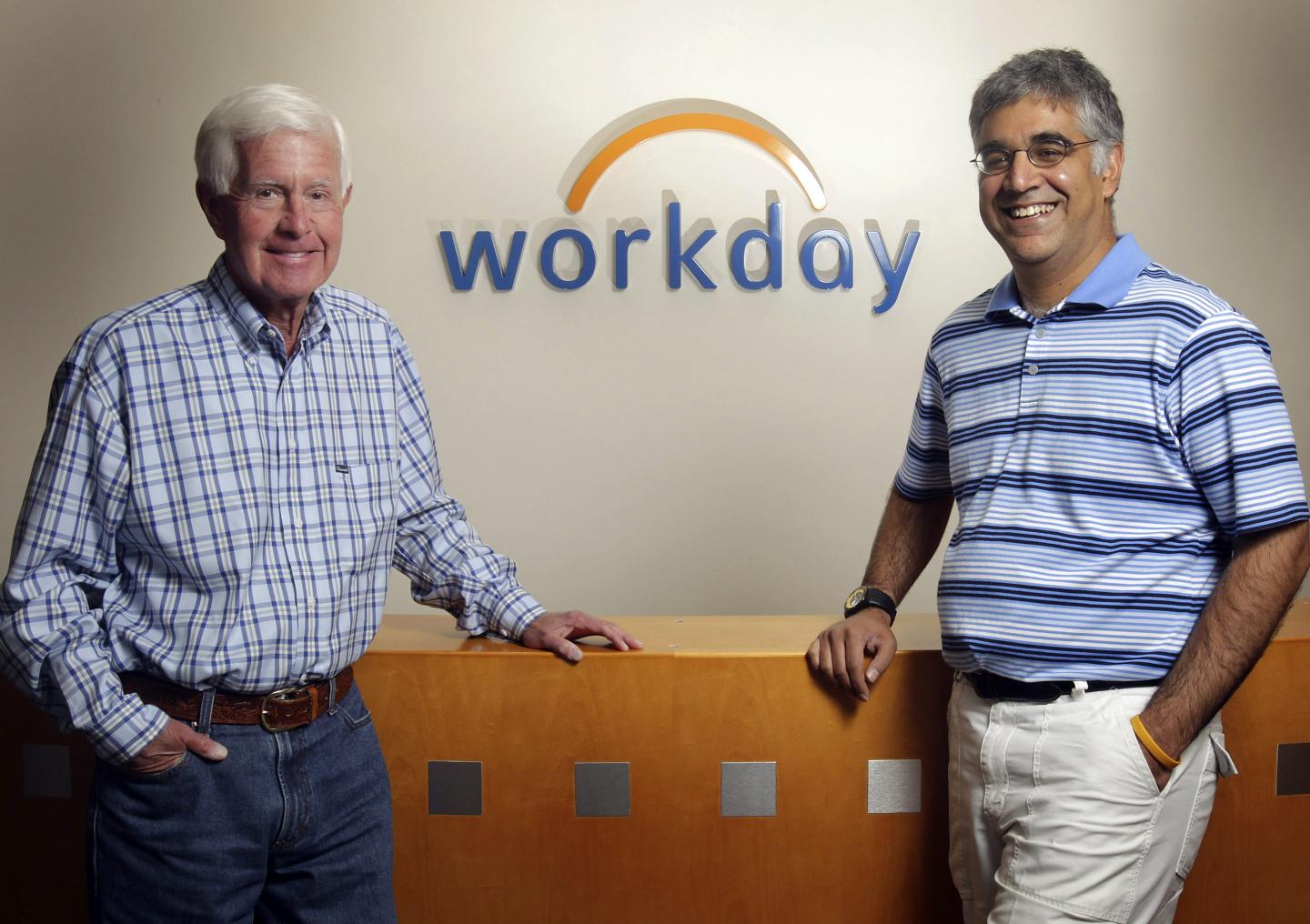
Two months later, cofounder Duffield started Workday with Aneel Bhusri, a PeopleSoft executive.
Three key strands of PeopleSoft DNA remain in Workday’s corporate composition today. The first, of course, is Bhusri. (Duffield, now 86, stepped down as Workday’s chairman in 2021.) The second is that quirky corporate culture—collaborative, empathetic, institutionally kind—that gives the company an uncommon stickiness with employees and customers that allowed it to get through stretches where the vision was clear but the tactics may not have been.
“I joined Workday for Dave and Aneel’s values,” says Enda Dowling, a product engineering executive who’s been working from the company’s Dublin offices since 2014. “Everyone has values. They’re just written on walls. But there are touchpoint stories that hang off those values.” Dowling recalls a 2016 executive training where Bhusri stressed that happy employees translate to happy customers. “‘We don’t know what tech shifts we’ll see in 10 years, but I guarantee if we take care of the one side of the equation, we’ll take care of the other,’” Dowling recalls Bhusri saying. “That degree of integrity I’ve never seen.”
The final strand? A good, old fashioned competitive chip on the shoulder. Well, sort of. Not a single Workday employee I interviewed dared refer to He Who Shall Not Be Named, and for many of them, the demise of PeopleSoft is irrelevant—a dusty tale from an ancient text. Ever introspective, Bhusri himself waves away any contemporary comparisons, saying that he admires Oracle’s Larry Ellison and the company he’s built. (“It’d be unfair to say that it’s not personal, but I don’t think about that at all,” he tells Fortune.) But the facts remain: In 2026, Oracle generates seven times the annual revenue of Workday, is valued 10 times as much by Wall Street investors, and is still the aggressive, sales-driven, Ellison-led enterprise pressure cooker that is anathema to Workday’s core belief system.
A silver lining: The entire ERP category is once again quaking from technological disruption. Oracle and SAP, like Workday, must build, buy, and partner their way through the great AI transition.
Wall Street is optimistically mixed on Workday’s prospects for successfully rounding the AI bend. On the one hand, Workday has a durable advantage as an incumbent corporate tool; building agentic AI on top of that foundation is both logical and compelling. On the other hand, those whiz-bang AI agents could simply shift companies’ existing software spending rather than actually grow it as hoped. Worst case scenario? AI could obliterate Workday’s per-employee pricing model if not redirect all that spend to a pure AI firm that learns to do HR and finance work, rather than the other way around.
Tal Liani, an analyst for Bank of America Merrill Lynch, isn’t convinced that will happen. He wrote in a May note to clients that there was “limited risk of outright displacement” for Workday thanks to its role as a “mission-critical system of record with an entrenched install base.” A “strategically sound” plan doesn’t hurt, either. Still, artificial intelligence is both a “strategic necessity” and an “economic uncertainty” for the company, Liani added, and “monetization remains nascent” for a business model that’s evolving from traditional software “seats” to agent-based pricing.
Karl Keirstead and Daniela Campo of UBS feel similarly. The analysts wrote earlier this year that Workday has demonstrated more resilience than expected, given the challenging environment, but did not show enough revenue growth to merit a valuation rethink. That growth, however, was “primarily driven by acquired AI assets rather than Workday’s core business,” the analysts noted, and the company’s backlog was not moving in the right direction. But without any observed behavioral changes among its customers, Workday had “some room to breathe,” they wrote.
But how much room is enough? In August, news hit the wires that publicly traded Workday was in talks with the private equity firm Silver Lake to go private. If consummated, it would be one of the largest software buyouts in history—and the latest coup for Silver Lake, which has successfully taken private a host of corporate giants including Dell, Endeavor, Qualtrics, VMware, Zuora, and most recently, Electronic Arts. The revelation pushed Workday shares up some 18%.
On the one hand, Workday has a durable advantage as an incumbent corporate tool; building agentic AI on top of that foundation is both logical and compelling. On the other hand, those whiz-bang AI agents could simply shift companies’ existing software spending rather than actually grow it as hoped.
I ask Bhusri if he plans to take the company private, or even outright sell to a larger competitor. “There’s a nuance between selling and going private,” he says. But on the former, “I can never say never. I didn’t come back to sell the company. I came back for the long run. But I don’t have a crystal ball. It would have been easier to sell before I came back.” He continues: “Was I annoyed when the stock was in the $110s? Yeah. I’m a founder. I thought it was ridiculous and irrational. I wondered how much of it was driven by short-sellers.” (Silver Lake has not publicly commented on the matter.)
Back on Wall Street, Keirstead of UBS wasn’t convinced taking Workday private was necessary, reasonable, or even possible.
“For [Workday] to turn around in a matter of months and negotiate a sale, at a historically depressed free cash flow multiple and before any material time for Workday to realize any upside from these investments, strikes us as very surprising,” Keirstead wrote to clients, citing tight credit markets and Bhusri’s fresh commitment to return as CEO. He added: “If indeed deal discussions (with Silver Lake) have occurred, this might signal that Workday has concluded that the transition to being AI-centric (a path that everyone is on) may be long and complicated.”
No kidding. One thing everyone seems to agree on, though, is that Workday has the right stuff—cash, culture, existential verve—to do it.
“I can recall the first conversation with Aneel and what really attracted me to Workday,” says Bill Onisick, Vice President of HR Transformation and People Operations at GE Vernova, the energy equipment giant, which uses Workday’s wares. “It was the similar approach to investment in relationships. They’re about reciprocity and relationships. Strategic partnerships. They’re very customer-centric.”
Onisick, a former CIO, says he’s relieved that today’s Workday is led by the same people who navigated the “gear shift” that was software-as-a-service. Bhusri and team’s entrepreneurial mentality—plus Workday’s enduring people-first approach—will serve the company well in this new era because AI is a similar, albeit far bigger, transition, he says.
“The unlock for AI is more about leadership than it is about the technology. It’s similar to SaaS but even more significant in terms of what’s at stake—the digital worker displacing some human workers, for example,” he says. “It takes the agility to productize your organization to really capitalize on AI technology. You can’t do this bottom up. You have to do this top down.”
And Workday? It’s like a brand new company, Onisick says: “They’re not a startup. But the way they’re operating is very similar to the agility in a startup.” For better and for worse: Workday laid off about 500 product and technology staffers in September, bringing the year’s total to 900, as the company recalibrated for its new direction.
Workday CTO Gabe Monroy says the anti-inertia mandate was clear as day when he joined the company last year from Google.
“Leadership knew it had to break some glass,” he says, “to do things differently.”
No one expects Aneel Bhusri to lead Workday forever. That includes the 10 other members of his board. Of the $138.8 million compensation package he’s due for succeeding as a boomerang founder-CEO, more than half, $75 million, pays out if he can hit a series of undisclosed stock price targets over the next five years. The other half of the package, roughly $60 million in restricted stock, requires only that Bhusri stick around for the next four years. At the rate artificial intelligence is developing, that’s an eon. But it would put him at roughly the same age that Tim Cook stepped down as CEO of Apple.
There’s little dispute that Hellermark, the 30-year-old Sana CEO, embodies the future of Workday’s potential. A host of other executives hired in recent years—CTO Gabe Monroy, CFO Zane Rowe, CIO Rani Johnson, commercial chief Rob Enslin—serve as trusted lieutenants for a new era.
But everyone freely calls Gerrit Kazmaier Bhusri’s heir apparent.
Kazmaier, 43, is Workday’s president of product and technology. For the last year and a half, he has overseen the company’s core platform, including its all-important AI agents. Before joining Workday, he spent four years running the business intelligence unit at Google Cloud; before that, the German spent more than a decade at SAP, helping the company make its cloud computing transition. A fixture at Workday headquarters in Pleasanton, Calif. and at Bhusri’s home in San Francisco, he is perceived as being in near-constant synchrony with his boss as the entire company reforms around agentic AI.
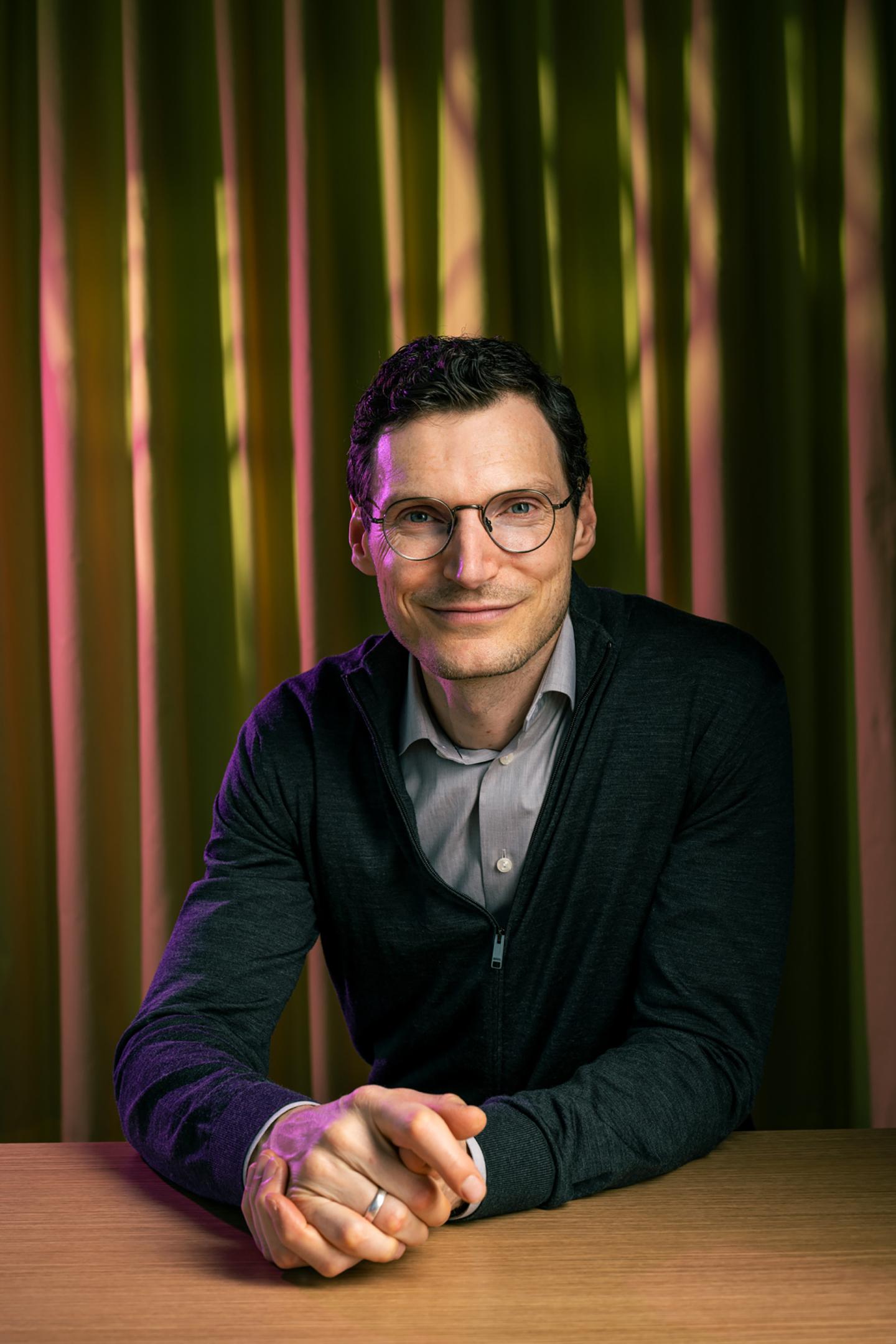
“I came in with a mandate to transform Workday,” Kazmaier tells Fortune. He recalls his first conversation with Bhusri during the recruiting process for his current role. “We were talking about the shift in the technology landscape, the implications it has for enterprise software, operating models, products…I came into the company with the understanding to set the stage for the next 20 years for Workday’s innovation agenda.”
No one defers to Kazmaier more than Bhusri himself. Consider the company’s recent quarterly earnings calls: “First, I’ll put it to Gerrit.” “Gerrit, over to you.” “I am going to ask Gerrit to talk about how we think about the different models.” “Maybe, Gerrit, you wanna talk about where the products are headed.” And: “With that, I will hand it to my Vulcan mind-melded friend.”
Kazmaier says he and his boss became fast friends because they’re both “product people.” It undoubtedly helps that Kazmaier’s expertise, not to mention that of his recently hired peers, helps offset Bhusri’s generational deficiencies with regard to AI.
“We love to get deep and maybe sometimes lost in building the best product—being so passionate about the craft of building a great product and what it looks like and feels like,” he says. “That’s something he and I love thoroughly together. That’s something that connects us deeply.”
For now, Workday is “in the building momentum phase” of its turnaround, Kazmaier says. He’s not wrong: In May, Workday logged its best first-quarter growth in new bookings in five years, topped Wall Street estimates on both earnings and revenue, and raised its full-year profit margin forecast. In August, Workday beat expectations on its second-quarter revenue and earnings and boasted that half of its net new customers signed up for one or more AI products. And now Sana, which will fully replace Workday’s widget-based interface with an agentic alternative, is evolving into a launchpad for Workday’s growing army of autonomous agents.
Meanwhile there hasn’t been a peep from Elliott Management, even though it publicly backed Bhusri’s predecessor Eschenbach.
There’s more to do—much more. “Our core mission is not fulfilled,” Kazmaier says. “The AI opportunity is so much bigger.” He pauses. “When you have momentum, mountains become hills. Are we at the pinnacle yet? No.”
Aneel Bhusri considers the nuances when I ask him about what it feels like to be back in the chief executive role yet again. He had a few weeks to sit with the idea before he came to a final decision, he says. He also paid a visit to mentor and cofounder Duffield, who remains Workday’s largest shareholder, for a consultation. Duffield told him to quit waffling, suit up, and set up the company for success.
“He didn’t convince me, but I think he nudged me,” Bhusri tells Fortune. That counted for a lot. “I would take a bullet for Dave,” Bhusri says. “In 33 years, we’ve never got into an argument.”
Though Bhusri says he feels like he’s “the right person” for Workday’s return to form, he acknowledges that there were butterflies on day one despite 15 years’ experience in the gig. “When I came back I didn’t know exactly what we were going to do,” he recalls. “That day, I just wanted to say we’re gonna get back to innovation, get back to customers, and have fun doing it.”
He continues: “I would definitely say I had some anxiety. I was not in the seat for awhile. I’m not a great operating executive; I’m a product person and a technologist. But I was also excited. I just want to see Workday succeed in this new world. I knew we needed to lean in, create a clear vision, and start to execute.”
Bhusri says there’s something “fundamentally different” about the AI revolution compared to the cloud one that took place more than a decade ago. AI isn’t deterministic, he says; it’s probabilistic. AI isn’t taking existing business processes and automating them with a better process and a slicker experience, he says; it’s reasoning and, in some ways, “replacing human thinking.” That’s both exciting and affirming. In previous tech revolutions, there was always an advantage to having “a clean sheet of paper,” Bhusri says. This time, though, Workday’s core existing infrastructure gives it a leg up.
“AI is not the next thing after cloud,” he says. “AI is orthogonal. It’s built on top of cloud. Taking a PeopleSoft app and moving it into the cloud wouldn’t have worked. The right AI is actually built on top of cloud.”
At any rate, Bhusri says he’s building for the long term. There are two things the Workday cofounder dwelled on in advance of his return as CEO. The first is The Innovator’s Dilemma, the iconic Clay Christensen text about why successful companies fail when facing disruption. (“I studied Clay’s book so many times,” Bhusri says.) The second is the vast library of video clips of Apple cofounder Steve Jobs outlining the steps he took to sharpen the company’s focus when he returned to Apple as CEO in 1997. (“As much as he was a product genius, he was a management genius, too,” Bhusri says.)
Great companies aren’t defined by one technology wave, Bhusri says; they succeed in riding multiple waves. The founder-CEO says he has zero desire to watch Workday fade into irrelevance as the company hurtles into the Intelligence Age.
“This is a re-founding of our existence,” Bhusri says. “Not to be dramatic, but it’s so profound. I’m 60 now. I’ve been around technology a long time. There’s been nothing like this.”