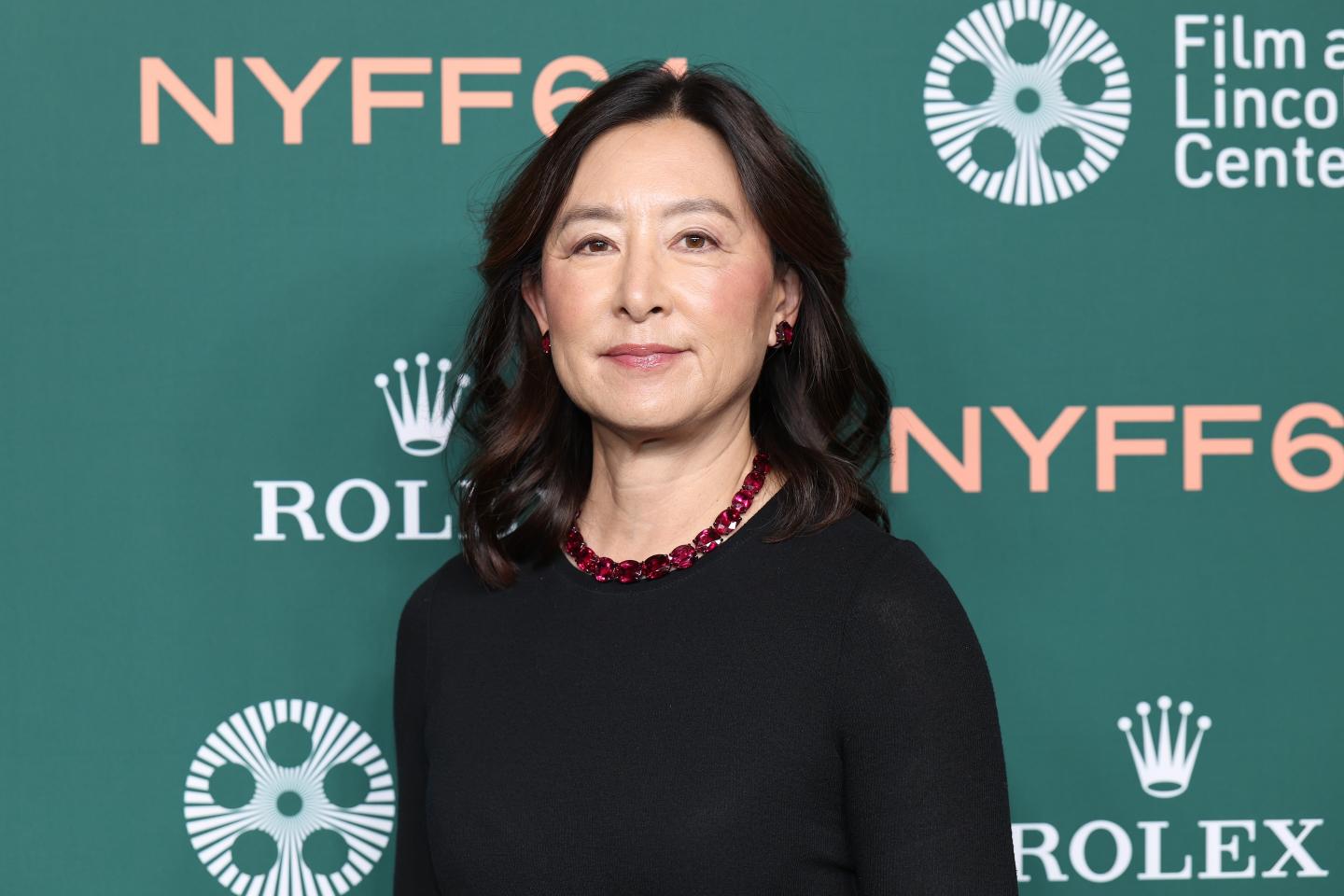
Clara Wu Tsai has a lot on her plate. She’s vice chair of Brooklyn Sports & Entertainment, the company behind the Brooklyn Nets, the New York Liberty, and Barclays Center, and she serves as the Liberty’s governor. She’s also a film producer: most recently of Werner Herzog’s Bucking Fastard, which premiered at the Venice Film Festival in September. She co-owns the National Lacrosse League’s San Diego Seals and is a trustee at Stanford, NewYork–Presbyterian Hospital, and Lincoln Center.
But for one of Wu Tsai’s projects in Brooklyn, the return can’t be measured in dollars alone.
In August 2020, amid racial justice protests on the plaza outside Barclays Center, Wu Tsai and her husband, Alibaba cofounder Joe Tsai, pledged $50 million over 10 years to social justice and economic mobility initiatives, prioritizing Brooklyn. The result was the Social Justice Fund, which Wu Tsai directs. Six years in, its stated mission is to support economic mobility across the borough by funding programs that address gaps in education, health, and wealth.
Its latest plan may be its most ambitious. Some of the fund’s money is earmarked for a guaranteed income program for new mothers in Brownsville, a neighborhood where poverty has long outpaced the citywide rate, the New York Times reported this month. Guaranteed income, which means regular, no-strings cash payments to a targeted group, is different from universal basic income, which would go to everyone. New York City has already experimented with the model, including a City Council pilot for expectant mothers run by the nonprofit Bridge Project. The fund hasn’t publicly detailed the Brownsville program’s size or start date.
Where the $50 million is going
The fund’s investments take many forms, according to its five-year impact summary.
Small-business loans. Its first major program, EXCELerate, launched in 2021 with low- and no-interest loans to help Brooklyn businesses reopen or survive the pandemic. In March, the fund joined the Asian American Foundation, Renaissance Economic Development Corp., and New York State for a $5.5 million small-business loan program.
Startups. BK-XL, an accelerator built with Boston-based Visible Hands, put more than $4 million into 17 startups led by founders of color. The fund has since said it is shifting toward loans and grants.
Courts. Partnering with NYC Parks, the fund says it has renovated 12 basketball courts across four Brooklyn parks in neighborhoods with high rates of gun violence. The parks are in East New York, Flatlands, Crown Heights, and Sunset Park, and the work is part of a roughly $2 million initiative.
Arts and events. The fund backs music and arts curriculums in public schools inspired by Brooklyn natives Jean-Michel Basquiat and Max Roach. Wu Tsai also uses Barclays Center to host free public events, like a summer concert series on the arena plaza.
The critics
The fund hasn’t escaped scrutiny. Brooklyn journalist Norman Oder, who has covered the Barclays Center for two decades, has published a series of reports arguing that its spending is hard to verify. Oder reports that the Joe and Clara Tsai Foundation’s IRS filings show no grants. He also reports that the fund doesn’t publish a full accounting. The fund told him that 10% of its money goes to administrative costs. After Oder questioned one impact figure, the number of students reached by the Basquiat program, the fund revised it from 70,000 to 12,000.
Oder has also documented the fund’s shift to race-neutral language. Its homepage mission promised to support “BIPOC communities in Brooklyn” until late 2024, when it dropped that phrase. The change mirrors moves by many companies and foundations to scale back DEI language. Oder found that the people and programs the fund supports have changed little.
A fund spokesperson told Oder the organization “is not a traditional philanthropic organization,” and that it takes on early risk so other capital can follow.
The Liberty playbook
For Liberty players and fans, Wu Tsai’s spending has paid off. Knicks owner James Dolan formerly owned the team, and in 2018 he moved it out of Madison Square Garden and into the roughly 5,000-seat Westchester County Center in White Plains. The Tsais bought the Liberty in January 2019 and moved it to Barclays Center the following season.
“These women were underestimated, but they were undeniably world-class … We gave these women resources that match their talent,” Wu Tsai told Vanity Fair, stressing the importance of “treating them like we invest in them; like we invest in the men’s team.”
That investment has taken several forms:
- Chartered flights. The Tsais chartered flights for players in 2021, which earned the team a record $500,000 league fine. Charter flights are now standard across the WNBA.
- A new practice facility. The team is building an $80 million practice facility in Greenpoint, slated to open in 2027. It is funded partly by a minority stake sale at a then-record $450 million valuation.
- Hands-on recruiting. Wu Tsai has acted like a front-office executive. In 2023, she flew to Istanbul to recruit star Breanna Stewart.
Five years after the Tsais took over, the Liberty won their first-ever WNBA championship in 2024. Sportico now values the team at $600 million, up from the $10 million to $14 million the Tsais paid.
Wu Tsai hasn’t built any of this alone. The Social Justice Fund was announced as an initiative of the Joe and Clara Tsai Foundation, which she shares with Joe Tsai, cofounder and chairman of Alibaba Group. The couple, who married in 1996, announced in late July that they are divorcing. They said the split won’t change ownership of the teams: Joe remains Nets governor and BSE chairman, and Clara remains Liberty governor and BSE vice chair.
What’s next
Wu Tsai has said she wants the Liberty to become a billion-dollar franchise. The WNBA’s first team to cross that mark was the Golden State Valkyries, which CNBC valued at $1 billion this year.
She’s also betting on science. In 2021, the Tsais committed $220 million to the Wu Tsai Human Performance Alliance. The six-university research collaboration, anchored at Stanford, studies elite athletes to improve health for everyone.
When Fortune asked her earlier this year which goal she’d rather achieve, a billion-dollar team or a major scientific discovery, Wu Tsai said: “I’d like to do both.”