
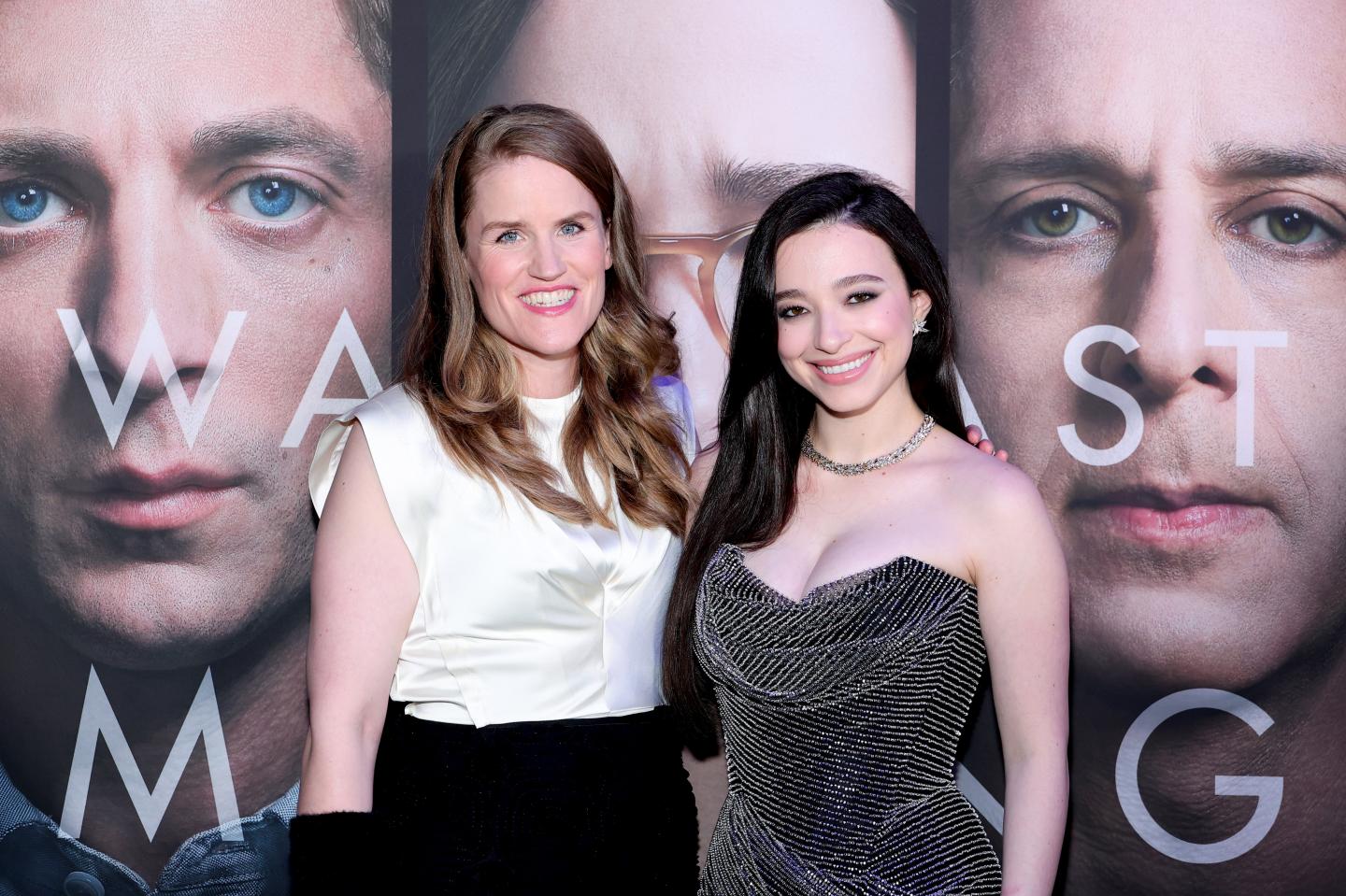
At an early screening of The Social Reckoning, Aaron Sorkin’s follow-up to The Social Network, I thought I knew what I was in for. Jeremy Strong is playing Mark Zuckerberg, taking over from Jesse Eisenberg. But when the film started, it was at least 30 minutes before the Zuckerberg character appeared onscreen.
Instead, the main character of The Social Reckoning is Frances Haugen, the whistleblower who helped the Wall Street Journal publish its series the Facebook Files, showing how the company failed to address known issues like how Facebook could be used to incite violence in developing countries and how Instagram harmed the mental health of teen and tween girls.
We see Mikey Madison—in her first major role since winning the Oscar for Anora—as Haugen, become increasingly disillusioned with Facebook, going from a true believer in its mission to connect the world to skeptical the company will ever sacrifice any profits for the sake of humanity. Alongside Jeremy Allen White as WSJ journalist Jeff Horwitz, she goes public.
Zuckerberg, instead, is a side character who we see preparing for Congressional testimony and in his bunker of an office. If Eisenberg’s Zuckerberg was a striver desperate to prove himself and gain social acceptance, Strong’s is years into life as a powerful, isolated billionaire.
That’s how Haugen views him; she joined us after the screening for a Q&A and we followed up for another interview too. Haugen worked at Facebook between 2019 and 2021, following a career across Silicon Valley at Google, Pinterest, and Yelp. What is it like for Haugen that the much-anticipated sequel to the Social Network is in fact about her? “As much as it is about my whistleblowing, I think it is a wonderful scene of life to help people understand how unique the circumstances are around [Zuckerberg’s] existence, given he is one of the most powerful people having as little checks and balances on him as he does,” she told me. “I’m grateful that they do depict him as well because it’s important for the public to understand.”
One character we don’t see onscreen is Sheryl Sandberg. She left her role as COO of Facebook in 2022 and was very much still involved during the period depicted in the film. Instead, the movie’s Zuckerberg is surrounded by composite characters of advisors.
Sorkin’s take on Facebook culminates in the Jan. 6 insurrection at the Capitol. The film’s view of Facebook’s harms on the world is focused on the U.S. Meanwhile, the real Sandberg was dealing with other problems. “She’s the one who had to deal with Myanmar, she’s the one who had to deal with Sri Lanka,” Haugen says. “By not having Sheryl [in the film], there’s not a natural conduit for exposing the issues that happened outside the U.S.”
The movie is opening as Meta deals with the impact of many of these issues today. In August, the company reached an $18 billion settlement over Facebook and Instagram’s harms to children’s mental health.
Since blowing the whistle on Facebook, Haugen has testified in the U.S., U.K., and in front of the European Parliament, founded a nonprofit, and published a memoir. Recently, she’s been working to support whistleblowers at AI companies.
She views the current surge of Hollywood interest in these stories as a sign of where society is today. In addition to The Social Reckoning, there’s the forthcoming Artificial, where Andrew Garfield plays Sam Altman, and the procedural Cupertino about how people have been harmed by big tech.
“When The Social Network came out, it was an end cap to an era of the internet. We got our first algorithmic feed around when the movie came out,” she says. Now, today’s projects are “a symbol of how hungry people are right now to try to gain any insight how to navigate this period of change in our society.”
The Social Reckoning is in theaters today.
Emma Hinchliffe
emma.hinchliffe@fortune.com
The Most Powerful Women Daily newsletter is Fortune’s daily briefing for and about the women leading the business world.
ALSO IN THE HEADLINES
A disturbing campaign development. Bernadette Greene-Placentia is running for Congress in Arizona as a Democrat. The candidate—a former long-haul trucker whose slogan is "trucker tough"—says that while she was out fixing campaign signs at night, she was attacked by two men and raped. She was left with multiple bruises and a lump on the back of her head.
And the Nobel goes to (again!). After Anne Carson's Nobel Prize for Literature, now we have a winner for the Nobel Peace Prize: Navi Pillay, a South African jurist and advocate for human rights. She's defended the rights of Nelson Mandela, led a panel that found that Israel committed genocide in Gaza, and served as a judge in international courts, including over the genocide in Rwanda. Pillay, 85, dedicated the prize to "all of the survivors of international crimes."
Caitlin Clark on racism in the WNBA. The superstar addressed comments by her Indiana Fever teammate Kelsey Mitchell, who said that her DMs are full of hate as a pro athlete, "specifically being an Indiana Fever basketball player." "Anytime I see something like that (it) makes me upset, makes me sad, makes me really disappointed because that's not who I am," Clark said.
Women's groups are suing the DOD. The National Women's Law Center, the the Service Women’s Action Network, and the ACLU's Women's Rights Project say the Defense Department failed to respond to a FOIA request. That FOIA request was over the Pentagon’s decision to launch a study of the “effectiveness” of women in ground combat roles and what its findings will mean for those women.
ON MY RADAR
The NFL's $192 million bet on flag football is paying off with teen girls Bloomberg
ShopMy is thinking (and linking) big Elle
How Gina Prince-Bythewood made it to the big leagues Elle
PARTING WORDS
"This documentary doubles as a fire alarm that I’m pulling to get people’s attention about what’s happening in the current moment."
— Director Ava DuVernay; her latest project is 14th, a documentary about the 14th amendment and birthright citizenship