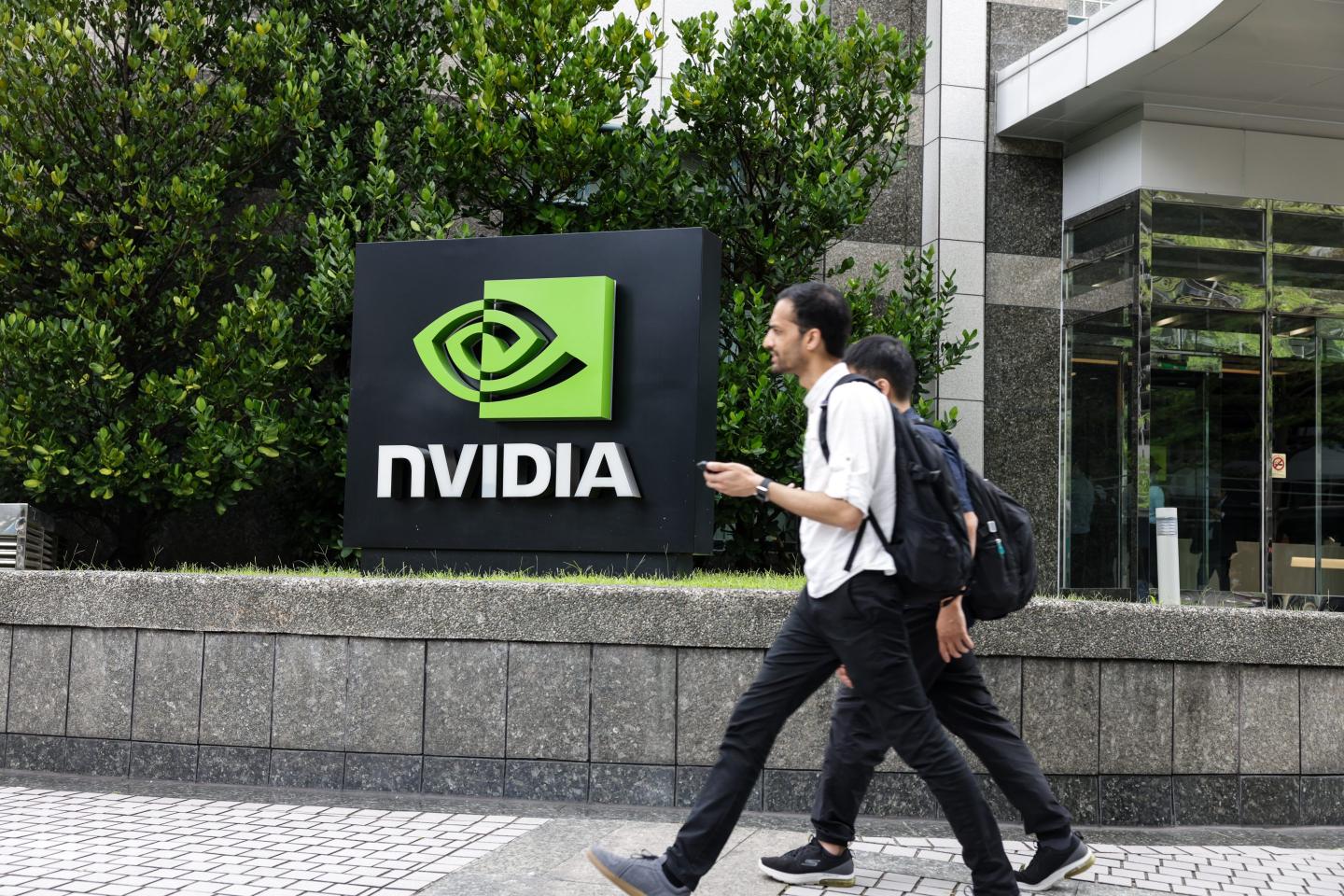
Much has changed at Nvidia in the 19 years since HR director Febe Punsalan started working at the Santa Clara, California, headquartered company. Two decades ago, Nvidia was largely known for manufacturing the GPUs that allowed computers to render 3D graphics on videogames. Today, it’s a key player in the global AI industry, developing the computer chips that provide the processing power required to train the most powerful models.
As employees at frontier AI firms blow the whistle on the supposed existential risks of artificial intelligence, Nvidia CEO Jensen Huang has proved much more measured in his outlook, putting the chances of AI ending the world at “zero.” Despite the seemingly ever-higher stakes of the AI transition, Nvidia has “always stayed true to our culture,” says Punsalan. “We’re growing in terms of headcount and we use AI coding and agentic tools every day.”
One region where the company is quickly growing is Europe. Nvidia ranks 14th on Fortune’s 100 Best Companies to Work For – Europe list and its architecture powers 90% of the continent’s AI factories—the largest GPU cluster in Europe will soon go live in the U.K. “Europe is hugely important to our business, and we’re growing across all regions and functions,” says Punsalan. The company has offices in 15 European countries and the continent is a critical hub for Nvidia’s robotics and automotive research. Meanwhile, Nvidia has recently hired a head of wellbeing for EMEA, to adapt perks for local customs.
But whether frontier R&D, HR, sales or engineering, Punsalan says that Nvidia’s guiding principle is that “the mission is always the boss”. This mantra helps guide all employees around a core objective, rather than directing staff through top-down initiatives. Everyone is encouraged to use their voice, Punsalan says, and the prioritization of tasks begins by listening to employees. “We start by listening. That’s really embedded at Nvidia,” she says. “We’ve got a very flat structure, with no org charts. We live by understanding what the mission is, what we need to drive towards, and then we go for it. I believe that’s what makes Nvidia a great place to work.”
This also allows the company to have a flatter organizational structure than other companies of a similar size. People leading strategically important projects will often report straight to the CEO. Huang has stated that he tries to keep the number of layers in the company as low as possible and as a result, he currently has 36 direct reports. Employees are encouraged to speak up, and the company maintains that it does not prioritize org charts or chains of command.
“We care and support our employees throughout the different stages of their lives so they can do their best work at Nvidia.”
Febe Punsalan, nvidia HR director
Money also provides a big incentive. Nvidia, which has a $5.65 trillion market cap, allows workers to buy shares in the company using their salary at a 15% market discount. This benefit has made multimillionaires of its employees. However, some employees have alleged that this can come with the expectation of working late nights and a persisting “pressure cooker” environment.
“When you come to work for Nvidia, it’s a challenging place, and it’s challenging work,” acknowledges Punsalan. “But it’s meaningful work, and that resonates whether it’s the U.S., EMEA, APAC or India. That’s going to come with a lot of dedication.”
Despite the high expectations, employee turnover remains low. The global turnover rate at Nvidia is 3.7% compared to the technology industry average of 21.9% and in the U.K., 95% of Nvidia employees say it’s a “great place to work”, compared to a 54% average for U.K.-based organizations.
That flat organizational structure is an important aspect of Nvidia’s workplace culture. Employees are encouraged to share suggestions with leadership, irrespective of how long they’ve been with the company or their seniority. Everyone from interns to junior employees to seasoned engineers can bring up ideas through a suggestion box. These are all considered by program managers and, at the very least, discussed in a one-on-one dialogue.
“We built that a long time ago, with the notion that every idea is a great idea, and so we’ll look into them,” says Punsalan. “It’s not a ticketing system like you have in other big corporations; every suggestion is looked at and reviewed and has a response.”
This initiative led to a company policy of ‘free days’ during the Covid-19 pandemic, which continues today. Each quarter, Nvidia employees globally are given two additional days off. “The entire company shuts down,” says Punsalan. “When you come back to work, you’re not returning with a full inbox because you took a vacation and everyone else was working. You’re not expected to work at all. That came from employee feedback, from listening, and through ideas.”
Nvidia’s workplace policies recently criticized for being “frugal” compared with some competitors because it doesn’t offer staff free lunch and snacks. But, Punsalan asserts that the business is focused on other, more important priorities over the cafeteria or campus perks such as gym access offered in other tech companies. These perks have also been criticized as a way to keep workers on-site. Instead, Nvidia focuses on improving work-life balance and has maintained a hybrid work programme, without strict return-to-office mandates.
Nvidia also aims to provide life-long support for employees. Besides paternity and maternity leave, the company helps pay off student loans, provides support for aging parents, reimburses IVF and surrogacy expenses, and offers support programs for neurodiverse employees and parents of neurodiverse children. “Our focus is really on what’s valued by employees,” she says. “We do that through listening—it’s not so much about the food.”
Many workers might not experience a rollercoaster trajectory as dramatic as Nvidia’s path from PC graphics provider to AI titan, but every period brings its changes and challenges. “We care and support our employees throughout the different stages of their lives,” adds Punsalan. “And by doing so, they can do their life’s best work at Nvidia.”
For the latest insights into the companies on Fortune 100 Best Companies To Work For – Europe list, visit this page.
Quick note: As the CFO mandate keeps expanding, Fortune is convening C-Suite Conversations: In Conversation with Finance Leaders on 28 October. CFOs from Loewe, Standard Chartered Bank, and MUFG Americas join Fortune's Sam Birchall to discuss building the next generation of finance leadership. Register here.