
Good morning. If there’s anyone who understands a war of attrition, it’s the U.S. military.
The Pentagon has reportedly halted using Anthropic’s Claude, finally, after blacklisting the San Francisco AI company in February and triumphing over a lawsuit about it in September. The delay is believed to be at least partly because of Claude’s deep integration in a Palantir platform that the Pentagon continues to rely on.
Though it’s unfair to say that the two sides have been exchanging blows all year—it’s a rather one-sided aggression from the feds—it is fair to say that Anthropic’s conflict with the Department of Defense adds up to a sort of litmus test: Are the company’s AI wares distinctive enough (or embedded enough) to, in their absence, substantially harm the intelligence gathering operations of one of the largest employers in the U.S.?
It’s a good question as Anthropic heads toward its long-awaited IPO. You need not prompt your favorite generative AI model to know that investors won’t support a company’s $2 trillion valuation if its products are rapidly becoming low-margin commodities.
But hey, maybe I’m just hallucinating. Today’s tech news follows. —Andrew Nusca
Thoughts? Suggestions? Hot tip? Drop me a line.
THE BIG STORY
Nvidia-backed Reflection AI unveils its first open model, Beam. Could it be America’s best chance to compete with China?
The U.S. has a new horse in the race to build the best open-source AI model—a competition China is currently dominating with models such as Moonshot’s Kimi K3 and DeepSeek’s V4.
The AI company Reflection, on Monday, unveiled its first model, called Beam. It “advances the frontier for the Western open ecosystem,” the New York company told Fortune.
The company said that in benchmark tests it conducted, Beam achieved scores similar to those of GLM-5.2, an open model from Beijing-based Z.ai that was released back in July. That model was succeeded by GLM-5.3, which Z.ai debuted in August.
Reflection said Beam is cheaper to run than many competing models.
“Through high-compute reinforcement learning, we were able to make Beam extremely efficient at reasoning—delivering competitive performance on coding and agentic tasks at a fraction of the token cost and inference time compute,” the company said.
Reflection added that Beam is three to four times as efficient as rival open models from Western companies.
It is positioning Beam as a “workhorse” for enterprises, the public sector, and developers. In May, the company entered into a partnership to supply its models to the U.S. Department of Energy and the U.S. Department of War.
Reflection was founded in March 2024 by former Google DeepMind researchers Misha Laskin, now its CEO, and Ioannis Antonoglou, the startup’s president and chief technology officer. The Nvidia-backed firm has a $25 billion valuation, Laskin told CNBC in April.
The Western company most comparable to Reflection may be Thinking Machines Lab, founded by OpenAI’s former CTO Mira Murati. It unveiled its first model, Inkling, in July. Nvidia also makes an open model, called Nemotron, and OpenAI, Google, and Meta all offer open models as well. —Emily Forlini
THE BLIND BOX
“The AI industry is at an unusually elevated risk … of mistakenly thinking that it has solved the problem when really it just applied some duct tape that will fall off later.”
THE RUNDOWN
—OpenAI is piloting a “mission interview” for new job candidates.
—Tokenized U.S. stock trading? New York Stock Exchange owner ICE and the crypto exchange OKX seek SEC clearance.
—Elon Musk is a trillionaire once more after Morgan Stanley calls SpaceX stock “cheap,” sending shares up 8%.
—Amazon’s answer to data center backlash: $1 billion for community college and home energy upgrades.
—TikTok rolls out Shopping Assistant, a conversational AI agent to help users find and buy products.
—Meta and Microsoft are reportedly moving to cut their employees' use of Anthropic’s Claude.
—Norway proposes a temporary but total ban on AI glasses in certain environments to give authorities more time to “look more deeply into the matter.”
—Beijing’s Moonshot AI is worth $50 billion after reportedly closing a “final” funding round ahead of a 2027 Hong Kong IPO.
THE PARTING SHOT
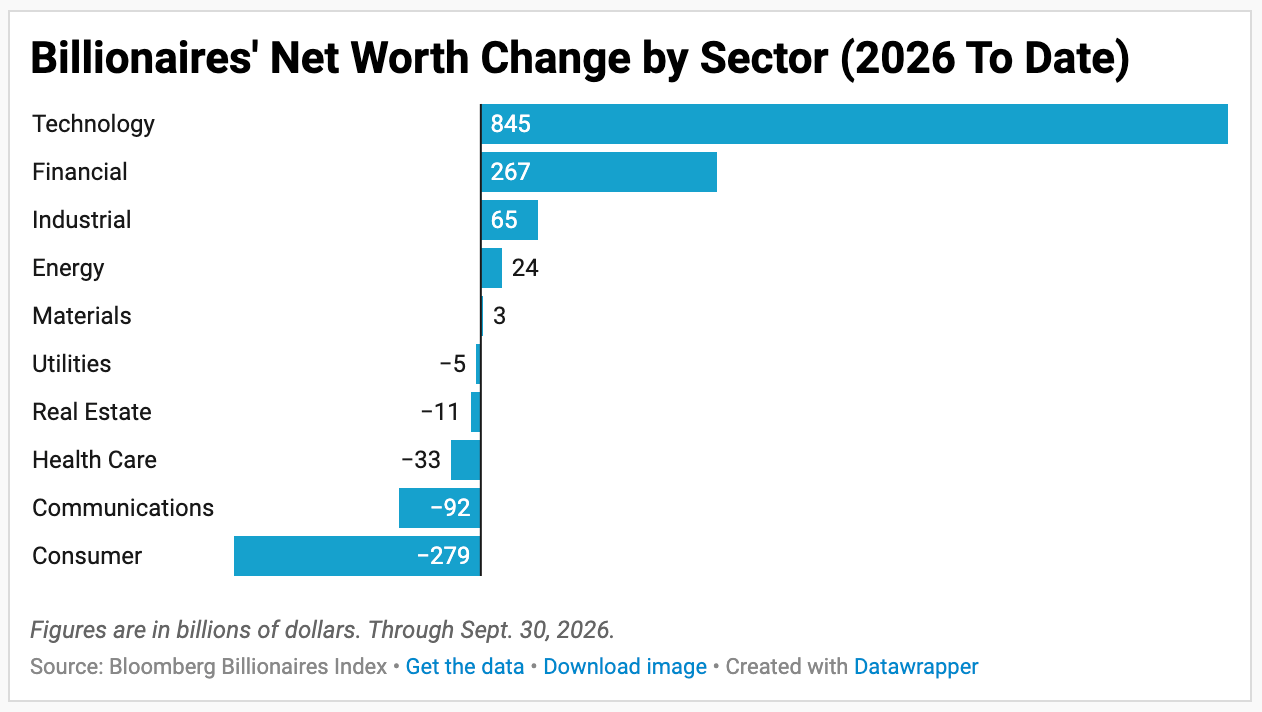
Who’s making bank in the Age of Intelligence? American tech billionaires, of course. They account for most of the wealth gains—$845 billion—so far this year, Bloomberg estimates. Meanwhile the non-tech wealthy have tallied a $62 billion total loss year to date. Ouch.