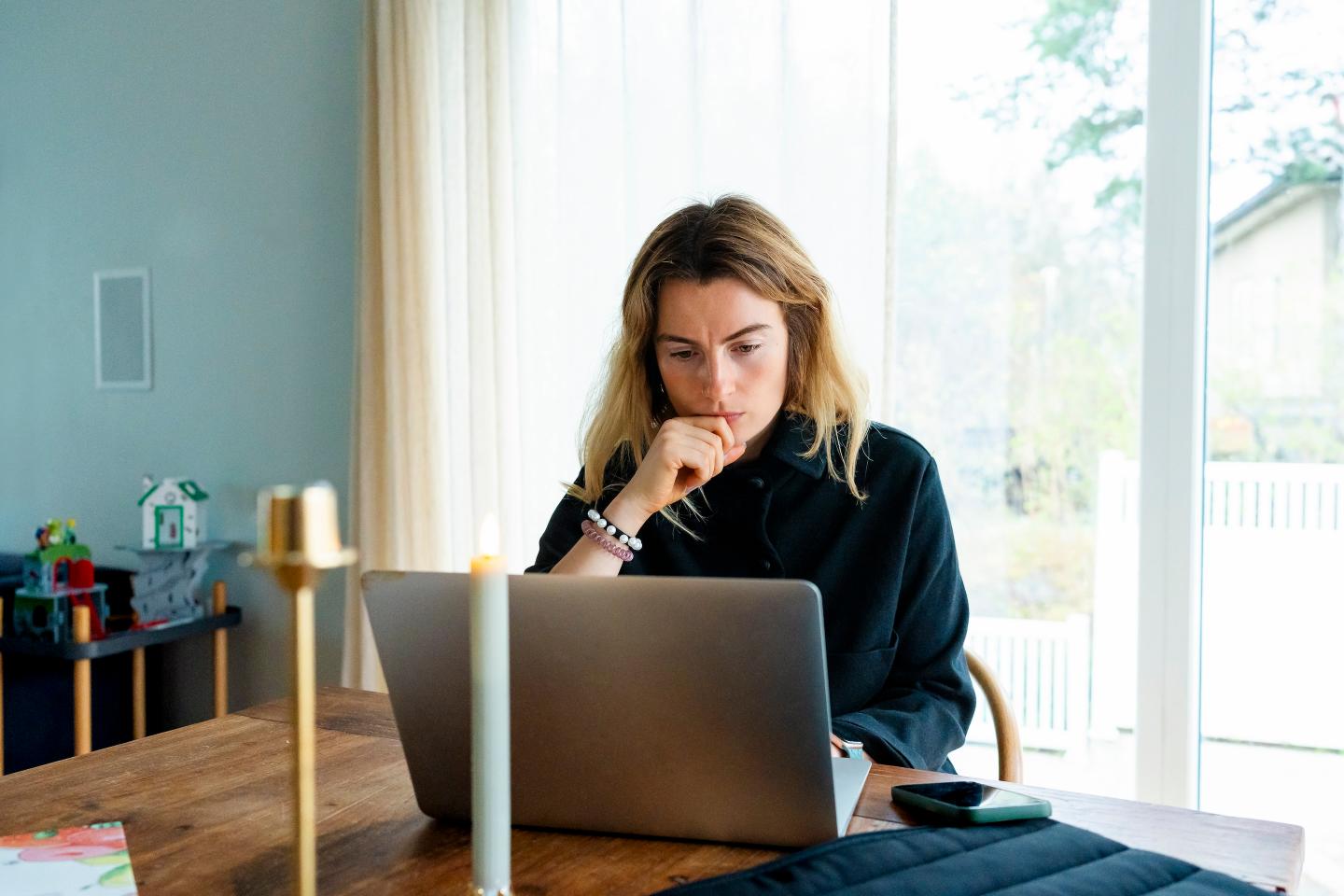
The appeal of working from home is no secret. No getting stuck in traffic or spending 30 minutes on a packed train, only to arrive at the office already tired. Instead, you’re in your pajamas next to your furry friend. And if you finish your work early, you can actually use that time to do laundry, vacuum the floors, or curl up on the couch with Netflix. Surely that beats killing time gossiping with coworkers.
But wait. Some of those conversations you were glad to escape may have been doing a job, too.
New research from Wharton management professor Peter Cappelli and University of Texas at Austin communications professor Y. Jasmine Wu suggests that working remotely can weaken “relational capital.” That’s academic speak for knowing whom to ask for help, feeling comfortable asking, and having a colleague willing to answer. You may not miss the office small talk. You might miss how easy it was to ask a quick question.
For the paper, “How Remote Work Is Reshaping the Office,” published online in July in California Management Review, Cappelli and Wu conducted 38 group interviews in late 2023 with roughly 760 employees at a multinational financial services company in the U.S., U.K., and India.
When employees said the work was getting done, they generally meant their own assignments and key performance indicators, or KPIs. Helping a colleague or showing a new hire the ropes was easier to push aside. Those tasks had often depended on personal relationships rather than formal job requirements, and the researchers found those relationships were weakening.
Sending a message was easy. Getting an answer was another matter. The company encouraged employees to use Microsoft Teams, but while some replied promptly, others put their own work first. Many defaulted to an “If it’s the end of my day, I wait until morning” attitude.
Knowing someone helped. The researchers found that employees who called familiar colleagues got help quickly; otherwise, help was more likely to be delayed. That’s especially hard for newcomers who haven’t built relationships at the company, a problem Cappelli has flagged before for entry-level workers. In the study, one relatively new hire with no work friends reported trying for three months to get an answer.
The authors describe a negative loop: Delayed responses can make people less willing to reach out again, which ultimately erodes the relationship further.
More meetings didn’t necessarily mean more connection, either. Employees described larger virtual meetings where people kept their cameras off and did other work, sometimes requiring follow-up meetings to cover what they had missed. Cappelli and co-author Ranya Nehmeh made a similar complaint in their book In Praise of the Office, writing for Fortune that remote work is making the workday longer and more transactional.
Who remote work helps
It might not be all bad. Some respondents saw less in-person interaction as a plus for women, minorities, and introverts. And working at home can make it easier to concentrate—that is, if you have a private space.
If employees enjoy working from home, wouldn’t a hybrid model be the perfect way to balance that preference with the need for face-to-face contact? Not as this company ran it.
Starting in the pandemic, supervisors were told to focus on individual deliverables. The company also cut office space to save money, leaving too little room for everyone to come in on designated office days. Shared desks made it harder to sit near the same colleagues regularly, and attendance requirements were inconsistently enforced. You could make the commute and still find your colleagues weren’t there.
The authors acknowledge that the interviews alone can’t prove working from home caused these problems, even if they believe it contributed. The study also can’t establish how widespread these problems are. They note that a self-care norm that took hold during the pandemic, when the company encouraged employees to prioritize their own well-being, may also have played a role.
To help colleagues reconnect, the authors recommend coordinating office days so teams and the colleagues they rely on actually show up together, and scheduling collective activities for those days. New hires also need more structured introductions to people beyond their own teams.
Helping colleagues keeps a company running, so it shouldn’t be treated as something people will do out of friendship alone. Cappelli and Wu argue that helping colleagues and mentoring new hires should be part of job descriptions and performance criteria, so those tasks don’t get pushed aside in remote work. Promotion decisions, they add, should also consider more than individual KPIs.
Cappelli, whom Fortune has called Wharton’s “great contrarian,” insists he isn’t against remote work. “The idea that remote work is obviously a good thing isn’t true,” he told Knowledge at Wharton.
Employees “seemed to highly value the ability to work from home,” the authors wrote. The challenge for management is making room for both the flexibility employees want and the teamwork the company needs. The dress code can be pajamas. Helping a colleague still counts as work.