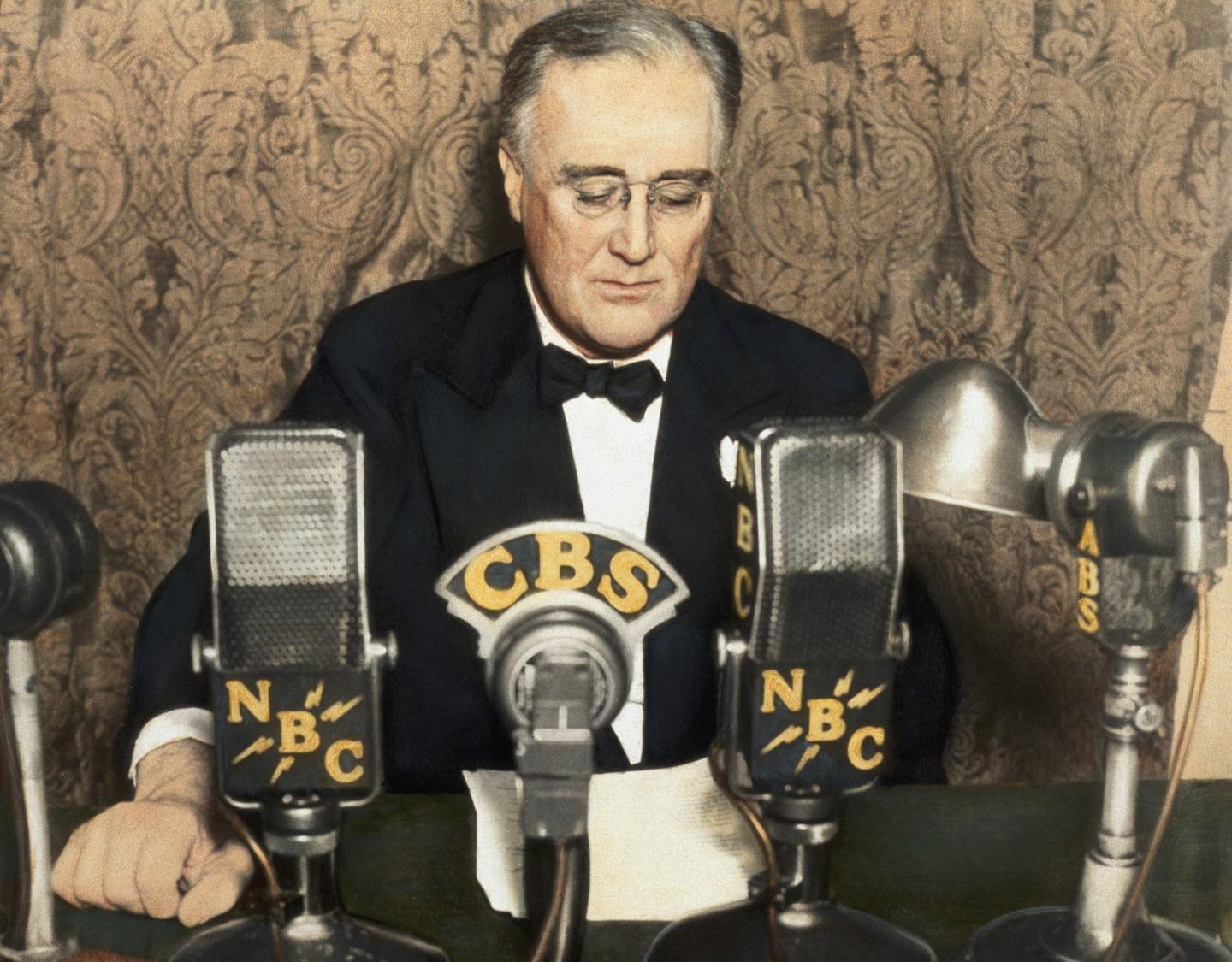
What’s the best way to regulate artificial intelligence companies? The surprising answer comes from Franklin D. Roosevelt. The 32nd president famously declared that “the only thing we have to fear is fear itself,” and in the critical field of financial markets, he rejected calls for a fear-driven federal takeover. Instead, he worked with Congress to create a novel mechanism for market participants to police themselves—without stifling the competition that best serves consumers and economic progress. A similar approach is needed with AI.
FDR was no free-market conservative, but neither did he give in to the statist demands coming from both sides of the aisle. Amid the suffering of the Great Depression, Wisconsin Republican Senator Robert M. La Follette Jr. and Colorado Democratic Senator Edward Costigan urged the Roosevelt administration to essentially nationalize the banking system. As the populist argument of the day went, industry leaders had proven reckless, justifying much greater federal control. La Follette and Costigan made this pitch to Roosevelt the night before Congress convened in special session, just days after the inaugural address in which he warned Americans not to be afraid.
Roosevelt himself was deeply critical of the financial industry, having declared in his inaugural that “the money changers have fled from their high seats in the temple of our civilization.” Yet he nonetheless rejected calls for bank nationalization in favor of a fundamentally different approach in the Securities Exchange Act of 1934. Rather than effecting a government takeover of markets, the law established a framework for “Self-Regulatory Organizations” that draw on the strengths of both the public and private sectors.
FDR’s insight was that the government that runs the post office isn’t best suited to regulate much more complicated financial markets. Instead, the self-regulating organization takes the day-to-day lead in devising standards, conducting oversight, enforcing rules, and punishing bad actors, drawing on its business members’ unique knowledge and real-world expertise. The SEC approves decisions from self-regulatory organizations, but the bureaucracy maintains a critical distance that allows competition to flourish.
Today, the most prominent organization is the Financial Industry Regulatory Authority, formed in 2007 by consolidating the National Association of Securities Dealers with the New York Stock Exchange’s member-regulation operations. FINRA is widely regarded for protecting investors while encouraging the innovation that expands accessible and affordable investing.
Compare the U.S. experience to Europe’s, where centralized government regulation is the name of the game. Our capital markets have flourished while theirs have struggled under the weight of government mandates. FDR’s model of self-regulated organizations has proven superior to both the largely unregulated capitalism that preceded the Great Depression and the strangling bureaucratic leviathan that threatened to follow it.
Could the same approach work for AI? Like the financial industry of the 1930s, the AI industry is currently largely unregulated, heightening fears that it could do widespread harm. It also faces widespread calls for a de facto government takeover, most notably Sen. Bernie Sanders’ June proposal to give the public a 50% ownership stake in the largest AI companies.
Also like the 1930s, the status quo seems untenable. But putting the federal government in control of this cutting-edge field would also be the quickest way to squelch its potential and give Communist China an unassailable lead, jeopardizing American global leadership when it’s needed most. Nor does it make sense to simply expand existing bureaucracies or otherwise give the government primary regulatory authority. Leading AI companies support that approach, likely because it would protect their own dominance from new entrants.
Congress should instead devise a 21st-century version of the Securities Exchange Act’s self-regulatory model. The best bill would include strong legal guardrails to prevent an organization from becoming anticompetitive or a shield for cartels. The self-regulation of the financial industry shows it can be done, as organizations like FINRA contributed to the democratization of finance that benefits everyday investors.
A self-regulatory organization is also preferable to the status quo. If AI companies are required to work together to devise industry-wide rules, they can check each other’s excesses and help ensure this advanced technology serves the common good. Such a system could also give Americans greater confidence that AI products adhere to strong standards. In the same way that no investor would use a securities broker not covered by FINRA, no consumer or business would use an AI product developed outside the bounds of a self-regulatory organization’s standards.
Franklin D. Roosevelt was right nearly a century ago when he warned Americans about the danger of fear. Today, that fear is contributing to calls for heavy-handed government intervention that is guaranteed to stifle the most revolutionary technology in decades, if not history. In the 20th century, FDR rejected bank nationalization to develop a common-sense securities framework that drew on the best of both the private and public sectors. In the 21st century, presidents and lawmakers would be wise to adopt the same strategy—not fearing AI, but creating a governance system that allows this technology to realize its potential as a source of hope and shared progress.
The opinions expressed in Fortune.com commentary pieces are solely the views of their authors and do not necessarily reflect the opinions and beliefs of Fortune.