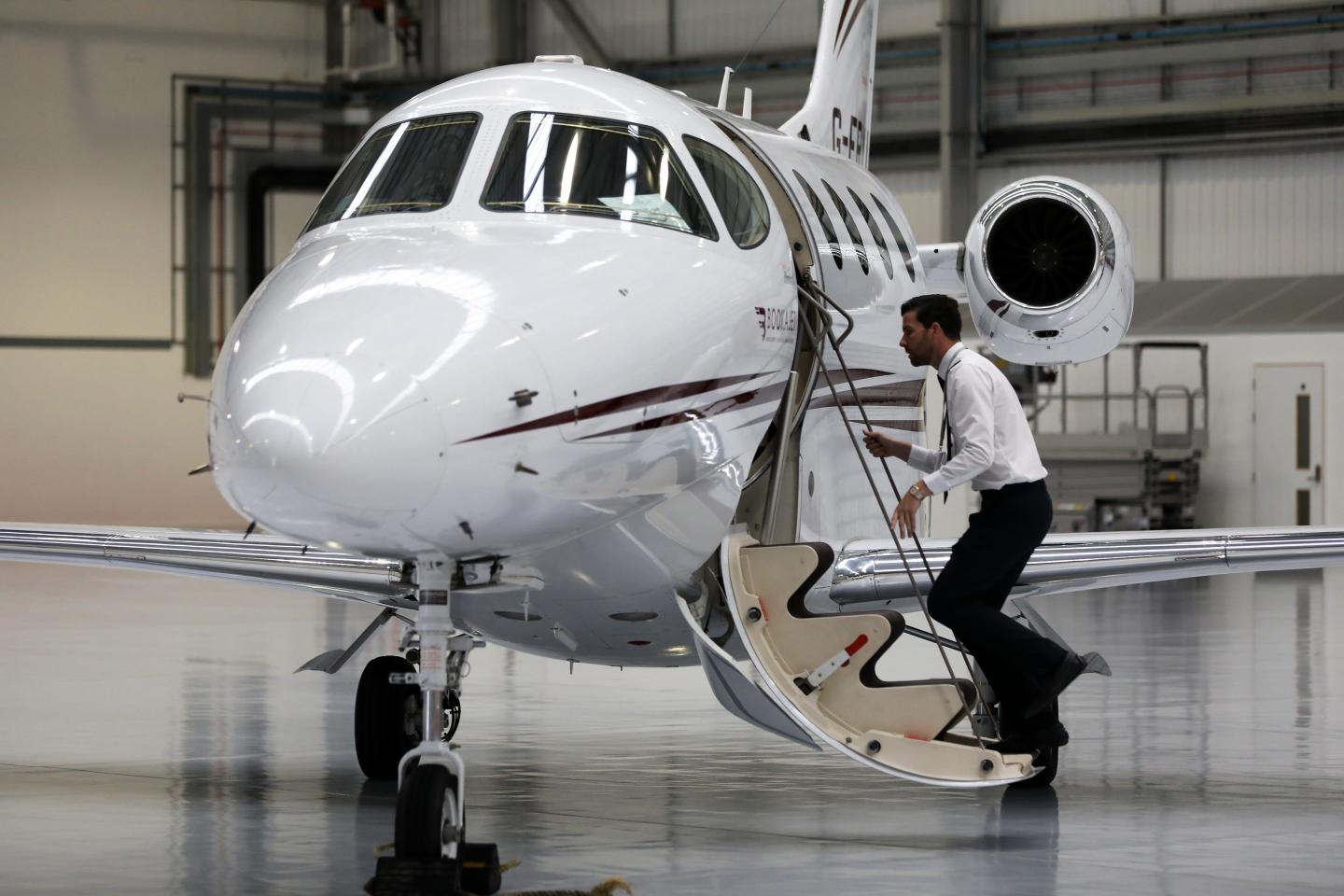
Getting a cheap ticket somewhere is as welcome a surprise as anything. There are whole forums devoted to award travel, entire companies and platforms searching for cheap flights, and shoestring travelers looking for the biggest bang for their buck. Whatever the price of the ticket, there’s one thing that’s for sure: taxes. Every time a traveler buys a plane ticket, 7.5% of the fare goes to the federal government. But those rich enough to zip through the skies in private jets aren’t subject to the same ticket tax.
That difference is one piece of what the Institute for Policy Studies called a “taxpayer subsidy” for private aviation in a September report. Noncommercial private jets account for about 7% of flights handled by the Federal Aviation Administration, but contribute just 0.6% of the taxes flowing into the fund that helps finance it, according to the Department of Transportation.
The private-jet class benefiting from this arrangement—which IPS estimates is 256,000 people, or just 0.003% of the global population—holds $31 trillion in wealth. IPS said they benefit in three ways: tax breaks on qualifying aircraft purchases, publicly-funded airport infrastructure, and an aviation-tax system in which private jets contribute far less than commercial travelers relative to their share of flights.
“Those are the menu of ways in which we all chip in for private jet travel,” Chuck Collins, coauthor of the report and director of the Program on Inequality and the Common Good at IPS, told Fortune. “We all subsidize this tiny segment of the ultra rich and their transportation.”
Private jets worth tens of millions bring in millions in tax breaks
Business is booming for private jets, with global sales reaching $40.3 billion in 2025, up nearly 24% over five years and growing at an annual rate of 4.7%, according to IPS. That increase in ownership, despite the pandemic, inflation, and high oil prices, is partly spurred by tax advantages.
Last year, President Donald Trump’s One Big Beautiful Bill Act restored 100% bonus depreciation for qualifying business assets, including private aircraft, which means an eligible buyer can deduct the full cost of a jet in the year it is put into service instead of spreading that deduction over several years.
Justin Crabbe, CEO of private jet marketplace Jettly, told Fortune he now sees companies buy $75 million private jets to “wash a lot of tax obligations off of their plate just by way of that purchase” instead of needing to fly them.
“We get a lot of people and inquiries [from] people that don’t even need the aircraft,” Crabbe said, explaining that buyers can then put the private jet into charter service so it earns revenue and can support the case for business-related use.
The IPS report illustrates the tax benefits with the example of a $40 million jet. IPS estimates the first-year deduction could reduce a buyer’s federal tax liability by as much as $14.8 million at a 37% rate, depending on the buyer’s taxable income, business use and other tax circumstances. However, IPS couldn’t calculate how much total federal tax revenue is foregone as a result of this tax provision.
But depreciation isn’t the only tax advantage. IPS said eight states—including Alaska, Oregon, and New Hampshire, which don’t have a general sales tax, and New York and Massachusetts, which do—have full or near-total sales tax exemptions on private jet purchases. In Massachusetts, where consumers pay a 6.25% sales tax on transport like cars and bicycles, the aircraft exemption will cost the state $25.3 million this year, according to an estimate from the Massachusetts Budget and Policy Center. Some Massachusetts lawmakers are trying to repeal the exemption with a bill introduced by Sen. Michael J. Barrett last year, but the Legislature’s revenue committee is reviewing it.
“The bicycle buyers of America are not a powerful lobby, so you have to pay sales tax, and you don’t get to depreciate your bicycle in one year,” Collins said.
The private jet lobby
Private aviation’s tax breaks have strong defenders. The National Business Aviation Association and other aviation groups argue tax breaks help support jobs while spending millions lobbying to preserve their favorable treatment. The NBAA, which represents 10,000 private aviation company and professional members spent a combined $3.4 million lobbying in 2024 and 2025, coinciding with the Big Beautiful Bill’s restoration of the 100% bonus depreciation for private jets, according to the IPS report.
The report also credits the trade group for fighting state taxes on private jet purchases. In Washington, NBAA opposed a 10% luxury tax on aircraft worth more than $500,000 that passed in May 2025 and urged private jet operators to “make their voices heard.” A bill repealing the tax then became law before the tax itself went into effect.
NBAA also opposed Massachusetts’ prior attempts to impose a luxury tax on aircraft purchases. During a 2021 fight, the group warned lawmakers that imposing its 6.25% sales tax on aircraft would put the state at a “competitive disadvantage” with its neighbors, forcing general aviation to move to other states and making Massachusetts lose its status as “a favorable location to base aircraft.”
There’s even currently a House version of a pending air-safety bill, the ALERT Act, which includes a provision that would block state and local officials from using aircraft-tracking data to identify and tax private jets, while the Senate version strips it out—with lawmakers racing to pass the bill before the midterms.
Taxpayers support private jets’ infrastructure
Private jet owners also benefit from taxpayer-funded airports and air traffic infrastructure.
The IPS report found that of the nearly $7.6 billion in federal Airport Infrastructure Grants awarded through August, about $1.3 billion went to smaller airports (with little or no scheduled passenger service) that mostly serve private jets and other general aviation. The report flagged over $1.1 billion in grants for projects with a “strong likelihood” of benefiting private jets, including hangars and runway improvements.
“Private jets don’t chip in their fair share of the use of the airspace,” Collins said.
Commercial passengers help fund that system through taxes on their tickets. Private jet owners do pay other taxes and fees, including fuel taxes and landing charges, but Crabbe noted private jets still use the same infrastructure.
“The controller has to work for the same aircraft that’s flying in with 400 people on board [as] it does an aircraft with nobody on board,” Crabbe said, estimating about half of private flights involve an empty plane. “The taxpayers are paying for these planes to be supported while they’re flying empty more often than not.”