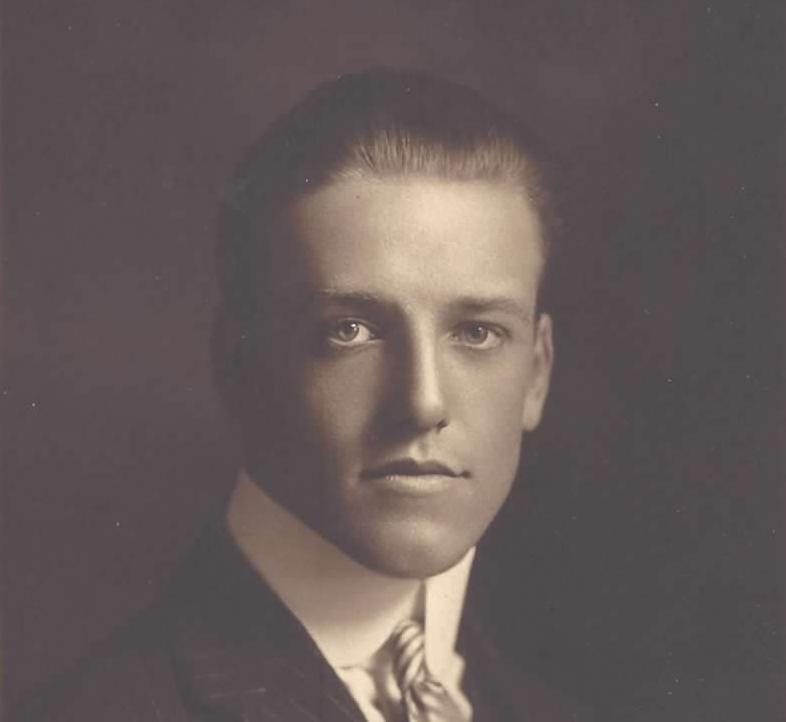
Florimond Duke knew how to sell a story.
Before the war, he had been the first advertising director of Fortune, a tall, square‑jawed Ivy Leaguer who moved easily through New York’s boardrooms and Fifth Avenue drawing rooms. He left a Connecticut mansion and a successful Madison Avenue career to join America’s new Office of Strategic Services, trading corporate clients for covert operations and moonlit airfields. In 1944, that unlikely résumé—part aristocratic polish, part marketing genius—made him the OSS’s choice to lead one of the riskiest deception missions of the Second World War.
Code‑named Operation Sparrow, the mission’s logic was brutally simple: if Duke could convince Hitler that the Allies would strike first through southeast Europe, the dictator would keep hundreds of thousands of troops far from Normandy when the real D‑Day came. It would be the biggest, most dangerous campaign pitch of Duke’s life, and his own body would be part of the message.
What follows is adapted from Operation Sparrow: The Secret Mission That Fooled Hitler and Saved D‑Day by Jason Bell.
By the Roaring Twenties, Florimond Duke had swapped muddy football fields for Manhattan’s glittering towers and the advertising department at Time Inc., where he earned more than generals and built a stock portfolio that made him a millionaire. In 1929, he became advertising director for Fortune magazine, a clean‑living exception in an industry fueled by liquor and exaggeration. No one ever saw him drunk, and people trusted him.
His name didn’t sound like the world he’d entered. DuSossoit—elegantly French but endlessly mispronounced—wasn’t built for elevator pitches and luncheon introductions. Friends had called him “Duke” since college, and in September 1929, he made it legal. A month later, the Great Depression hit. His salary fell, but he hardly suffered. He kept climbing through Time Inc., taking increasingly important positions in a growing publishing empire.
By 1939, as Hitler seized Poland, forty‑three‑year‑old Duke was wealthy, well connected, and under no obligation to fight. He volunteered anyway. The army commissioned him, then the newly created Office of Strategic Services recruited him into secret intelligence and special operations. In 1943, he was running the OSS’s southeast European section from Washington—planning missions from the Adriatic to the Black Sea, directing spy networks from Prague to Tirana.
On paper, he had the perfect wartime desk job: steering strategy, issuing orders, cracking secrets. But he wasn’t most men. The former Fortune ad director wanted field work. What he got instead was something closer to a corporate assignment—only the client was the Joint Chiefs of Staff, the target audience was Adolf Hitler, and the media plan involved commando drops and forged intelligence.
By early 1944, Allied planners faced a brutal math problem. Hitler still controlled most of Europe and had eight million Axis troops under arms. The Allies could put only about 150,000 soldiers onto the French beaches on D‑Day. Deception had to make up the difference.
As Winston Churchill put it, “In wartime, truth is so precious that she should always be attended by a bodyguard of lies.” The phrase gave its name to Operation Bodyguard, the most ambitious deception campaign in military history. One late‑game move would involve George Patton’s imitation army of fake tanks and bogus radio chatter near Calais. But the opening play—the one that would shape German force allocation months before the first landing craft hit Normandy—was Operation Sparrow.
Duke understood segmentation and positioning as instinctively as any Madison Avenue executive. Hitler was obsessed with the Balkans, a region he imagined as the ancient battlefront between his supposed Aryans and the Slavs he despised. He feared that an Allied drive through southeastern Europe could link up with the Soviets, strand German forces in Greece, and turn his defensive line from fortress into trap. In the spring of 1944, Germany kept 826,000 troops in the southeast—five times more than would land on D‑Day.
Allied strategists wanted to feed that fear. The top‑secret Bodyguard directive ordered pressure on the southeastern Axis satellites while threatening invasions against Greece, Bulgaria, Romania, and the Dalmatian coast, keeping Hitler’s troops far from France. Sparrow, conceived inside that directive, would work like a campaign iceberg. Above the waterline, Hitler would see what he already dreaded: unrest and Allied probing in the Balkans, reinforced by the “proof” of captured American commandos behind his lines. Below the surface lay the real objective: convincing him the main Allied invasion would strike there, not in France.
Then came the leak. In December 1943, American intelligence discovered that a Hungarian officer involved in quiet feelers to the Allies was feeding “very full particulars” of his connections to the Germans. Standard procedure said you cancel the mission when the enemy knows you’re coming. The OSS did something closer to a corporate turnaround. Instead of plugging the leak, they decided to exploit it.
Allen Dulles, the OSS spy chief in Switzerland, and Duke accelerated the Sparrow timeline. They suspected Hitler had only part of the story. A standard magician’s trick is to let the audience think they’ve uncovered the secret, when the real trick is something else entirely. The Führer believed he had unmasked a conspiracy to invade southeastern Europe—and that he would crush it. He had no idea he was stepping into an American ruse.
Building Sparrow’s “brand” meant choosing the right face for it. The OSS had already picked two top commandos: Major Alfred Suarez, a radio and explosives expert, and Captain Guy Nunn, a multilingual propagandist and labor organizer. They still needed a leader who could talk to prime ministers as easily as partisans, someone who could walk into a palace in Budapest and a Gestapo cell in Belgrade and sell the same story in different ways.
Dulles went to General William Donovan, the OSS’s founder. Donovan knew the right man was Florimond Duke. Tall, square‑jawed, his hair streaked with silver, Duke was the American equivalent of a British aristocrat. He could comfortably confer with admirals, generals, and nobles, yet he was also the Madison Avenue advertising maestro who had once persuaded corporate America to buy space in Fortune. For this campaign, Hitler would be the target customer.
Sparrow’s design reflected that heritage. German intelligence knew that documents could be forged and radio chatter planted. Commandos caught behind enemy lines were a different signal. A parachute team with unusually high ranks—a colonel, a major, a captain—could make the idea of a southeastern invasion feel credibly “over‑resourced,” just as a premium brand spends more than it needs to on a splashy launch. The trick was to have the mission fail in exactly the right way.
That failure would happen in interrogation rooms.
By April 1944, Duke was in Budapest, facing Gerhard Clages, the urbane Nazi security chief for Hungary. Clages wore tailored English suits and had an American accent from his prewar work in shipping; he could have passed for a board member at one of Duke’s Manhattan clubs. In their encounters, the former Fortune ad director used the same techniques he once deployed on skeptical clients: lay out enough information to be persuasive, hint at more just beyond reach, and let the listener connect the dots you want them to see.
Duke confirmed that his mission had been authorized by the Joint Chiefs of Staff and the U.S. State Department, then stopped short of mentioning the OSS or Hungary’s regent, Miklós Horthy. He acted like a man who knew more than he was willing to tell, dropping references to the Adriatic, Yugoslavia, and “coming operations” in the southeast, then pulling back. To Clages, the triangulated stories coming separately from Duke, Suarez, and Nunn—each matching in detail after weeks of isolation—felt too consistent to be a plant. To Duke, it was just disciplined message discipline.
“The Madison Avenue PR executive Florimond Duke had just pulled off one of the greatest advertising campaigns in the history of warfare,” Bell writes. The men who stormed Normandy won D‑Day. The spies who tricked Hitler, in conference rooms and prison cells, gave them the chance.
Adapted from Operation Sparrow by Jason Bell. © 2026 by Jason Bell, used with permission from Hanover Square Press, an imprint of HarperCollins.