
In September 2025, my organization teamed up with a few allies at Consumer Reports and More Perfect Union to run an experiment. Americans were rip-roaring mad about grocery prices, and we suspected that delivery companies like Instacart were making things worse. So we hatched a simple plan to test the theory.
Here’s how it worked: We recruited over four hundred volunteers from across the country to serve as secret shoppers. When I worked retail, I lived in constant fear of secret shoppers. Twenty-five years later, I was finally ready to exact my revenge.
Once we had our shoppers lined up, we asked them to join a Zoom call, pull out their phones, and shop for groceries on Instacart. Each volunteer was given the same task: Shop for a basket of about twenty grocery items from the same store in the same location, such as a Safeway. Our selected stores were in Washington, DC; Seattle, Washington; St. Paul, Minnesota; and North Canton, Ohio.
We kept the list simple: breakfast staples like a dozen eggs and a twelve-ounce box of store-brand Frosty Flakes; lunch-box regulars like a jar of Skippy peanut butter and a pack of Oscar Mayer turkey; produce like a Honeycrisp apple and a one-pound bag of carrots; pantry items like a box of penne pasta and a party-size bag of Ruffles. Once they selected their items, synchronized at the same store at the same time, they took screenshots of their carts, capturing both the total and the price of each individual product. It was straightforward enough.
Then we crunched the numbers—and that’s when things got weird. So weird, in fact, that I asked the team to run the numbers again just to be sure. They did. And here’s what we found: Nearly 75 percent of the items in those Instacart baskets varied in price from one shopper to the next. A dozen Lucerne eggs at the same Safeway in Washington, DC, cost $3.99 for some shoppers and $4.79 for others—a 20 percent increase. Across the board, the average price difference for the same items was around 13 percent, but some shoppers were charged as much as 23 per-cent more. For certain products, there were as many as five distinct prices.
Basket totals varied too—by about 7 percent on average. That may not sound like much, but when we ran the math using Instacart’s own estimate of annual grocery spending, that 7 percent worked out to more than $1,200 a year for some households. In many cities, that’s a month’s rent.
It wasn’t long ago that if you and I were standing in the checkout line buying the same box of Cheerios, we could be reasonably certain we’d pay the same price. And if you were charged more, you’d assume the cashier made a mistake. We expect prices to be consistent—and that expectation is core to how we understand pricing for essentials like groceries.
But over the last few decades, that tacit promise has quietly unraveled. The entire idea of a true or standard price has started to feel like a relic.
In fact, for thousands of years, variable, personalized pricing was the norm. As early as 6,000 BC, shoppers in the ancient Middle East haggled over everything at bazaars, souks, and marketplaces. Haggling was the original form of personalized pricing. If the shopkeeper didn’t like you or your family, you probably paid more. If you knew he was stepping out on his wife, you paid less. That’s how it worked.
Most historians credit the Quakers with the rise of fixed prices in nineteenth-century America. Dispirited by what they saw as the greedy, dishonest, ungodly practices of Puritan haggling, the Quakers introduced a new model: If “all men were created equal under God,” all men should pay an equal amount at the checkout counter.
Fixed prices eventually gave rise to the price tag—first used, by many accounts, by John Wanamaker in the 1870s at his department store in Philadelphia. Wanamaker, was a devout Presbyterian who shared the Quaker belief that haggling was unfair. But he was also a businessman—and the price tag made business sense.
Haggling was labor intensive. Wanamaker wanted shoppers to linger in his Crystal Tea Room and fill their carts with shoes, cuff links, and lipstick—not waste time at the register. Price tags streamlined the process. They were both ethical and efficient: public, uniform, and easy to compare. They helped shoppers on a budget to plan ahead and gave everybody the same deal.
But today, that public price is eroding. Pricing, especially online, looks less like a trip to Wanamaker’s and more like a visit to the souk—only instead of sizing up your tunic, companies are analyzing an elaborate social graph of your demographic, behavioral, and financial data before deciding what to charge you. It’s like if the merchant from the souk was sneaking into your house, rummaging through your belongings, and then deciding what to charge you based on what he finds.
When setting prices, corporations have stopped asking how much something should cost, and started asking how much you will pay. They hire highly-paid pricing strategists to test which marketing messages, design tweaks, or psychological nudges are most likely to trigger a purchase—especially a higher-priced one.
We chose Instacart as the focus of our study in part because we suspected our experiment would expose theirs. About a year earlier, in October 2024, I came across a company called Eversight—an AI pricing firm whose software allowed companies to run continuous, automated pricing experiments directly on shoppers. The platform enabled retailers to devise and test millions of price permutations in real time, dramatically expanding their ability to probe just how much customers would pay before hitting their pain point. Instacart acquired Eversight in 2022, and by the time we fielded our study, the company was off to the races.
New technologies are being deployed across nearly every sector in our economy to industrialize price experimentation and wallet extraction at scale. With this treasure trove of experimental data at their disposal, companies are developing all sorts of ways to measure how price sensitive each of us is. They are developing consumer intelligence and sensitivity scores, built to help them tailor prices, discounts, and offers. Doordash, for example, amasses data on 16 different indicators, such as how jerkily you scroll or how much time has passed since your last order, and uses this data to craft an ‘agitation score’ – their attempt at predicting how hungry you are. Scores like these can follow shoppers all across the economy, for the duration of their financial lives. More “sensitive” consumers get the deals; the rest of us get fleeced.
Companies are also deploying surveillance technologies to profile and case customers with the same cold precision criminals use to size up their victims. Retailers track your purchases, browsing habits, location, device type, and even the charge left in your phone battery to determine exactly how much they can extract from you, down to the penny. These technologies now make it possible to create a bespoke price, tailored to you alone. Your economics professor may have called this first-degree price discrimination. These days, surveillance pricing—or simply personalized price gouging—feels far more accurate.
Here are a few examples. In 2012, Orbitz began showing different search results to Mac and PC users. At first, it denied that users were being shown different prices based on the make of their machines. But later that year, Orbitz came clean and confirmed to The Wall Street Journal that computer users were paying as much as 50 percent more than customers on their phones. And Expedia was caught charging visitors who logged on from wealthier regions of the country more for an identical hotel room in Manhattan.
Retail stores like Target and Staples engage in price discrimination based on app usage, location, and browsing data. Target’s app was found to be charging users more if it detected that they were in a store—under the assumption that they were more likely to purchase. When users walked out of the store and out of range, prices on the app were seen to decline. In a statement, Target confirmed that app prices can vary between in-store and off-site locations. The Wall Street Journal revealed that Staples, the office supply store, charged higher prices to customers in zip codes where competitors like Office Depot were located farther away, presumably because they knew those customers wouldn’t be able to quickly go elsewhere for a lower price.
Delta is another culprit. When Ed Bastian, Delta’s CEO, joined CNBC’s Squawk Box to preview his November 2024 “Investor Day” remarks, he boasted that the company would generate sustained, durable, higher profits and $50 billion in operating cash over the next three to five years. It was a bold claim –so bold that the hosts of the popular morning show, best known for treating Fortune 500 CEOs with kid gloves, started peppering Bastian with follow-up questions.
The interview was curious in many respects. Airlines don’t typically expect to see big boosts in profits from one year to the next, and many investors stay away from them for that reason. So what could possibly explain Delta’s confidence in their ability to upend history? Later that day, we got a pretty big clue.
The answer was in Delta’s embrace of AI. Bastian said the technology would “allow us to figure out how we can drive the optimal revenue premium.” He went on to ask rhetorically, “Is there opportunity to do better? I think there might be.” When Bastian finished his remarks, Glen Hauenstein, the company’s president, made a big announcement—one that mostly flew under the radar at the time. Delta would be undergoing a “full reengineering of how we price and how we will be pricing in the future.” Thanks to a new partnership with Fetcherr, an Al start-up specializing in pricing technologies, the company was about to supercharge its pricing.
Fetcherr was the key to unlocking higher fares for travelers and higher profits for Delta. The company had piloted a program to let Fetcherr price 1 percent of the company’s routes to study the extent to which the AI could deliver on its promise of higher revenues. As Hauenstein explained, “Generally, we match our competitors’ fares and they may or may not be available. But if we take small increments and say to Tokyo, could we take a $20 increase in our fares and not see a decline in market share? Could we take a $40? It’s doing that real-time now.” In other words, Fetcherr would be testing the outer limits of what Delta could charge for every single route before losing customers to the competition. The early results were promising, to say the least.
But there was more. About six months after Delta’s soft launch of its partnership with Fetcherr, the company had an update. In its July 2025 second-quarter earnings report, Hauenstein shared that Fetcherr was now behind the pricing decisions of 3 percent of Delta’s domestic network, with the goal of handing over a full 20 percent by the end of year. “We like what we see. We like it a lot…,” Hauenstein declared triumphantly.
There it was. Investors now understood the reason Bastian had appeared so bullish on Squawk Box a few months earlier. Delta was planning to make major advances in its ability to overcharge its customers, especially the wealthiest ones, and it was well on its way to cruising altitude. A white paper entitled “Alien Intelligence in the Boardroom: Generative Al’s Innovative New Market Strategies,” authored by Fetcherr’s cofounder and chief AI officer, described the company’s product as having two phases: an “exploration phase,” in which the system would learn the contours of the marketplace, and an “exploitation phase,” in which “the system’s true potential is realized, as evidenced by a significant, double-digit revenue uplift for the business.” The exploitation phase—that was Delta’s big bet.
But there was one more thing. Fetcherr aimed to help companies with personalized pricing too. In a 2024 blog post that has since been removed, the company said its future outlook included “individualized pricing,” allowing airlines to understand “each customer as an individual, optimizing every interaction for maximum value.” Analysts on the call loved this idea, telling Delta that “the Holy Grail on Supply and Demand is sort of meeting each and every individual’s personal demand curve.” Hauenstein gleefully concurred.
When my organization helped to expose Delta’s plans, public outcry predictably ensued. Lawmakers in Congress penned stern letters to the company. The CEO of American Airlines even weighed in saying he didn’t think what Delta was doing was “appropriate” and promised, “it’s not something we will do.” Eventually Delta relented.
At this point you might be asking yourself: So what’s the big deal? Isn’t this just capitalism? Aren’t companies supposed to be making as much money as they possibly can by charging you as much as they possibly can? I’m sure you can find plenty of economists and CEOs who will tell you that there’s nothing to see here. Some will even argue that any price willingly paid is, by definition, fair. If you buy it, it’s fair–end of story. But I think they’ve got this one all wrong, and according to polling, most Americans do too.
It’s not too late to save the humble price tag.
Once we published our Instacart study, a few things happened. First, it went viral. Yes, apparently a white paper can go viral. It landed on the covers of both The New York Times and the New York Post. Tens of thousands of consumers signed a petition to put a stop to these pricing practices. Lawmakers penned oversight letters to Instacart demanding answers. About a week later, the Federal Trade Commission launched a formal investigation into the company’s pricing experiments.The company’s stock price plunged.
And then, just two weeks after our study was released, Instacart posted a stunning announcement on it’s website: “Ending Item Price Tests on Instacart.” Gone was the evasive legalese. Gone were the pretzel-shaped denials. In bold typeface, the company finally came clean, pledging—effective immediately—to “[end] all item price tests on our platform.”
It was a remarkable reversal. A multibillion-dollar tech company that had once viewed its AI-driven pricing experiments as the crown jewel of its business model had been brought to heel—by a citizen-led investigation and the groundswell of consumer backlash it unleashed.
But it’s not just Instacart. Something is stirring.
Roughly 90 laws in 27 states have been introduced in the past two years alone to rein in algorithmic pricing, including many laws to ban surveillance pricing, the creepy practice of using your personal data to spy on you and overcharge you. From Senator Josh Hawley to Senator Elizabeth Warren, there is growing interest from both parties in bringing these companies to heel. And they’re right to spring to action; corporate price gouging is a top concern for Americans.
A few companies are even taking the high road—gambling that consumers will reward them for fair, transparent pricing. This is just beginning; we’re not there yet. But consumers are fed up, and the tide is slowly turning. And together, we can restore a fair price in America.
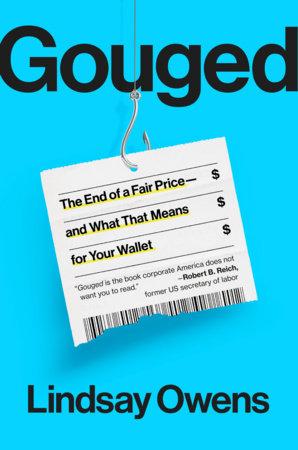
This excerpt was adapted from GOUGED: The End of a Fair Price – and What That Means for Your Wallet by Lindsay Owens. Published by Viking, an imprint of Penguin Publishing Group, a division of Penguin Random House LLC. Copyright © 2026 by Lindsay Owens.