The bond market is today by far the biggest, broadest, and most important part of the global financial system.
By the middle of 2025, there were at least $188 trillion worth of bonds outstanding, according to the Bank for International Settlements. They were issued by everyone from the Japanese government, ExxonMobil, and the World Bank to American high schools, Sri Lankan banks, and the Church of England. By comparison, the world’s stock markets were valued at roughly $130 trillion.
More importantly, bonds are also almost certainly bigger than the traditional banking system—and probably crossed that mark sometime in the past decade, for the first time since both were invented a millennium ago. If you count the assets of all banks around the world, the tally totals roughly $190 trillion, but much of this is actually in the form of bonds and bond derivatives, rather than mortgages and other classic types of loans. The distinction matters in myriad ways.
Bonds are often thought of as interchangeable with loans and are treated generically as debt. That is a mistake. Yes, bonds are debt too. But their form is fundamentally different. They behave differently at crucial times. The opportunities and challenges that the bond market’s growth entails are therefore also fundamentally different. In fact, how we grapple with the ascendance of fixed income markets is one of the defining conundrums facing finance today.
To take just one example, America’s biggest lender is no longer a bank, it is actually BlackRock, an investment group. At the end of 2025, BlackRock holds roughly $3.2 trillion in bonds on behalf of its customers, which range from central banks, sovereign wealth funds, and huge insurers to humble pension plans and ordinary people saving for a rainy day. That outstrips the $3.1 trillion of debts that JPMorgan holds on its balance sheet. In fact, over half of those debts are in the form of bonds.
This is no accident. In fact, it is a consequence of a century of political choices. While JPMorgan faces a vast and onerous regulatory burden—a legacy of all the financial crises caused by bank failures—BlackRock is still relatively lightly regulated. There are good reasons for this. Banks are truly very different beasts from investment managers. Yet the diverging political and regulatory attention paid to the two industries makes increasingly little sense, given the bond market’s growing primacy in the financial system, and its ability to also cause mayhem.
There are enormous economic consequences as well. Modern capitalism has largely been ordered around the view of banks as the focal intermediaries of money. Central banks were mostly set up initially to backstop banks and eventually began trying to regulate the temperature of economies by tweaking the cost of their funding by moving their overnight interest rates up and down. Yet with the rise of bond markets, entirely new challenges have emerged and experimental tools to deal with them have become necessary—most notably enormous bond-buying programs dubbed “quantitative easing.”
After all, if the ultimate goal of a central bank is to regulate the temperature of an economy by changing the cost of credit, then the fact that credit is increasingly extended by the bond market rather than banks inevitably has consequences. In fact, it is no understatement to say that the growing ascendance of the bond market, and the legion implications that flow from this phenomenon, is the defining issue for finance and economics today.
The response to the 2008 financial crisis made the shift impossible to miss. After cutting short-term rates sharply, the Federal Reserve began directly purchasing long-term bonds, including securities issued by Fannie Mae and Freddie Mac and mortgage-backed securities they guaranteed. The aim was to lower yields, reduce the cost of credit, and support housing and financial markets.
The policy was extraordinary in scale. By 2016, the Federal Reserve’s balance sheet had risen to about $4.5 trillion, more than a fourfold increase since the eve of the financial crisis. quickly became one of the most controversial elements of central bank efforts from 2008 onward to fight the crisis and then stimulate economic growth. Proponents call it one of the boldest financial experiments in history; critics say the most reckless. Despite there now being over a decade of exhaustive studies and even more exhaustive debates on the subject, many economists still cannot agree entirely whether QE works—and if it works, how it works.
At their best they are dependable and safe. Bonds have therefore long been considered the most boring bit of finance, the dour, dependable sibling to the racier, more glamorous stock market. Fixed income has occasionally cropped up incidentally in literature—The Great Gatsby’s narrator, Nick Carraway, and Sherman McCoy in Tom Wolfe’s The Bonfire of the Vanities were both bond salesmen—but never in popular culture in the same way as stocks. When fixed income does appear, it has often been to signify dreariness. Ian Fleming chose the name Bond for his spy because he thought it was “the dullest name I’ve ever heard.”
Nonetheless, bonds have played an integral if underappreciated part in humankind’s evolution from subsistence farming to the modern era. The original “decentralized finance” has funded everything from wars, ports, highways, and coal mines to electric cars, Netflix TV series, and the data centers that now power artificial intelligence.
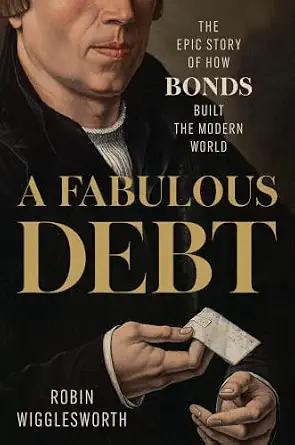
Adapted and condensed from A Fabulous Debt: The Epic Story of How Bonds Built the Modern World by Robin Wigglesworth, in agreement with Portfolio, an imprint of Penguin Publishing Group, a division of Penguin Random House LLC. Copyright © Robin Wigglesworth, 2026.