
Good morning. On Fortune’s radar today:
- Anthropic’s $2 trillion IPO prospectus leaked.
- Markets: Oil and bonds are driving the drama.
- The equity risk premium on stocks over bonds has collapsed.
- Private credit lenders are girding for trouble.
- What would happen if they closed the Panama Canal?
- AI hyperscalers need $300 billion in revenue to cover their costs.
- Stinking rich: The infamously smelly durian fruit is a $7.4 billion industry.
ONE BIG THING
Anthropic’s $2 trillion IPO prospectus leaked—here’s a snapshot of its income statements
A draft of Anthropic’s $2 trillion IPO prospectus was leaked to Reuters and we now have details about the AI lab’s finances. The financial statements will look like this, per the S-1:
FY 2025
- Revenue: $4.6 billion.
- Operating expenses: $13 billion.
- Operating loss: $8 billion-plus.
- Net loss: $42 billion.
- Cash and cash equivalents on hand: $20.28 billion.
Q2 2026
- Revenue: $11.5 billion (up from $4.73 billion in Q1).
- Will be profitable on an operating basis for a second straight quarter.
- Plans to spend $518 billion on cloud services and data centers.
Obviously, we’re still missing many details.
CEO Dario Amodei devoted more than one-third of the S-1 to warnings about Anthropic’s business risks, including “existential risks to humanity,” the FT reported, “including the potential of increasingly advanced AI models to manipulate, blackmail and exhibit other unpredictable behaviours.”
Customer concentration is another risk: A quarter of Anthropic’s revenue comes from just two clients.
- Here’s a non-paywalled version of Reuters’ story.
- Anthropic's path from AI startup to industry-defining IPO - Yahoo
- OpenAI axes next model citing safety issues - FT
- Anthropic leaders to control AI lab to promote public good over market forces - CNBC
MORE FROM FORTUNE
When AI Becomes Management | Fortune Daily
Inside Danny Meyer’s promote-from-within culture: 80% of his GMs started as hourly staff - Diane Brady
The bill has come due. But no one wants to pay for climate mitigation - Stephanie Walton
The bond market has outgrown the banks - Robin Wigglesworth
The man who looked into the ‘actual beating heart’ of the financial system—and saw something ‘profoundly dangerous’ - Nick Lichtenberg
The U.S. should be ‘more confident’ and less worried about losing ground to China, says Peking University expert - Angelica Ang
THE MARKETS
Oil prices are driving a selloff in the bond market, and stocks don’t know where to go
S&P 500 futures were flat this morning after mixed trading in Europe and Asia. The U.S. index closed down yesterday.
The real drama is once again in the oil and bond markets, however. Oil was at $105 per barrel this morning. It has been over $100 for roughly five straight days. That’s likely inflationary, and traders reacted by selling out of bonds. The 10-year Treasury breached 5.26% in the last few hours, although it fell back to 5.24% at the time of writing. Oil and bond yields are moving in lockstep: The higher oil goes, the greater the risk premium investors demand to hold debt.
“If central banks seemingly care about oil, the only policy remedy is to weaken the non-oil economy, as something they can control. In that case, higher oil prices make it more likely interest rates will have to rise to recession-inducing levels. We are not at that stage, but there are enough oil price comments to have markets contemplating more repressive monetary policies,” UBS’s Paul Donovan told clients this morning.
- S&P 500 futures were flat this morning. The index fell 0.77% on Friday.
- In Europe, the Stoxx 600 was up 0.46% in early trading, and the U.K.’s FTSE 100 was up 0.37% before lunch.
- Asia: South Korea’s KOSPI was down 0.27%. Japan’s Nikkei 225 was down 0.6%. India’s Nifty 50 was down 0.49%. China’s CSI 300 was up 0.10%.
- Brent crude rose to $107 per barrel this morning.
- Bitcoin was at $83,792.
The risk premium for holding stocks over bonds is disappearing
The Equity Risk Premium—which measures the market’s estimate of the future returns from the S&P 500 versus what you’d get from holding 10-year Treasury notes—has largely disappeared, according to Fortune’s Shawn Tully.
Today, for every $100 invested in the S&P 500 you’re getting about $3.80 in earnings. For every $100 in 10-year TIPS, you’re guaranteed about $2.86 a year above inflation. The difference, less than $1, is your reward for riding out the stock market’s swings. But historically, that reward has averaged roughly $3.50.
Private credit braces for pain as lenders tighten the screws
The current U.S. expansion has lasted six years. That makes it one of the seven longest on record, as this chart from Henry Allen at Deutsche Bank shows.
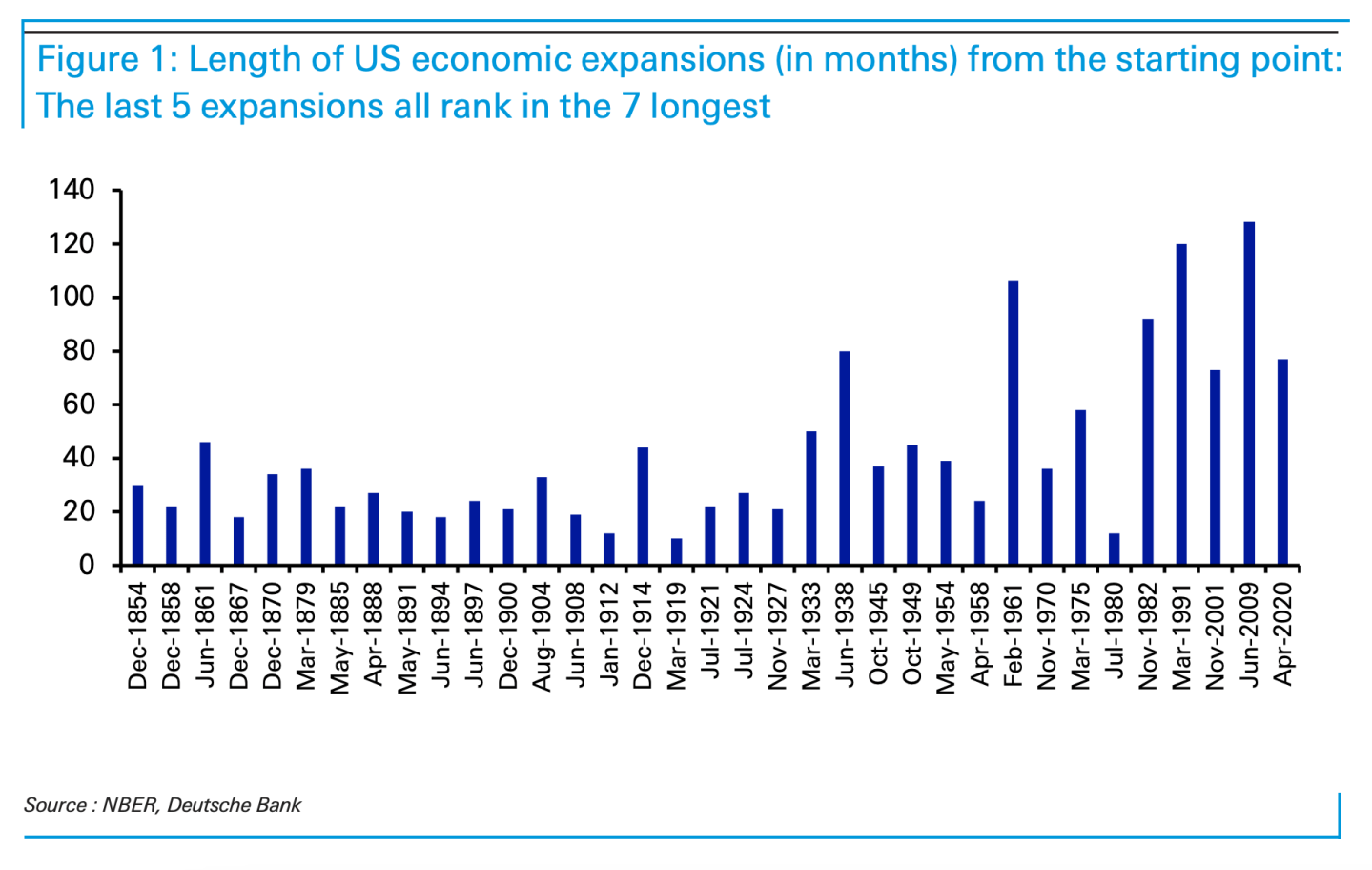
In that context, Wall Street is now actively wondering how much longer this can last before there is a recession or a major correction in the markets. The recent rise in bond yields—making credit more expensive for anyone who borrows—is one such harbinger of doom, according to Macquarie’s Thierry Wizman. “Any rapid rise in bond yields (from whichever cause) can fall disproportionately on one company, lender, or whole sector that had over-leveraged. In the current context, that over-leverage may have happened during the low-yield environment of 2021,” he told clients in a recent note.
He is particularly concerned about private credit—the market in which banks and business development companies lend money at high interest rates to private companies. “Where might the stresses show up this time? One place to scrutinize might be those areas that saw relaxed underwriting standards, high leverage-to-EBITDA ratios, and covenant-lite structures since 2021,” Wizman suggests.
He’s right to be concerned, according to the team at Noetica, part of Thomson Reuters. Private credit lenders are becoming more aggressive about protecting their bets, their data shows. “Creditors have stopped treating bankruptcy risk as a tail scenario and started pricing it as a base case,” their report on the first half of 2026 states.
One example of this phenomenon is the increasing use of legal terms in private credit loan documents that restrict borrowing companies’ rights. Here’s one example: So-called “J. Crew blockers” can now be found in 50% of private credit agreements, up from 35% in 2025. (A “J. Crew blocker” is a legal requirement that prevents a company from transferring its intellectual property to another company where it can’t be touched by the lender, or creating subsidiaries which are out-of-reach of the terms of the loan—something J. Crew once did to evade its creditors.)
"What counted as an aggressive lender ask a year ago is now market standard. Borrowers negotiating off older precedent are already behind, and when lenders are protecting themselves this hard, it's fair to ask where we are in the cycle,” Noetica VP Dan Wertman told Fortune.
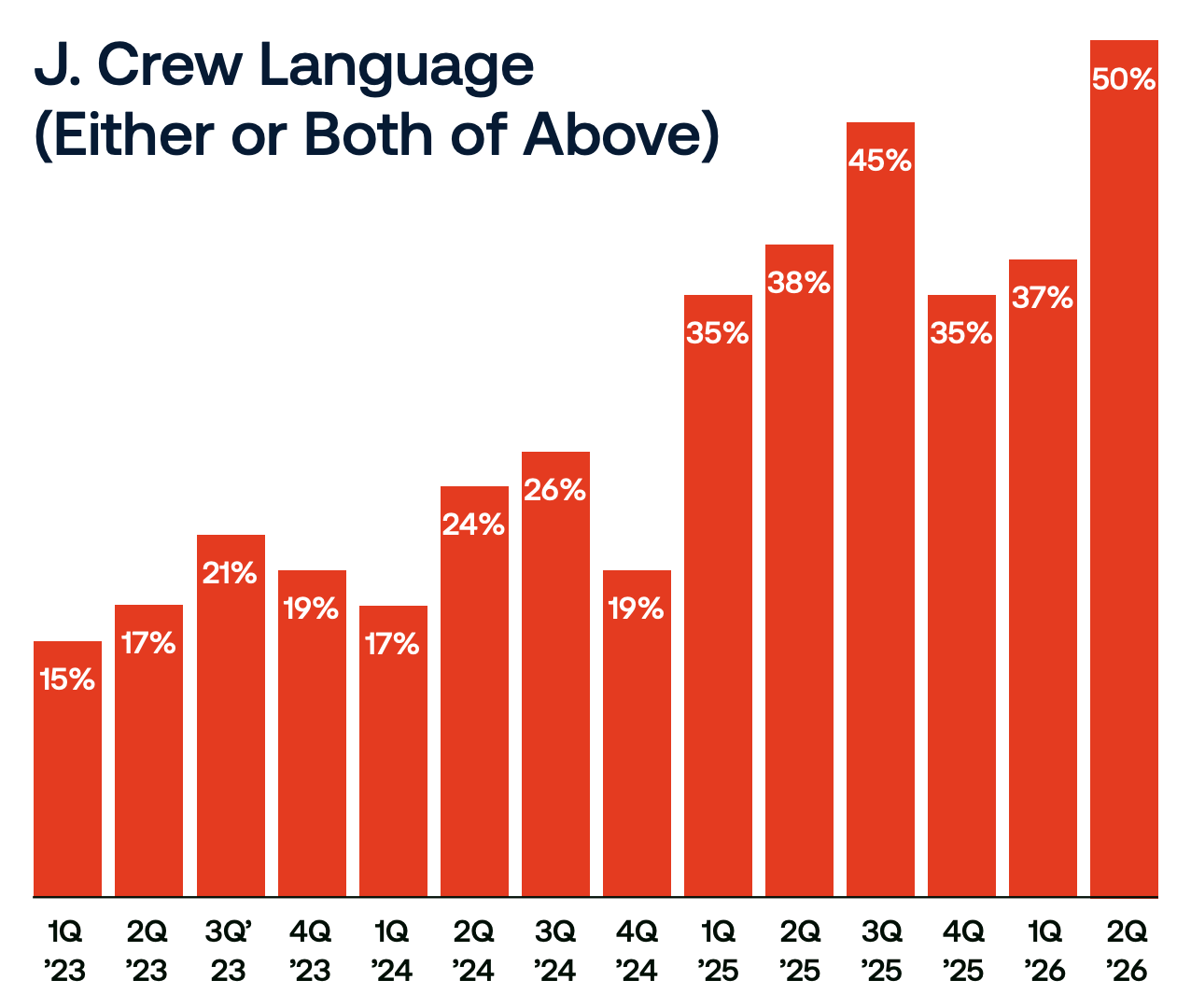
CHART OF THE DAY
Forget about the Hormuz. Closing the Panama Canal would do the most damage.
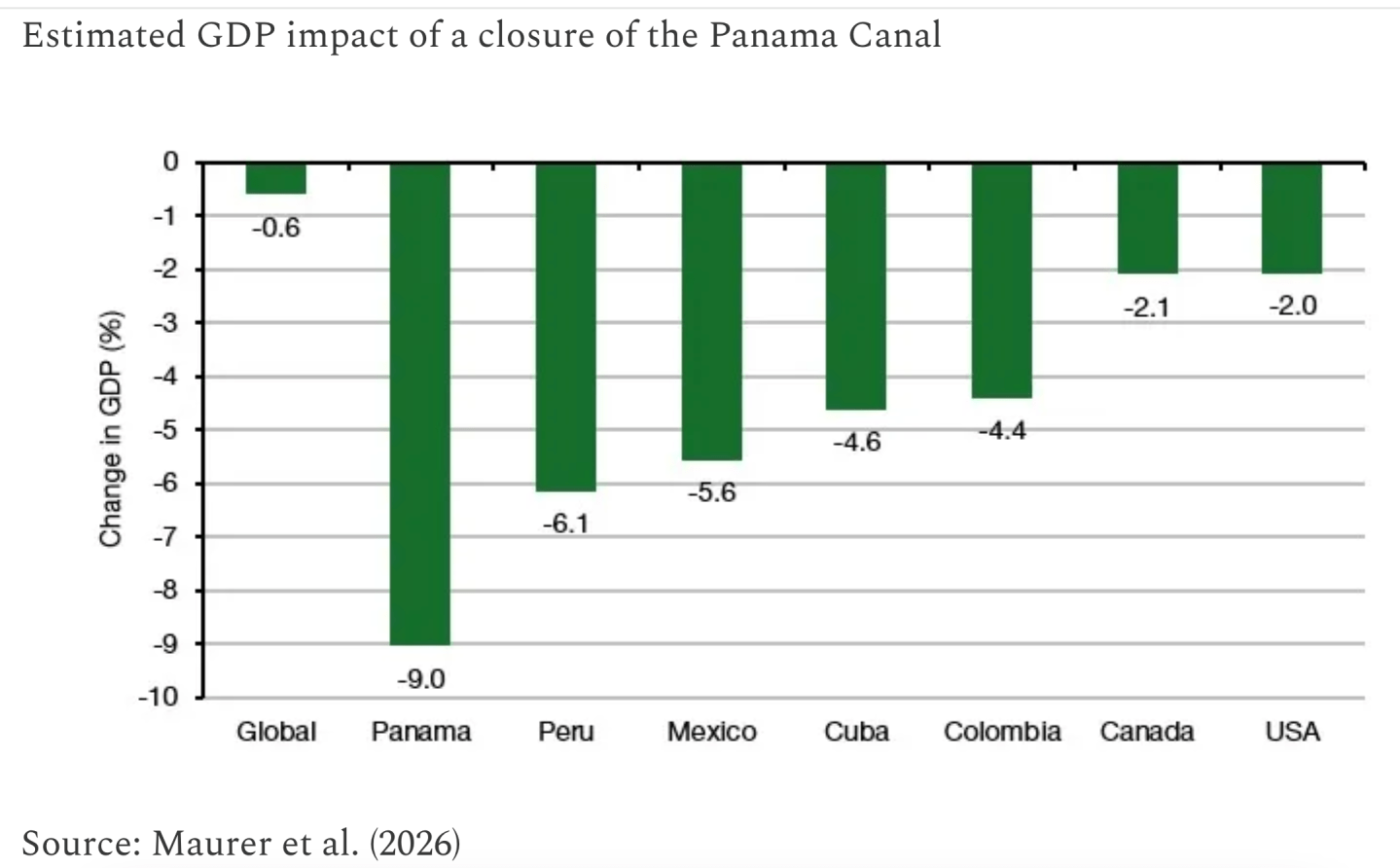
This chart shows estimates of the hit to GDP that would be taken by the countries most affected by a putative closure of the Panama Canal. Panama, of course, would be hurt the most—losing a staggering 9% of its GDP. But the U.S. could take a 2% hit and the world as a whole would see a 0.6% decline, according to a new-ish discussion paper from the Center for Economic Performance (which Fortune first read about on Joachim Klement’s Substack.)
NUMBER OF THE DAY
$300 billion
The amount of revenue needed by the major AI hyperscalers over the next few years to cover their capex spending on data centers and chips, according to Ryan Hammond and his colleagues at Goldman Sachs. Currently, their AI revenues remain below that number. However, “The three major US public cloud companies (AMZN, GOOGL, MSFT) have also announced a combined revenue backlog of $1.7 trillion,” Goldman points out—and if that pipeline comes good, there’s no need to panic.
THE FRONT PAGES TODAY
The booming business of insuring against US gun violence - FT
Mistral CEO says U.S. AI safety debate masks competitors’ ‘negligence’ - CNBC
Trump offers Iran economic relief for concrete nuclear concessions - Axios
The ‘Colossal Headache’ of Building a Made-in-America Monopoly Game - WSJ
X Blocks Nearly 500 Accounts in Turkey After Fund Market Crisis - Bloomberg
Embarrassing Breach at F.B.I. Fuels Fears of Harm to Its Employees - NYT
Goldman Sachs discusses plan to name John Waldron next CEO, succeeding David Solomon - NY Post
ONE MORE THING
Durian, the fruit that stinks so bad it’s banned from planes, is now a $7.5 billion export business
Have you ever eaten a durian fruit? You’d know if you have. Its rich, creamy taste is accompanied by the powerful smell of rotting garbage. Durians stink so bad they’re banned from many Asian public transport systems. In Indonesia, a flight was once cancelled because a passenger brought a durian on board.
Now the Malaysian durian industry is pushing to increase exports, the AP reports. Don’t worry. Big Durian’s Malaysian lobbyists are under no illusions that durian will gain masses of new international fans. Rather, they want to steal global market share from Thailand, which until now has dominated the durian export business.
Malaysia’s plan working. In 2025, China imported $7.5 billion-worth of durian, a six-fold increase in volume over the previous 10 years. In the first half of 2026, Malaysia quadrupled its durian sales to China from the year before.
- Would you like to sponsor this newsletter? Contact Polly Raven (polly.raven@fortune.com) for details.