
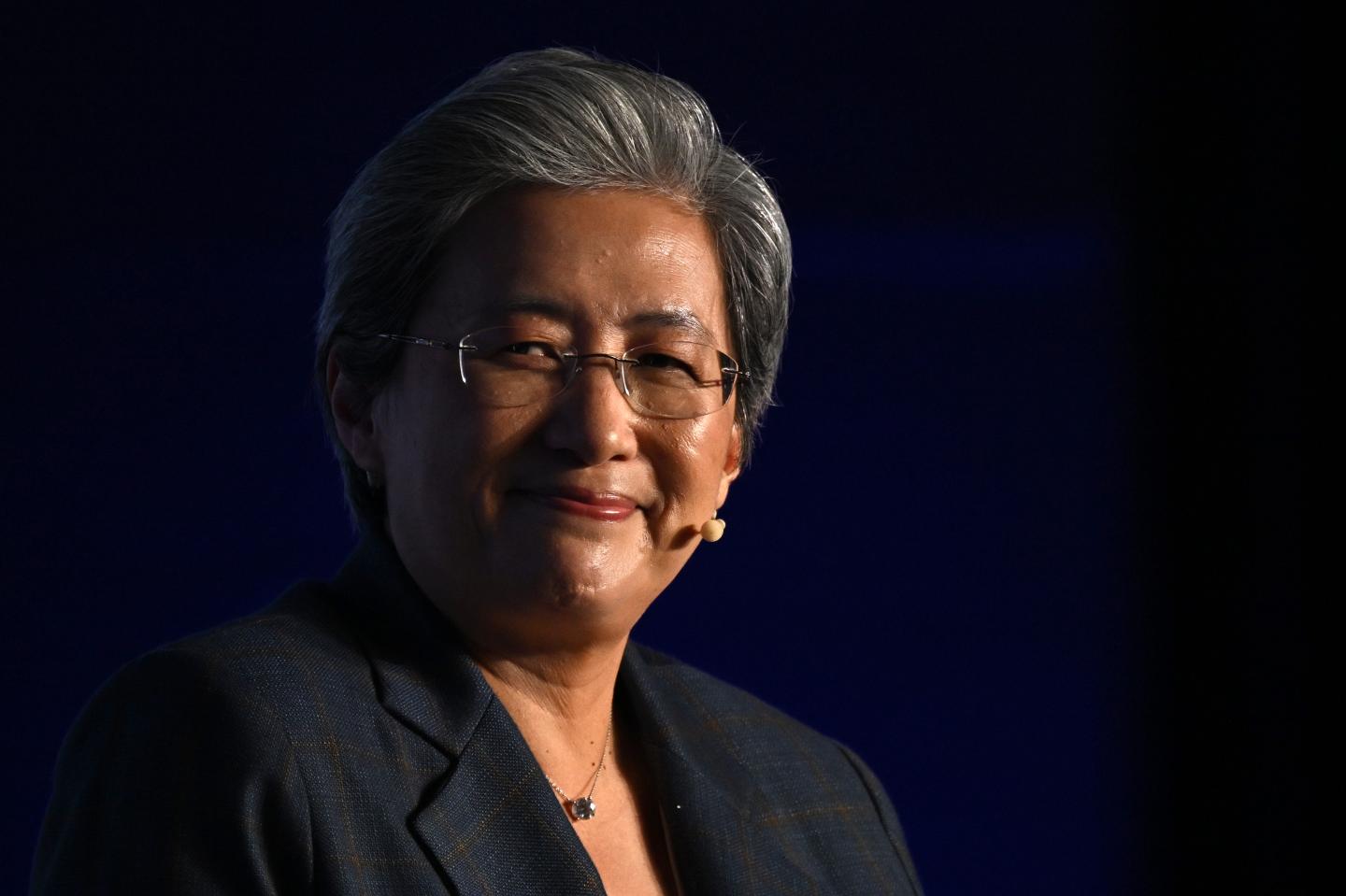
A week ago, AMD crossed a $1 trillion market cap for the first time. News coverage focused on the implications for the AI race: a surge in demand for chips and the impact of Meta’s launch of its AI agent Muse. AMD hit the milestone after a five-day rally that saw its share price climb 25%.
But reaching the trillion-dollar mark came with another achievement of note: AMD was the first company led by a female CEO to be worth more than $1 trillion. It joined a rarified club of just over a dozen companies, including Apple, Amazon, Alphabet, Microsoft, Meta, SpaceX, and Nvidia. Of all the companies on that list, only AMD is led by a female CEO, Lisa Su.
Oracle previously came close; while Safra Catz was in charge, its market cap peaked at around $925 billion last fall. (Today it’s down almost 60% from that high point.)
Su addressed the achievement during her appearance at Melania Trump’s Imperia summit last week. “It was a pretty darn good moment,” she said when Fox Business host Liz Claman noted that AMD was the first woman-led company to cross $1 trillion.
Su was No. 3 on the 2026 Fortune Most Powerful Women list earlier this year. She took over AMD 12 years ago and has become a visible player in Washington, often one of few women in the room in the White House’s gatherings of tech leaders.
Today, AMD has dropped back below the trillion-dollar mark as AI stocks fell this morning; its market cap is sitting at $984.4 billion.
And yet crossing the trillion-dollar mark is a remarkable achievement, whether or not AMD continues to straddle the border. Women have advanced so far in business, running 11% of the Fortune 500 and many of the world’s most influential companies and serving as key execs at other trillion-dollar businesses (ahem, SpaceX). Yet the very top echelon remains for the most part impenetrable.
By hitting $1 trillion, Su has officially put a measurable crack in one of the business world’s hardest glass ceilings.
Emma Hinchliffe
emma.hinchliffe@fortune.com
The Most Powerful Women Daily newsletter is Fortune’s daily briefing for and about the women leading the business world.
ALSO IN THE HEADLINES
The investigation at Cornell. A student filed a civil lawsuit against Cornell, saying that she was gang-raped in October 2024 and only two of her seven attackers (who were all part of the same fraternity) were expelled. The others' punishment was to write essays or serve a short suspension. And none were arrested. Now New York prosecutors have reopened an investigation into the case. And backlash is growing against Cornell.
Meanwhile... The Trump administration today finalized its repeal of the Biden administration's interpretation of Title IX rules governing how sexual misconduct is reported and addressed on college campuses. Now the rule defines sex discrimination as only discrimination related to biological sex, not a broader definition including sexual orientation and gender identity, effectively revoking protections for LGBTQ students.
How do you open a Dolly Parton hotel without Dolly Parton? The SongTeller Hotel in Nashville is officially opening this week. She's still "omnipresent" throughout the space, with giant portraits in some of the hotel's rooms.
Meet the anti-data center candidates. Both Republicans and Democrats are running in opposition to data center projects and incumbents who have supported them. Stephanie Hollist won a Utah GOP primary in June. Joanna Whaley won a Democratic primary in Michigan. Myrna Muñoz won a Democratic primary in Oregon, with rejection of data center projects part of a platform opposing ICE enforcement and Flock cameras.
ON MY RADAR
Being a WNBA fan used to be affordable. Not anymore The Athletic
Why has abortion faded from America's national conversation? Guardian
Showgirls: The gratuitous, surreal bomb that was maybe brilliant NYT
PARTING WORDS
"I didn’t expect to be this age and at this place in my life, but for whatever reason, that’s the plan of the universe."
—Dakota Johnson on her path to having kids