
Soaring Treasury yields are raising concerns in Congress as their precipitous rise in recent months further darkens the outlook for U.S. debt.
The 10-year yield shot up to 5.23% on Friday, the highest level since 2007 and more than a full percentage point since right before the Iran war started. Meanwhile, the 30-year yield hit 5.49%, the highest since 2004.
With oil prices up due to the Middle East conflict, AI hyperscalers spending hundreds of billions a year, the economy running hot, and U.S. debt now at $40 trillion, Treasury yields have already blown past the Congressional Budget Office’s long-term outlook.
According to its most recent forecasts issued in February, the 10-year yield was seen at 4.1% this year, 4.2% in 2027, 4.3% from 2028 to 2031, and 4.4% from 2032 to 2036. Those projections seem quaint now.
In addition to setting the pace on other borrowing costs, yields determine how much the Treasury Department must pay in interest on the U.S. debt, which can accelerate as rates go up.
Annual interest expenses on the debt are already at $1 trillion, while the budget deficit is on pace to reach $2 trillion this year, with no sign of any political willingness to rein them in.
The sudden spike in yields prompted Sen. Jeff Merkley, the ranking Democrat on the Senate Budget Committee, to ask the CBO for fresh numbers. In a letter replying to the senator, CBO Director Phillip Swagel addressed a scenario in which interest rates increased until they’re 1 percentage point higher than the baseline.
Before incorporating macroeconomic effects, the CBO estimated that the primary deficit, which excludes net outlays for interest, would be 0.4 percentage point larger by 2056 compared to the baseline view. But the total deficit would be 4.9 percentage points larger, indicating how much of an additional burden interest expenses will be.
In addition, the total deficit would balloon to 14% of GDP, up from 5.8% expected this fiscal year and the 3.8% average from 1976 to 2025.
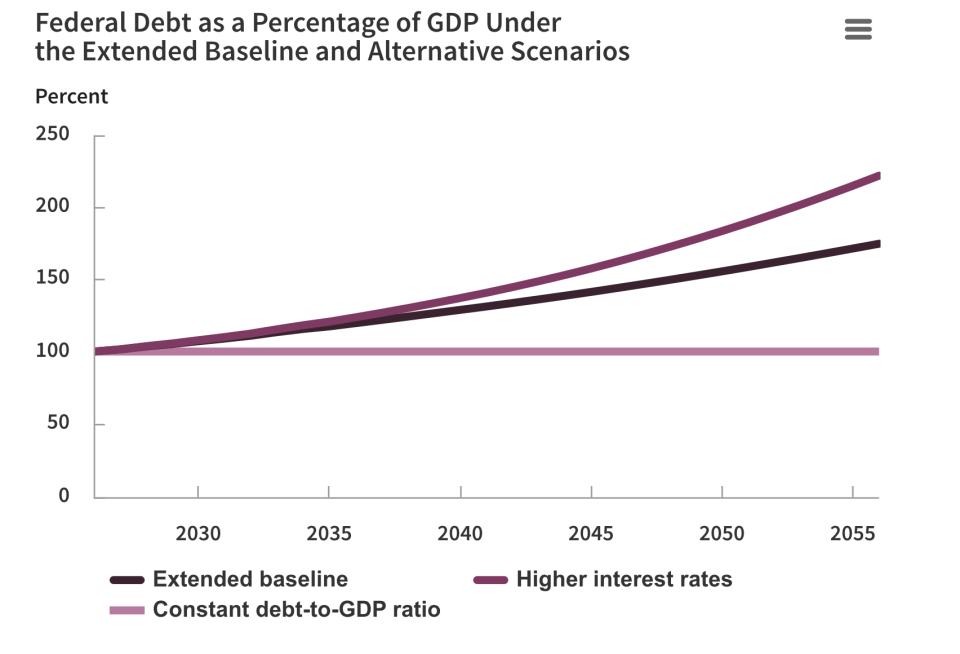
Meanwhile, publicly held debt would explode to 222% of GDP by 2056, under the scenario where interest rates rise by 1 point. That’s up from 101% of GDP today, and 47 percentage points higher than the CBO’s current baseline forecast for 2056.
As the debt soars, the U.S. economy will slow and will not be able to keep up with the pace of borrowing as capital is funneled to Treasury bonds than more productive uses.
The CBO said GDP growth will be 0.1 percentage point below its baseline. That dampens hopes that the U.S. can grow its way out of the debt. Treasury Secretary Scott Bessent said this is possible if growth hits 3%.
The CBO also suggested its numbers under this scenario would be even worse after accounting for effects on the broader economy.
“The resulting increase in debt as a percentage of GDP increases interest rates on Treasury securities even further,” Swagel added. “Thus, macroeconomic effects push interest rates above the initial boost that was built into the scenario.”
For the purposes of comparison, the CBO presented another, albeit fantastical, scenario where the debt-to-GDP ratio somehow stays flat at its current level of 101%.
In this utopia of fiscal prudence and frugality, the primary deficit would be 2 percentage points smaller than the CBO’s baseline by 2056, the total deficit would be 5.6 percentage points smaller, and publicly held debt would be 74 percentage points smaller.
And while GDP growth would only be 0.05 percentage point higher than the CBO’s baseline, that doesn’t account for additional macroeconomic spillover effects.
“The increased GDP growth encourages more investment, increasing the amount of capital available to workers,” Swagel wrote. “That higher capital stock raises the marginal product of labor, encouraging more labor, which results in further GDP growth.”