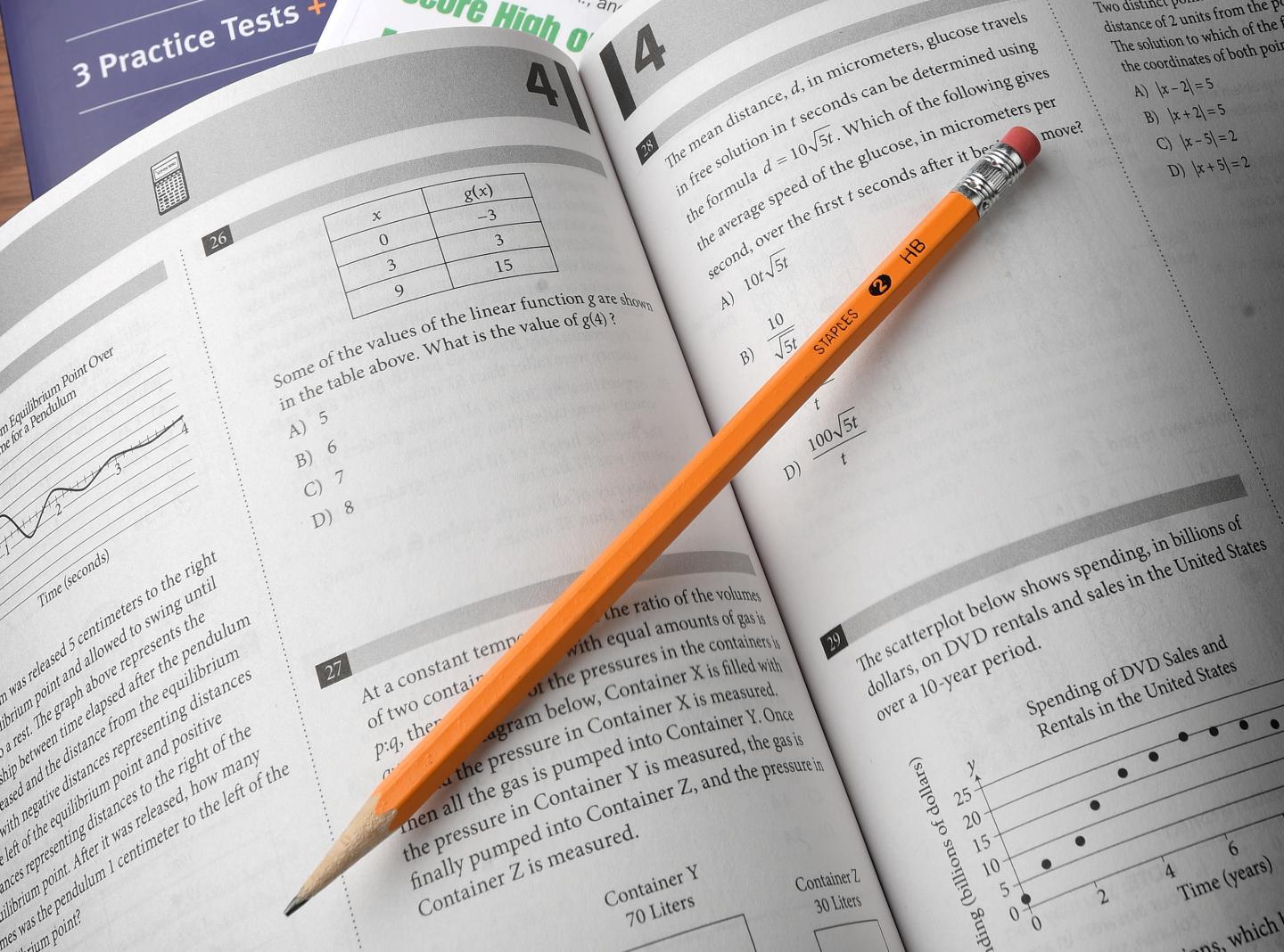
In June 1926, the SAT exam was first administered to 8,000 high school students who hoped to attend elite universities.
The SAT has undergone many changes since its original form 100 years ago, ranging from how the test is administrated to what kinds of subject matter it covers.
One particularly big shift came around 2000, when about 280 colleges and universities allowed applicants to apply without submitting scores for the SAT or the ACT, another common standardized test. Today, approximately 86% of colleges and universities are test-optional.
Whether the SAT accurately measures students’ academic strengths continues to be debated. Some research shows that the test offers a strong indication of students’ skills, knowledge and potential for college success.
Other research points to fundamental flaws of SAT and ACT testing, including that students from higher-income families tend to have higher SAT scores. The test, after all, costs money to take, and wealthier families can afford tutors and prep classes. Wealthier students also typically attend well-funded public or private high schools.
As a professor of education, I think that understanding the history of the SAT is helpful to understanding the current debate surrounding it.

A new kind of exam
The SAT was developed in the 1920s by the College Board, an organization founded in 1900 by the presidents of 12 leading universities to standardize the college admissions process.
At the time, each university had its own variation of entrance exam. These tests were in essay format and written and graded by professors.
In 1926, a uniform SAT exam was used for the first time. It had 315 questions, with a time limit of 97 minutes. This gave test-takers about 18 seconds to answer each question – though students were not expected to answer every single question.
The original exam included nine sections, some similar to those that students would see today, like paragraph reading and arithmetic. But other sections, like artificial language, are no longer in use. Artificial language meant writing coded sentences using a set of complicated rules such as “plurals are formed by adding -o.”
In 1928 and 1929, as well as from 1936-1941, the SAT had no math questions. In 1930-1935, the math questions were all free response, rather than multiple choice, as is standard today.
At the time, the SAT was revolutionary because it was not an essay exam with subjects and questions chosen by one university’s professors.
Multiple choice or fill-in-the-blank exam questions could be quickly and objectively scored. High school students no longer had to travel to a college campus to take an entrance exam. The SAT allowed thousands of students to take the same exam closer to home, removing the barrier of travel to campus.
The scores were viewed by multiple colleges, rather than just the one. This meant the SAT created both more competition and access to college.
But not all colleges or even high school teachers embraced the idea, in part because of concerns about a test dictating high school curricula.
The SAT was still used relatively rarely around this time, with about 10,000 students sitting for the exam each year in the late 1930s and early 1940s.
In 1947, Educational Testing Services, a private nonprofit organization devoted to testing and educational research, was created to administer the SAT and develop other exams. This organization had an incentive to sell the SAT to institutions, resulting in more widespread use.
The SAT gains traction
Starting after World War II, universities experienced a sharp increase in college applicants who benefited from the GI Bill. This government program offered educational and financial assistance to military veterans.
Universities began to strengthen their admissions criteria and rely more on the SAT to weed out some applicants.
The University of California system became the first and largest public system to require the SAT in 1960. This was also the year that the ACT was created.
Over the next few decades, more schools began requiring the SAT as part of the standard admissions process.
In an effort to prevent students from relying too much on private tutors, the test creators also expanded the length of the exam and revised the questions.
In 1994, another change occurred when students used physical calculators on the SAT for the first time.
Not just a test
Taking the SAT or the ACT is a high-stakes moment for students. Not only is their college admission potentially riding on the score, but a small score increase of 50-100 points could also mean thousands of dollars in scholarships.
The achievement gap between different racial groups on SAT scores has been both well documented and debated for decades.
Asian students have the highest average score for any ethnic group, followed by white students.
Wealthier students are 13 times more likely than low-income students to score a 1300 or higher on the SAT, out of a maximum 1,600 points.
Some research shows a link between family income and students’ test scores and college success, as defined as GPA, retention and graduation.
Other research indicates that a student’s high school GPA is a better predictor of college success than SAT scores.
Colleges and universities reconsider the SAT
Because of concerns about the usefulness of the SAT in college admissions, around 2000 about 280 colleges and universities moved to make the SAT an optional part of the admissions process.
The start of the COVID-19 pandemic in 2020 served as a natural experiment for test-optional admissions. Students simply could not sit to take the SAT due to virus transmission concerns, so almost no universities required either the SAT or ACT for admission in 2020 or 2021.
Six years later, over 2,000 colleges and universities are still test-optional – although the categorization may be deceiving, as some scholarships may depend on SAT scores.
More than 2 million students, or approximately 47% of graduating high school students, took the SAT in 2025 – marking the highest number since before the pandemic.
And 36%, or 1.38 million, took the ACT that year.

A high school ritual
The SAT continues to be modified.
In 2024, it was shortened from three hours to two hours and 15 minutes. The shortened time is closer to the original exam from 100 years ago, which lasted 97 minutes..
Also in 2024, the SAT went fully digital.
The exam isn’t a perfect reflection of students’ potential and skills, but it continues to be the rite of passage that most high school students undertake as they look ahead to college.
Beth Kania-Gosche, Professor of Education, Missouri University of Science and Technology
This article is republished from The Conversation under a Creative Commons license. Read the original article.
