In February 1993, weeks into Bill Clinton’s presidency, James Carville famously quipped: “I used to think if there was reincarnation, I wanted to come back as the president or the pope or a .400 baseball hitter. But now I want to come back as the bond market. You can intimidate everybody.”
What Carville was referring to is the fact that the U.S. government runs massive deficits every year, which requires the U.S. government to issue bonds to fund those deficits. In turn, other people, i.e. the bond market, have to be willing to buy those bonds we issue. That is the difference between a healthy country vs. a country like Russia, where nobody wants to buy their debt and they have to resort to cannibalization to fund spending.
When the bond market stops buying the debt we issue, bond yields rise, increasing debt servicing costs; and quickly rising bond yields amounts to a flashing red light to stop spending and to stop issuing new debt.
Just as Clinton had to collapse his new spending plans when faced with a bond market revolt, President Donald Trump is now learning the same lesson as bond markets are in active revolt over what the market clearly perceives to be excessive spending plans, with 30-year bond yields reaching heights unseen since before the 2008 Great Financial Crisis.
But instead of picking up the hint, Trump only continues to throw fresh fuel on the fire, sending bond yields ever higher at the risk of sparking a self-inflicted economic crisis.
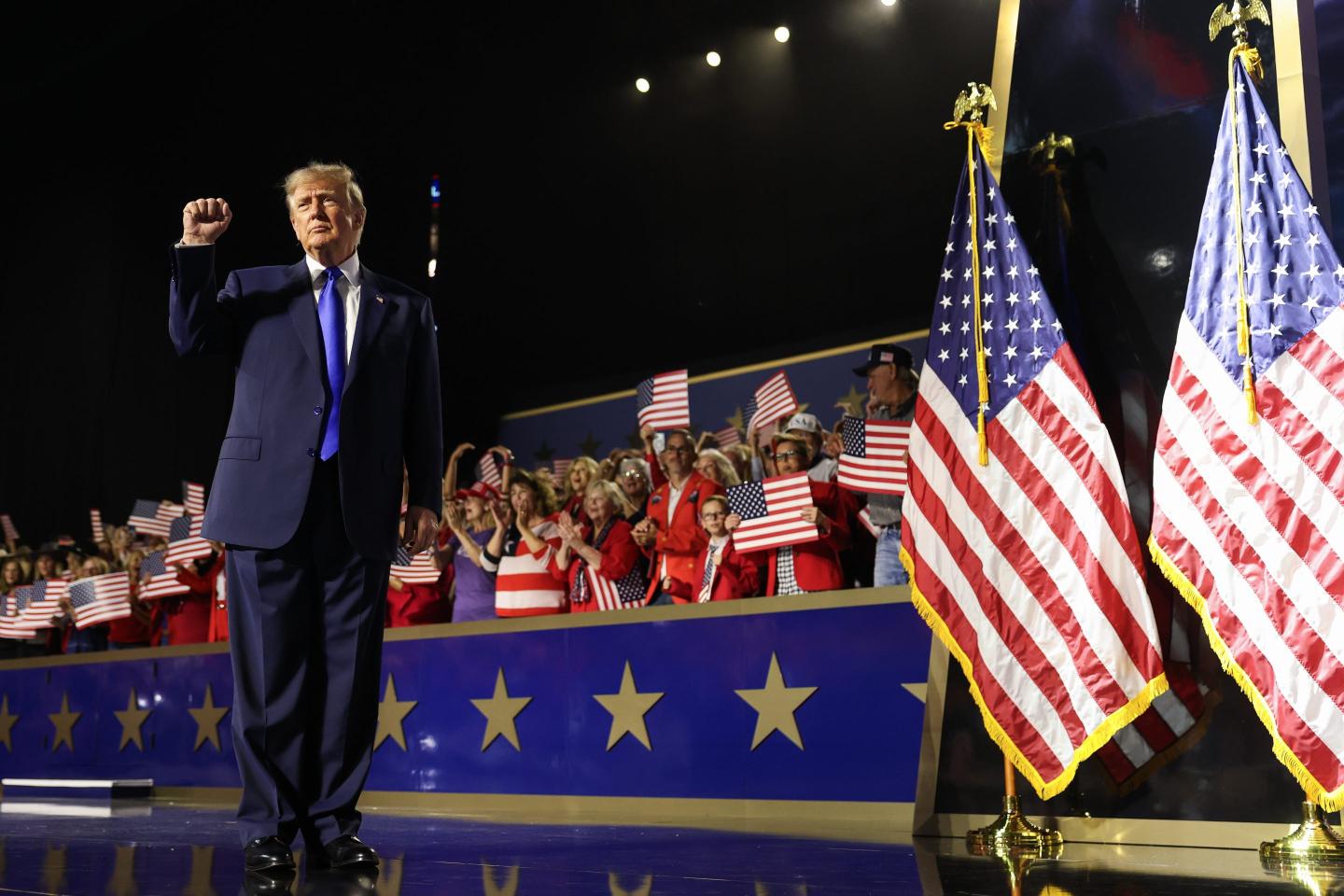
Indeed, on Wednesday night in Dallas, at the RNC “Midterm Convention,” Trump promised that if Republicans hold Congress in November, he will “issue a dividend to every adult citizen in the United States of America for $5,000, very much like a successful company will do a cash distribution to its shareholders.”
That comparison conveniently omits the fact that companies pay dividends out of profits and generally suspend dividends when they need to pay down debt, which is the situation Washington finds itself in, running a deficit of nearly $1.8 trillion last year on top of over $40 trillion in debt.
But far more importantly, bond markets have sold off even more dramatically in the aftermath of Trump’s $5,000 announcement, with 30-year bond yields reaching a fresh 30-year high of 5.35%, up 6 basis points today alone, and 10-year bond yields up 9 basis points to 4.92% this morning.
Bond markets surely realize what Trump does not, which is that sending $5,000 to every adult citizen will likely end up costing the U.S. taxpayers far more than $5,000 per person, given the U.S. government will have to fund these payments by issuing new debt at currently elevated interest rates. Consider the back of the envelope math.
If there are roughly 245 million adult citizens, each of whom will receive $5,000 – then the U.S. government will have to issue $1.2 trillion of debt to fund those payments. If the government issues 10-year bonds at the current interest rate of 4.92%, then over 10 years, the interest plus principal will come out to approximately $8,000 – far more than $5,000 a person. Thus, not only does the “Trump Dividend” substantively amount to a payday loan in which the taxpayer is both borrower and lender; but the U.S. is plainly getting a raw deal.
And that is far from all, as the bond market has not been revolting against merely a single pledge. It is revolting against a pattern of spending promises by Trump which the market sees as excessive and reckless. Last November, it was $2,000 tariff-dividend checks, whose odds experts now put at “effectively zero.” In December it was $1,776 “warrior dividend” checks to 1.45 million service members.
Then came the war with Iran, which had cost $37.5 billion by July, for which the Pentagon floated a $200 billion request in March and came back for $67 billion more this summer, while the conflict pushed Brent crude past $100 and reignited inflation. Layer on interest on the debt that reached $1.25 trillion last year, more than the entire defense budget, and you have the reality that the bond market is behaving like a disgruntled lender that has stopped extending credit on faith.
Treasury Secretary Scott Bessent’s answer has been to try to throw money at the problem, bragging that “I am the house now,” which is flailing in plain sight. Bessent has initiated Treasury buybacks, which amount to issuing new bonds at higher interest rates to buy back older bonds issued years ago, at a lower interest rate – which is a bit paradoxical as this creates an effectively higher cash interest rate the U.S. government has to pay.
Furthermore, Bessent has accelerated a pattern he previously attacked the Biden Administration for doing, of retiring longer-term notes by issuing more short-term bills – which amounts to switching fixed low rates for floating high rates, making the U.S. government even more vulnerable to every tiny move in short-term interest rates. In short, Treasury is buying bonds with money it raises by selling more bills. Evercore’s Krishna Guha called it “a weak form Operation Twist.” It is almost akin to bailing water while the captain drills holes in the hull.
Markets have seen through the emptiness of Bessent’s remedy, as ‘bond vigilantes’ have driven bond yields even higher despite Bessent’s band-aids. That hasn’t stopped Bessent from continuing to throw more money at the problem.
In August, he doubled Treasury’s buybacks of long-dated bonds to $4 billion per operation, declaring “we have a big toolkit” and insisting that yields “don’t reflect the underlying fundamentals.” On Wednesday, the same day Trump promised $1.3 trillion, Treasury went to $6 billion. Yields rose anyway, counteracting Bessent’s move entirely. Despite Bessent’s braggadocio that “I am the house now”, the house is evidently undercapitalized, as bond traders mint fortunes calling out the fact that the emperor has no clothes.
Yes, this is a global storm. British 30-year gilts sit at 5.88%, the highest since 1998. Japan’s 10-year is near 3%, a three-decade high. German bunds are at levels unseen since 2011. But those governments are being disciplined into restraint; in London, the gilt market is effectively writing the next budget. Only Trump is responding to the highest borrowing costs in a generation by promising to borrow $1.3 trillion more to mail out checks before an election, with no signs of stopping his spending binge anytime soon.
Carville’s point was that the bond market is the ultimate failsafe, the one constituency a president cannot spin. Clinton grasped that within a week, but Trump is still refusing to learn the lesson, at the soaring cost of debt, still fast rising by the day, sparking heightened risk of a self-inflicted economic and financial crisis.
The Republican Illinois Senator Everett Dirkson, Senate Minority Leader through the 1960s, is commonly attributed with saying, “A billion dollars here, a billion dollars there, pretty soon you’re talking real money.” (This ad lib quip was drawn from unwritten remarks before a Senate-House Republican leadership press conference on March 8, 1962.)
Dirksen’s admonition is worth keeping in mind amidst Trump’s casual dismissal of the rapidly escalating costs of his far-fetched spending pledges. Presciently – Dirksen’s $1 billion in 1962 is worth $1.1 trillion in 2026 dollars the nominal cost of Trump’s program and the debt financing cost of this doubles the total cost to $2.3 trillion.
Paying $8K to $10K per person to receive $5K per person may help explain why President Trump as a business leader went bankrupt six times.
The opinions expressed in Fortune.com commentary pieces are solely the views of their authors and do not necessarily reflect the opinions and beliefs of Fortune.