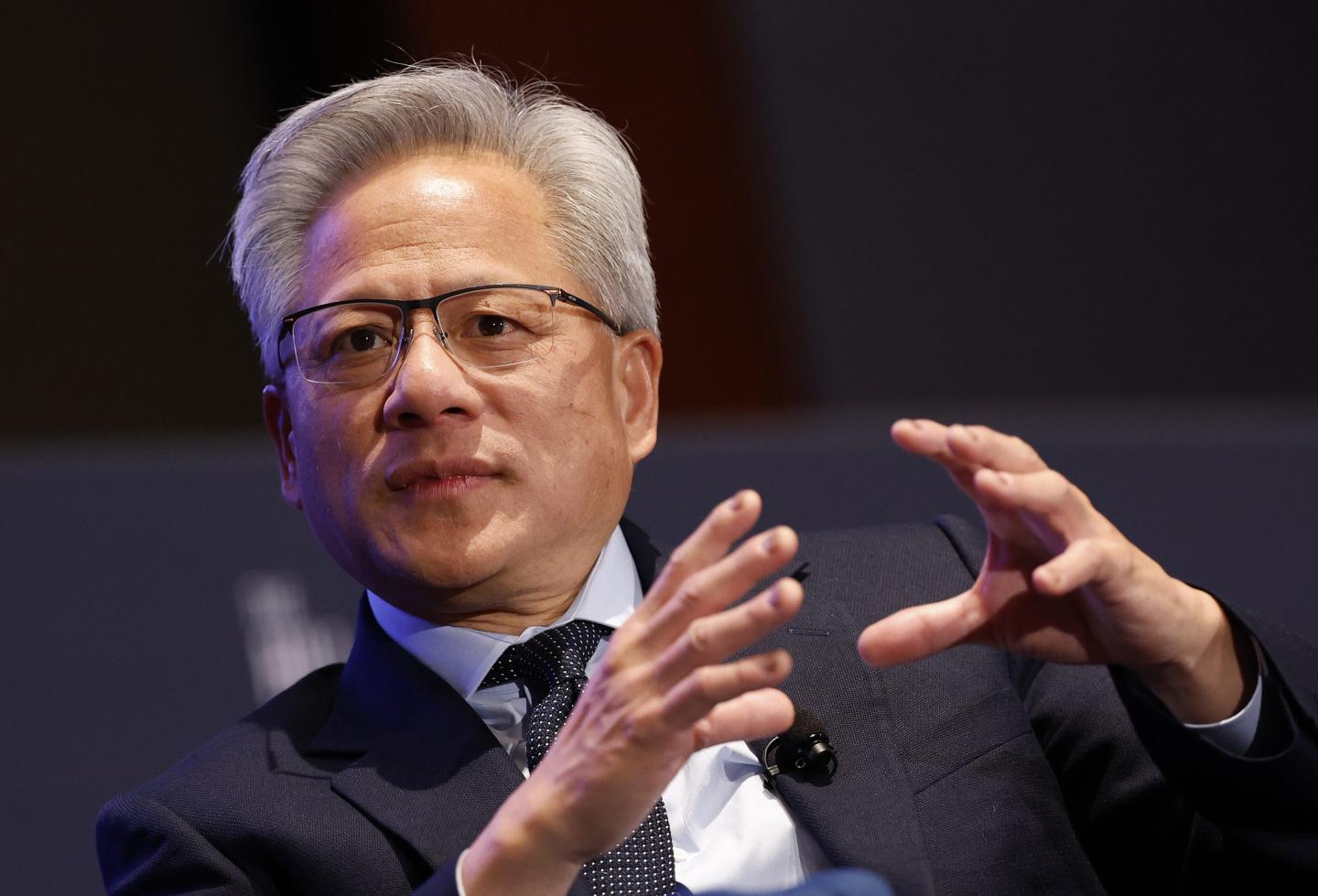
AGI, the technology once imagined to both destroy and enrich human civilization, has arrived, Nvidia chief Jensen Huang declared over the weekend.
OpenAI’s newest model, Astra (“stars” in Latin), has achieved the goal, Huang wrote on X on Sunday, after training on 100,000 Grace Blackwell chips (an earlier post said 300,000 before he deleted it). His post was received with a healthy mix of supporters and detractors: Jim Cramer said Nvidia was winning from the release, and crypto CEO Hunter Horsely said Huang was the “most credible referee.” But others had questions: Did Jensen not, asked AI critic Gary Marcus, have a financial incentive to declare AGI?
Markets got their first chance to weigh in Tuesday after the long Labor Day weekend. CoreWeave, battered by months of suspicion over its debt, exploded up 15%. SoftBank notched another 2%. But the hefty, lumbering Nvidia shed 2%. The last time Huang declared AGI (he’s done it twice before, by Fortune‘s count), on Lex Fridman’s podcast in March, the stock fell 0.3%. So it follows that markets don’t believe Huang, or AGI has already been priced in.
“If you look in a slightly different place,” Gil Luria, head of technology research at D.A. Davidson, told Fortune, “you’ll see that the market is responding.” Indeed, the companies most leveraged to OpenAI—SoftBank, Oracle, CoreWeave—are the ones whose stocks are up. Astra, he added, “puts OpenAI as the state-of-the-art model, which they haven’t been in about a year.”
Nvidia, on the other hand, has been the dominant market player since 2024; it’s “too big to grow,” Luria said. Two weeks ago, Nvidia reported the most profitable quarter in capitalism’s history: $96 billion in quarterly revenue, up 106% from a year earlier, and guided to $108 billion for the current quarter. “They’re so good that nobody believes it can continue,” Luria said. For traders, the stock is more like a source of funds you pull from, rather than something you buy and sell based on individual news about the AI race— it’s what you sell to buy CoreWeave. That’s also why Luria shrugged off board member Mark Stevens’ filing last week to sell up to $1 billion of his shares. “Good for him.”
But what of AGI? Huang defined the word himself to Fridman in March as the ability to create a $1 billion company, but made no mention of that benchmark in his X post Sunday. Can Astra build such a company? Theoretically, Luria said—but until we see a billion-dollar business built by one person with an AI model, or an agent by an agent alone, “it’s a hypothetical.”
AI researchers have a stricter test. A widely cited definition describes AGI as an AI that can match or surpass the “cognitive versatility and proficiency of a well-educated adult.” Marcus and Miles Brundage, a researcher who quit OpenAI in 2024 over safety concerns, created a 10-point list to make that tangible: a well-educated adult can write an Oscar-caliber screenplay, laugh at the right moments in a movie, and master a new video game within hours.
By that standard, “we just absolutely have not achieved AGI, even though the models are astounding,” said Basil Halperin, an economist at the University of Virginia who co-wrote a widely circulated 2023 analysis arguing that financial markets don’t anticipate transformative AI for decades. He ran his own test last weekend, where he asked GPT-5.6 to move his old iTunes playlists to Spotify. “It got the job done. But I had to sit there babysitting it for three hours.”
Still, a spectacular new model release should beget more compute demand, which begets a higher stock price for Nvidia, or at least for the hyperscalers selling compute—right? Wrong, Halperin argues. Stocks, he said, “are a giant pain in the butt because they reflect many different things.” The two leading labs are private. Maybe existential risk, or cybersecurity risk, would could push equities down, rather than up, as investors flee to Treasuries and gold. And competition between OpenAI and Anthropic could leave the industry “kind of like Uber and Lyft—they earn money, but they’re not as profitable as Google or Apple.”
Where you would actually see AGI show up, Halperin argues, is in real interest rates. If AI raises growth, it raises interest rates, since rates are the expected discounted value of future earnings. And since a stock is the discounted value of its future earnings, higher rates shrink the present value of future profits, meaning a real AGI could, theoretically, make Nvidia’s stock fall.
The real interest rate—also known as the yield on inflation-protected Treasuries with inflation stripped out (TIPS)—is the cleaner signal of AGI. Halperin’s rule of thumb is that every percentage point of extra growth should add roughly a percentage point to real rates. So when Sam Altman and Dario Amodei talk tough about growth of 5% or 10% or more, they are describing a world where real rates sit near 10%. “Those will just swamp everything else, if those are actually going to come.”
But now, they’re not. They haven’t. Real interest rates have climbed an enormous three to four percentage points since 2021, and Halperin attributes some of that to hyperscalers’ capex, sitting at now running around 2% of GDP a year. But that’s nowhere near a singularity, and Astra didn’t add much to it at all. In fact, Halperin pointed to a paper by MIT economists Isaiah Andrews and Maryam Farboodi that found that long-term Treasury yields have on average fallen by more than a tenth of a percentage point around major model releases, and stayed down for weeks, a pattern that “would suggest that the market on average has been disappointed.”
The efficient market is thus aggregating the views of the general public, rather than those on X. A survey Halperin helped run tested the expectations of groups from normal people to AI researchers and found that most expect AI to add about half a percentage point to GDP growth. On one hand, that’s enormous. On the other, it’s nothing.
Halperin’s own forecast for the next five years is like “the dot-com boom, but twice as fast and twice as hard. Not the singularity. Not yet.” That seems to be what the markets are saying too.