
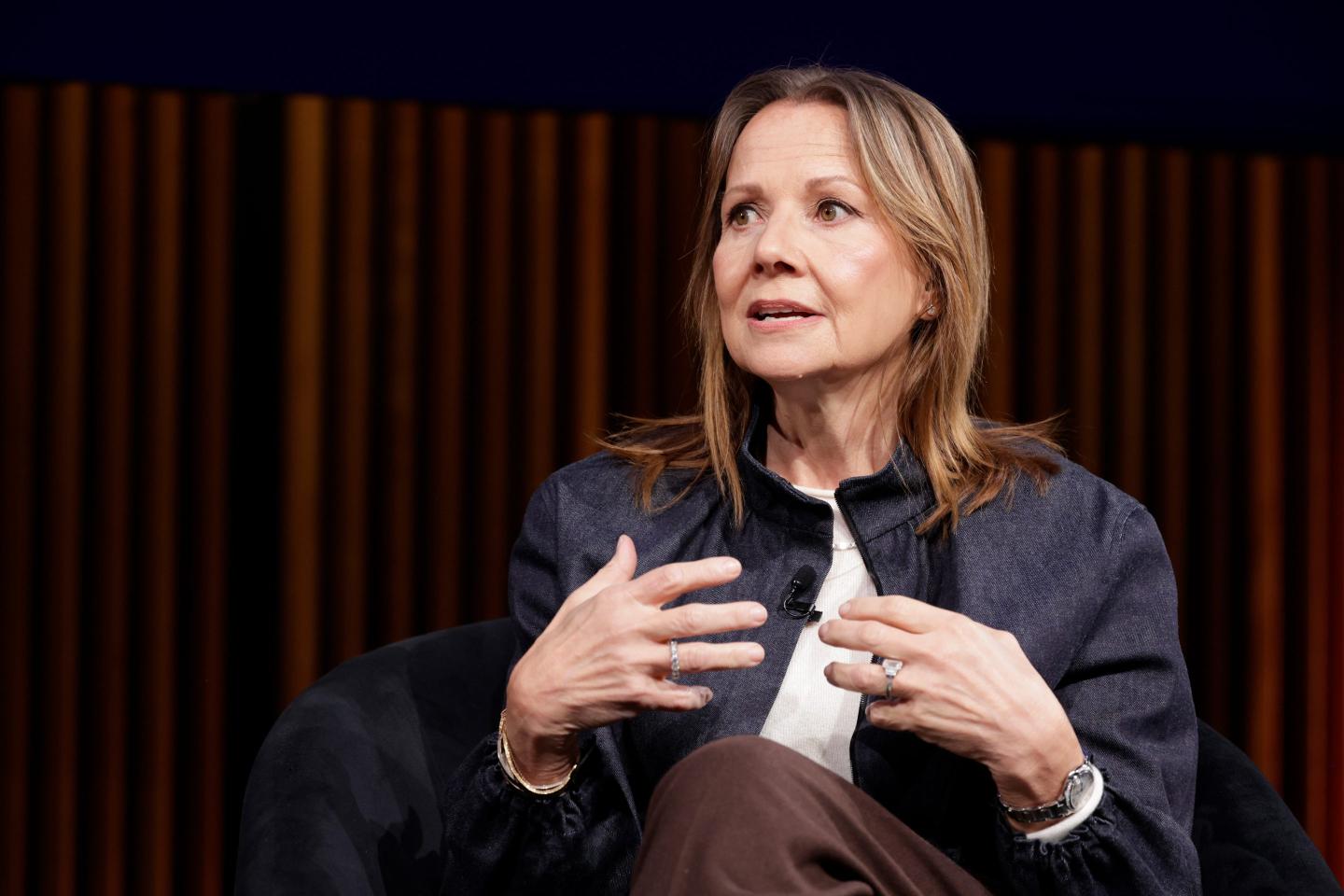
- In today’s CEO Daily: An interview with GM CEO Mary Barra
- The big leadership story: Jensen Huang declares the start of the AGI era.
- The markets: Mixed globally as Brent crude tops $100 a barrel
- Plus: All the news and watercooler chat from Fortune.
Good morning. Alyson Shontell, Fortune’s Editor-in-Chief, writing from New York this morning. When I had the chance recently to interview Mary Barra for Fortune’s Titans podcast, the GM CEO made clear that the company has no plans to abandon EVs, even as consumer adoption has slowed, improvements to the charging infrastructure have taken longer than expected, and the Trump administration has pulled back on policies designed to accelerate the transition.
“I don’t think it’s shifted our mission,” she told me. “We still think EVs are the end game.”
That conviction matters, given that GM has spent years investing in electric vehicles, batteries, software, and charging. Going forward, Barra is applying a pragmatic framework: GM will keep selling EVs and hybrids; it will also keep selling the lucrative trucks and SUVs that many Americans still want. Investors by and large have applauded her embrace of the messy middle: The stock is trading near its all-time high and is up nearly 6% YTD.
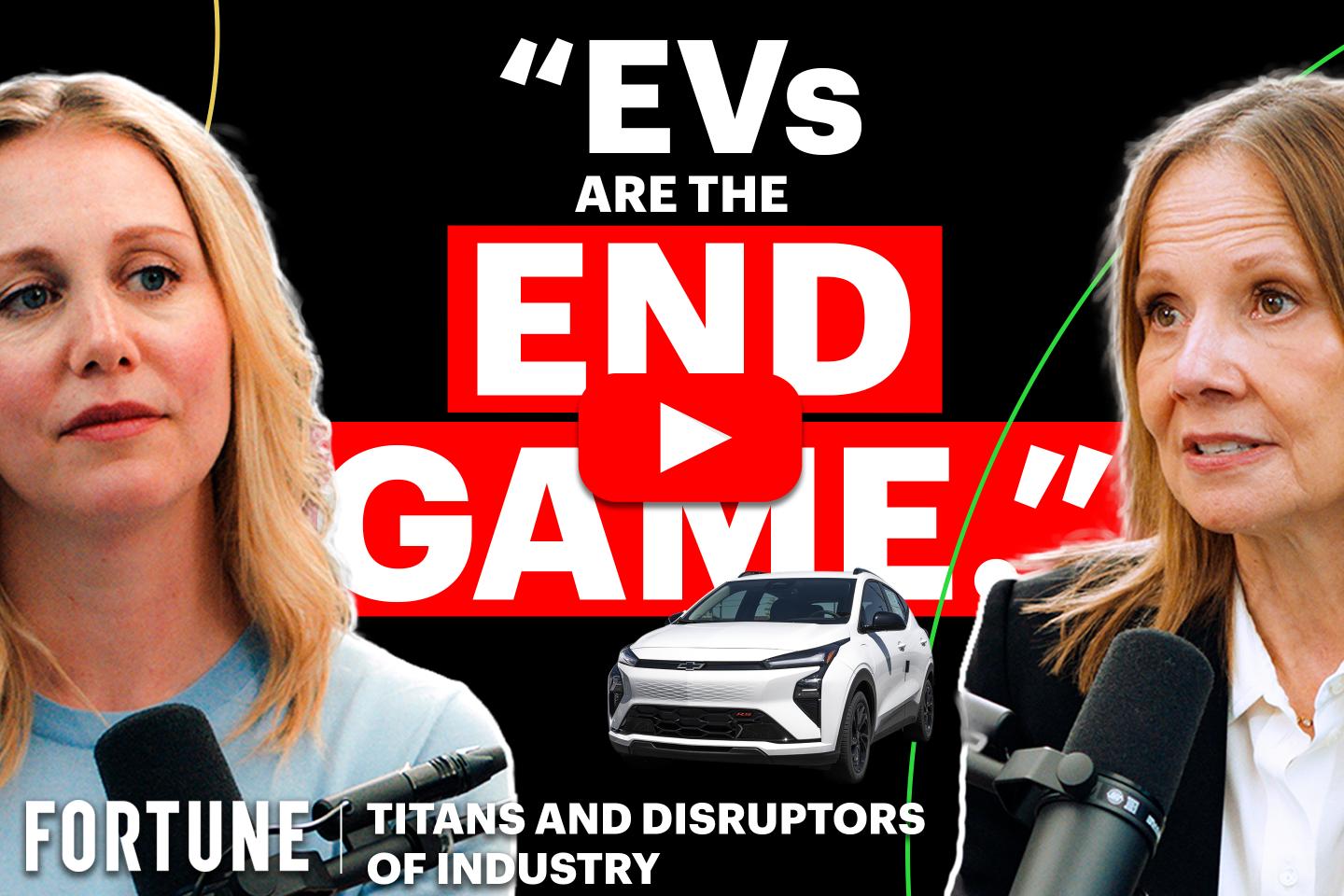
The mantra that Barra returned to again and again in our interview was choice. She invoked the goal of the legendary GM CEO Alfred P. Sloan: to reach “a lot of pocketbooks.” It’s an idea that feels newly relevant in an inflationary era, as automakers try to serve customers with very different budgets, driving habits, and comfort levels with electrification.
As for her broader management philosophy, Barra told me, “Agility is a superpower now.” It’s a lesson she learned early in her tenure as CEO, when it became clear that a disastrous ignition-switch malfunction had not been addressed for months because of what she called at the time a “deeply troubling” culture of bureaucratic inaction. Barra quickly instilled a set of protocols to prevent anything like that from happening again: Solve problems immediately, build mechanisms for employees to surface concerns, and repeat the message until it becomes embedded in the culture.
That’s still her approach. “Rarely do problems get smaller,” she told me. Today, GM starts every meeting with a safety message—a way to keep the lessons learned from the ignition switch crisis top of mind—and maintains a “speak up for safety” culture.
Creating an agile organization also means anticipating what lies ahead. To that end, GM is investing in automation, aiming to offer eyes-off-the-road highway driving in a Cadillac Escalade IQ by 2028. It is spending more than $250 million on skilled-trades training, which Barra has told high school students may be “a little more AI-proof” than some white-collar jobs. And it is experimenting with AI in factories and vehicle design to help its workforce move faster.
These approaches add up to a clear strategy other leaders can learn from: Play the long game and don’t let shifts in the landscape throw you off course. Address problems as they arise and retain the flexibility to meet customers where they are now.
Check out my full interview with Mary Barra here.
Contact CEO Daily via Diane Brady at diane.brady@fortune.com
Top leadership news
Nvidia’s Jensen Huang says OpenAI’s Astra has reached AGI
Nvidia CEO Jensen Huang said OpenAI’s Astra has reached artificial general intelligence, or AGI, in which an AI system can handle a broad range of intellectual tasks at a human level. Investors were more cautious as Nvidia shares fell 2% on Tuesday, while companies more directly tied to OpenAI, like CoreWeave and SoftBank, rose.
Pony.ai sees robotaxis going mainstream within 5 years
Pony.ai CEO James Peng told the Fortune Leaders Forum in Macau that robotaxis could become as common as regular taxis within five years because the core technology is “pretty much already solved.” The Chinese company operates commercial services in Beijing, Guangzhou, Shenzhen, and Shanghai, averaging about 25 rides per vehicle per day, and plans to deploy more than 2,000 robotaxis in Europe with Uber.
Nike will leave the S&P 100
Nike will lose its spot on the S&P 100 on Sept. 21 after nearly 18 years in the index, following a 78% decline in market cap from its 2021 peak, including a 36% decline in 2026 alone.
The markets
S&P 500 futures are up 0.01% this morning. The last session closed down 0.58%. The STOXX Europe 600 was down 0.73% in early trading. The U.K.’s FTSE 100 was down 0.43% in early trading. The Nikkei 225 was down 0.19%. South Korea’s KOSPI was up 1.40%. China’s CSI 300 was up 0.30%. Hong Kong’s Hang Seng was down 0.17%. India’s NIFTY 50 was down 0.65%. Bitcoin is up at $79k.
Around the watercooler
Apple expected to announce the biggest iPhone update in its history, as new CEO John Ternus prepares launch of foldable device by Sebastian Herrera
When things go bad, you want to be in China, says Gavekal’s Louis-Vincent Gave by Angelica Ang
Peru’s monetary system would not work in Venezuela by Steve H. Hanke and Emilio Ocampo
This European CEO says building a startup outside of AI is an advantage: ‘We will never be out-competed’ by Emma Hinchliffe
How Canada decided to hurt its own economy, raise its inflation—and most Canadians approved because they’re so angry at Trump by Sasha Rogelberg
CEO Daily is curated and edited by Joseph Abrams, Jason Ma, Claire Zillman, and Lee Clifford.