
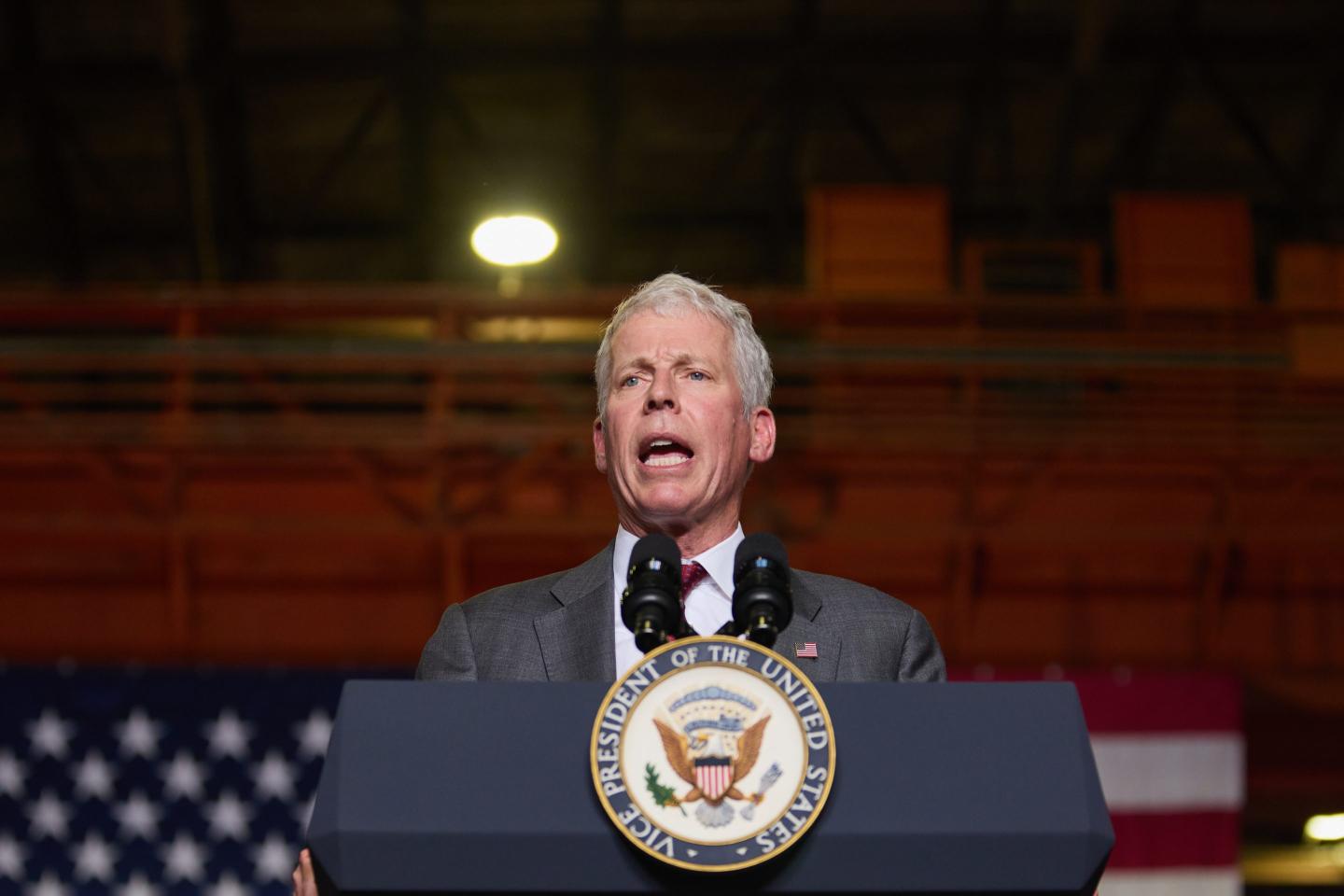
U.S. Energy Secretary Chris Wright raised eyebrows in energy markets Wednesday when he said more oil exports left the Middle East on Monday—between the Strait of Hormuz and alternative routes—than before the beginning of the Iran war.
While crude oil exports have indeed risen in recent weeks—at least until an escalation of U.S. and Iranian attacks on Tuesday that slowed exports yet again—analytics firms that track tanker traffic rebutted Wright’s claims.
As the U.S. has worked to carve out a path for oil tankers that hews closer to Oman, more oil shippers are using smaller tankers to move through the narrow Strait of Hormuz and then transferring their volumes to larger tankers in the broader Arabian Sea, a process called ship-to-ship transfers.
That process can be time consuming over days, and it appears that Wright is adding up transfers over multiple days into a single day, said Samir Madani, co-founder of TankerTrackers.com, jokingly calling it “mathemagics.”
Here’s what Wright initially had to say during an interview with CNBC:
“Monday was our record ever through, since the conflict began. Over 17 million barrels of oil flowed through the Strait of Hormuz on ships on Monday. If you add the bypass export pipelines, more than left the region [than] in the pre-conflict.”
Prior to the war, nearly 15 million barrels of crude oil routinely trekked the Strait of Hormuz—about 20 million barrels including other petroleum products. Wright seems to be counting products too. And, in terms of Wright’s mention of “bypass export pipelines,” Saudi Arabia, most notably, is now exporting between 3 million and 4 million barrels of oil each day through the Red Sea—which is under threat by the Yemeni Houthis—or the more circuitous Suez Canal.
Taking Wright’s word for it, that would indeed put traffic back above pre-war levels, including the Red Sea and Suez Canal volumes.
But Madani told Fortune the data says otherwise, although the past seven days of traffic are higher than the 28-day average.
On Monday, Aug. 31, Madani said an estimated 9.14 million barrels of oil exited the Arabian Sea—including volumes through Hormuz and the United Arab Emirates’ bypass volumes from the Gulf of Oman.
That was in fact one of the highest days of traffic of late, he said, but still well below pre-war volumes. Madani said the seven-day average is 8.27 million barrels of oil exiting the Arabian Sea, well up from the most recent 28-day average of 6.85 million barrels.
So, clearly, the U.S. military’s efforts to clear shipping paths, remove mines, and reduce Iran’s threats are slowly working. But, when hostilities resumed, Madani said volumes fell to an estimated 6.81 million barrels on Sept. 1 and then to 4.63 million barrels on Sept. 2.
“You can see that it is anything but steady,” Madani said, noting that volumes can fluctuate wildly day by day, as opposed to before the war.
The Hormuz ‘card’
Later in his CNBC interview, Wright argued that blocking the Strait of Hormuz was Iran’s “one card.”
“They’re causing some disruption, but they are losing that card,” Wright continued.
Earlier in August, energy analytics firm Kpler said Middle Eastern oil-exporting volumes had returned to about 65% of their pre-war levels, including pipeline bypass alternatives. While Kpler did not have end-of-August numbers readily available, those volumes could have risen above 70% by the end of the month.
The White House though doubled down on Wright’s remarks when asked.
“The United States government and the United States military maintains the best available data related to oil products transiting the Arabian Gulf,” a White House official said in a statement.
The White House also pointed to President Donald Trump’s comments on Monday. “We have the Strait of Hormuz in extremely good shape,” Trump said. “You know, we’re taking over. Many, many ships got through last night, as you know, with the Navy’s assistance. And we’ve been averaging 30 ships a night. That’s a lot. And a lot of oil is coming out. That’s why you haven’t seen the price of oil go like they thought it might have to go.”
Largely because of China’s reduced imports and the United States’ increased exports—and the ongoing depletion of the U.S. Strategic Petroleum Reserve to 44-year lows—the price of oil has remained below the $100 per barrel threshold. However, the global oil benchmark did rise above $95 on Wednesday after the resumption of attacks—up from $87 a week prior.
The U.S. average price for a gallon of regular unleaded gasoline on Wednesday was $4.12—the highest price ever heading into a Labor Day weekend, not accounting for inflation.
“Last year saw the cheapest Labor Day since 2020, but the pendulum has swung wildly this summer. This year has been less about typical supply and demand, and more about uncertainty over how global tensions will affect the availability of crude oil and refined products,” said Patrick De Haan, head of petroleum analysis at GasBuddy.