Welcome to this week’s Fortune Gulf Brief. We’ll be covering:
- Saudi’s $15 billion tech deals put AI ambitions on show
- Dubai airport’s wartime fightback
- Washington turns the screws on UAE banks over Iran
- Syria’s ‘Coffee Visa Swipe’ signals a financial comeback
- And, the three things we enjoyed reading this week
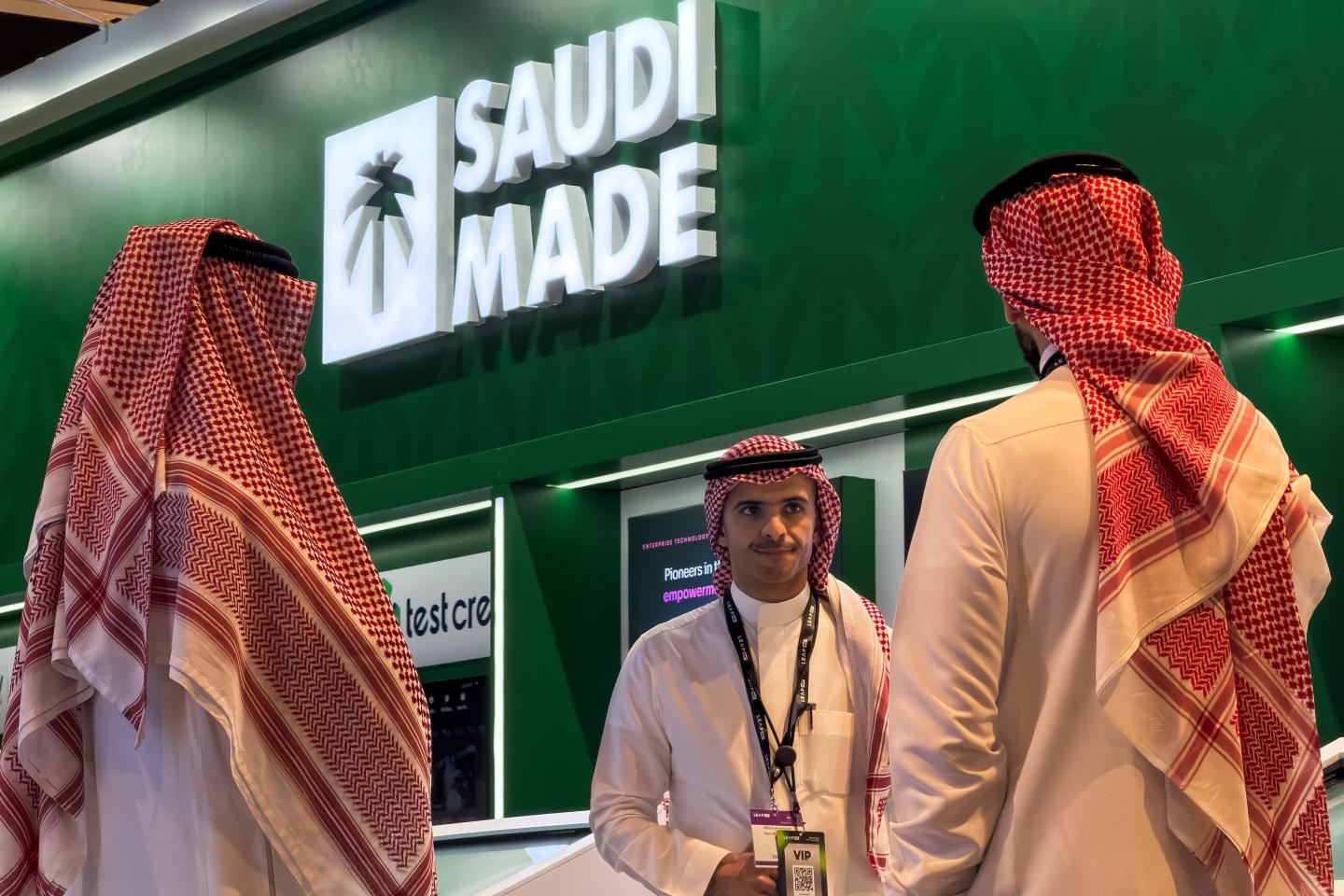
LEAP, Saudi’s biggest tech conference, kicked off on Monday with $15 billion worth of planned technology investments and strategic commitments being unveiled, helping make up for lost time after the event was delayed by four months due to the Iran war.
San Francisco-based AI cloud platform Together AI signed an agreement with Saudi-backed HUMAIN to build a 250 Megawatt (MW) AI data center in the kingdom. It is expected to yield over $5 billion in gross annualized revenue in its first year.
Also notable is Amazon Web Services’ (AWS) expanded partnership with HUMAIN—the key vehicle for Saudi’s AI ambitions which aims to provide up to 50 MW of capacity in the kingdom’s first AI Zone by 2028.
Meanwhile, Elon Musk’s xAI announced plans to build its first data center outside the U.S., initially targeting 50MW of capacity before scaling to 500MW.
Riyadh is increasingly competing with its Gulf neighbors, most notably the UAE, to become the region’s AI hub.
In a clear endorsement of its ambitions, LEAP 2026 has seen senior leaders from global tech behemoths, including NVIDIA, Google, Roblox, Uber, Meta, Lenovo, Nokia and Luma AI, fly in for the event despite the ongoing geopolitical instability.
Since LEAP launched in 2022, Saudi Arabia’s digital economy has grown by 69%, from $118 billion to $199 billion, according to the kingdom’s Communications and Information Technology Ministry.
This year’s event features 1,800 global technology brands exploring the future of AI, cloud computing, cybersecurity, smart cities, fintech, healthcare, space, gaming, and mobility. And, of course, the now seemingly mandatory robots to showcase the latest technological advancements.
Melissa Hancock
As ever, thanks for reading, and do keep in touch with your thoughts and ideas.
melissa.hancock@fortune.com
Dubai airport’s big test: Will international airlines return amid war?
Dubai Airports was flying high in 2025; it handled a record 95.2 million passengers last year—the highest annual international traffic ever logged by an airport.
But the impact of the U.S.-Iran war on its operations has been stark.
Passenger numbers plunged 31.3% in the first half of 2026 to 31.5 million, compared with the same period a year earlier, while cargo volumes dropped 28.7%.
The war has even seen the airport become a direct target. Since February, its infrastructure has been hit by 16 missiles, and 111 missile alerts have been triggered.
And yet, Dubai Airports CEO Paul Griffiths said it is staging a healthy recovery, telling Fortune that he expects full-year traffic to finish “in the 70 millions.”
Wishful thinking?
Griffiths said Dubai International Airport is operating at roughly 80% of capacity, while Emirates and flydubai have restored around 90% of their networks.
There is also evidence of international airlines gradually returning. Air France, for example, resumed its service to Dubai on 26 August after a six-month disruption, but noted its operations “will remain subject to an assessment of the security situation locally”.
Therefore, the UAE’s announcement on Monday that it had intercepted an Iranian drone over its territorial waters is exactly the kind of event that could threaten Dubai Airport’s recovery.
The attack comes after the U.S. and Iran exchanged fire over the weekend for the first time since late July.
The resumption of hostilities has led Europe’s aviation regulator, the European Union Aviation Safety Agency, to extend its warning to airlines until 30 September, advising them to avoid airspace over the waters of the Persian Gulf within the UAE, Bahrain, Kuwait and Qatar.
That matters enormously for Dubai Airports because its business model depends on being a global connecting hub. Restoring the confidence of international airlines remains its biggest challenge; before the war, roughly 90 airlines served the emirate, today it stands at 56.
You can read Inzamam Rashid’s full interview with Griffiths here.
U.S. escalates Iran pressure with UAE banking crackdown
The U.S. Treasury Department announced last week that it will bar the UAE branches of Egyptian lender Banque Misr from the U.S. financial system over its dealings with Iran. The move comes as it seeks to sever the remaining financial lifelines that sustain the Iranian regime.
The Treasury estimates that between January 2024 and June 2026, Banque Misr UAE processed approximately $1.8 billion for 103 companies that are “potentially part of Iranian shadow banking networks”.
In a statement, Treasury Secretary Scott Bessent noted that the U.S. had warned that Iran’s enablers cannot continue to enjoy access to the U.S. dollar and the global financial system.
“Banque Misr UAE decided to find out the hard way, and today, we are taking the first step in holding it accountable for its continued, egregious support of the Iranian regime,” he said.
The UAE’s central bank has said it will launch an investigation into the transactions. Last month, the UAE said it would cut trade ties with Iran.
However, Iranian banks across Dubai remain open for business, including a branch of Bank Melli, Iran’s largest lender, according to the Wall Street Journal.
Notably, Bessent stated that: “Every Bank Melli branch must be shuttered and dark” when he launched Operation Economic Outcast on 24 August, comprising a new package of sanctions aimed at severing Iran’s global economic ties.
The UAE is Iran’s key trading partner in the GCC and its top source of imports. In the 10 months preceding the war, Iran's trade with the UAE totalled $21 billion according to official Iranian figures.
A coffee, a card swipe—and Syria rejoins the global financial system
Last week proved significant in Damascus’ reintegration into the global financial system.
Buying a cup of coffee is usually considered a fairly mundane event. But last Wednesday, Syrian President Ahmed al-Sharaa carried out the country’s first international Visa transaction in 15 years to purchase a coffee in the presence of the Syrian Central Bank governor Mohammed Safwat Raslan, who called it a “new beginning.”
The purchase was made possible by the U.S.’s decision to remove Syria from its list of state sponsors of terrorism—a major step in dismantling the country’s barriers to establishing international financial relationships.
On Thursday, Mastercard and Qatar’s QNB Group announced that they had processed Syria’s first international card payment in more than 15 years.
These developments will ease the path for Syrian banks to establish relationships with international lenders and for companies to attract foreign investment.
On Monday, UAE developer Arada signed a $7 billion deal with the state-owned Syrian Sovereign Fund to develop a 4 million-square-meter residential, health and entertainment megaproject dubbed “New Damascus”.
Meanwhile, Dubai’s Emaar Properties plans to invest up to $18 billion in Syria across various projects.
Last week, Saudi Arabia and Syria’s governments established a joint bank to streamline cross-border payments and boost bilateral investment. Saudi firms have also signed key deals, including a 30-year agreement via Ithraa Group to rehabilitate and operate the Hama Steel Plant, alongside transport agreements covering roads, rail, and aviation.
There are also Qatari-funded plans to redevelop Damascus airport and double the size of Syria Air’s aircraft fleet.
The influx of Gulf money is proving critical to helping Syria get back on its feet.
After being ravaged by a civil war for 13 years before the fall of the Assad regime in December 2024, the World Bank has estimated that the country’s post-conflict reconstruction costs stand at $216 billion.
The Big Number
$2.7 billion
The total amount that ADNOC’s shipping arm has spent on vessels this year, spanning both newbuild and existing ships. Last week, it announced it had acquired two newbuild LNG ships for $444 million, with delivery scheduled for 2029.
The 3 things we enjoyed reading this week
- Sheikh Tahnoon bin Zayed al Nahyan, the deputy ruler of Abu Dhabi and UAE national security adviser, is a major shareholder backing a new U.S. bank the Trump family’s cryptocurrency venture is preparing to launch. Sheikh Tahnoon, who chairs the Abu Dhabi Investment Authority with over $1 trillion in assets, and co-investors own a 49% stake in the holding company behind World Liberty Financial's planned U.S. crypto bank. The bank recently won preliminary regulatory approval to issue USD1—the dollar-backed stablecoin World Liberty launched last year. DT Marks DEFI, an entity affiliated with Trump and members of his family, owns about 38% of the holding company. This Wall Street Journal piece shines a light on the entanglement between Trump’s political power, a foreign government insider and a rapidly expanding crypto business—raising questions about conflicts of interest and the unusual blending of state and private money.
- In this impressive piece of investigative reporting, the FT reveals Russia has secretly been helping Iran build supersonic cruise missiles under a covert programme, using top Russian missile specialists to develop a ramjet propulsion system capable of threatening U.S. warships in the Gulf. The collusion began in 2023 and has continued through the U.S.-Israeli war with Iran. Experts say the technology, long sought by Tehran, would require top-level Kremlin approval.
- Frieze, the global contemporary art organization founded in London in 1991, is bringing its global art-fair brand to Abu Dhabi for the first time. Set to debut at Manarat Al Saadiyat from November 19-22, the inaugural fair will bring together 84 galleries from across 36 countries, including major names such as Gagosian, Pace and Perrotin, alongside leading galleries from the UAE and wider region. The National notes how the fair will span contemporary art, antiquities and early-20th-century works, with new sections including Frieze Masters Abu Dhabi, focused on the Indian Ocean’s history of cultural exchange, and Global Futures, exploring artists and ideas connected to the region.