

A Shakespearean saga is playing out between the White House, Treasury Department, the Federal Reserve and Wall Street—and Scott Bessent, to paraphrase Shakespeare, is being hoist on his own hedge-fund petard.
As Hamlet told his mother Gertrude in Act 3, Scene 4, having just stabbed an eavesdropping Polonius, “’tis the sport to have the engineer/ Hoist with his own petard.” Now Bessent’s former mentor, Stanley Druckenmiller, is the one pulling the trigger—using the same playbook they wrote together over 30 years ago.
In the early 1990s, hedge funds were evolving, and Bessent and Druckenmiller were there at the inception. Their boss, George Soros, pioneered a “global macro” approach that discovered sovereign balance sheets could be read the same way a company’s could: an investing opportunity for the gap between what a government claimed it could sustain and what the market would allow.
The defining proof came in 1992, when Britain was maintaining the pound inside Europe’s exchange-rate mechanism at a level that German interest rates had made untenable. Soros Fund Management built a short position of roughly $10 billion against sterling; Druckenmiller ran the trade and a young Scott Bessent was part of the team. When the pound broke on September 16, the fund made roughly $1 billion in a single day.
Now Druckenmiller is invoking the same logic against Bessent, who has crossed from the trading desk to the Treasury Department. He used the Wall Street Journal opinion page to call out his former protege. But, perhaps unprecedentedly, he did so with an AI-assisted essay. Jeff Stein, the Pulitzer-winning former chief economics correspondent for the Washington Post, wrote on X that he contacted Druckenmiller, who responded “of course” he used AI to write the essay: “There’s a reason I moved from an English major to being an economics major. I’m not embarrassed by it.” Druckenmiller could not be immediately reached for comment by Fortune. The Treasury Department did not respond to a request for comment.
In the Journal, Druckenmiller criticized Treasury’s decision to double long-dated bond buybacks from $2 billion to at least $4 billion per operation—operations targeting securities with maturities of 10 to 30 years, announced after the 30-year Treasury yield had reached a 19-year high.
“The market’s verdict was swift and correct,” Druckenmiller wrote. “This wasn’t liquidity management, it was price management.”
Jon Hilsenrath, who spent two decades covering the Federal Reserve and Treasury for the Journal, read Druckenmiller’s decision to publish as significant in itself. “The fact that he went to the Journal with it suggests to me that he didn’t think his message was getting through,” Hilsenrath told Fortune. He also noted that after serving as Bessent’s mentor at the Soros Fund, Druckenmiller later got closer to Federal Reserve Chair Kevin Warsh.
The situation has a Shakespearean shape—the master watching two proteges navigate a principal whose economic instincts run contrary to what he taught them. Put that way to Hilsenrath, he didn’t resist the framing. “Druckenmiller’s two most prominent students are now running economic policy,” he said, one at Treasury, one at the Fed, “and they are doing so for a president who has a completely different worldview.” Druckenmiller, Hilsenrath noted, didn’t mention Trump by name in his op-ed. The omission is deliberate: the piece puts Druckenmiller at odds with Bessent without putting him openly at odds with the president.
The alignment between the two proteges may be less complete than it appears. Warsh has articulated a market-purist position: let yields speak, don’t intervene. Bessent’s stated rationale for the buyback expansion is nearly its opposite—that Treasury has asymmetric information about market functioning and should act on it. “Those are two diametrically opposed views of the world,” Hilsenrath said. It matters, he added, because budget deficits are “clearly out of line with what the fundamentals say they should be,” and every American is paying the price.
What the long bond says
Druckenmiller’s argument is not that Treasury can never buy back securities. The modern buyback program was introduced in 2024 as a tool for liquidity and cash management. Buying older, less actively traded “off-the-run” bonds can improve market functioning without attempting to dictate the level of yields.
His argument is about timing and presentation. Treasury enlarged the program after the 30-year yield hit a two-decade high, outside the usual quarterly-refunding rhythm, and Bessent subsequently suggested it could grow further. To Druckenmiller, that is the difference between debt management and price management. He saw no failed auctions, dealer-balance-sheet seizure or forced unwind of the kind that accompanied Treasury-market turmoil in March 2020 or the U.K. gilt crisis of 2022.
He also contended that buying longer-dated debt while funding purchases with bills shifts duration risk out of private hands—a limited form of easing undertaken by Treasury rather than the Federal Reserve, and a problematic one when inflation remains above the Fed’s target.
Treasury can offer a different account: properly designed buybacks are a routine, bounded technique for improving liquidity and managing cash, not a formal cap on yields or a covert monetary-policy tool. But the distinction is perishable. If investors read the Aug. 19 decision as Treasury flinching at an unwelcome price—rather than responding to genuine market dysfunction—it invites further tests of official resolve.
Asked to calibrate the danger, Hilsenrath was measured. “A 5% Treasury yield is not a clear and present danger to the economy,” he said. “But it is a problem, which is why you have to pay attention to these market signals now.” Hilsenrath added that his own view is that the bond market has been “complacent” for a long time, and maybe, per Druckenmiller’s point, “the bond market might just now be waking up.”
The industry that changed
The warning lands differently because the Treasury market Bessent is managing is not the one that financed America’s deficits when Druckenmiller and Soros were building their reputations.
Adam Tooze, the Columbia historian and author of the Chartbook newsletter, recently tracked what has changed. For much of the 2000s, foreign official buyers—reserve managers in export-oriented economies—absorbed a significant share of new Treasury issuance.
Countries running trade surpluses with the United States accumulated dollars and recycled them into government debt. That mechanism has weakened substantially since the global financial crisis, and particularly since 2020. In its place, domestic and foreign private investors—including, prominently, hedge funds operating through offshore financial centers such as the Cayman Islands—have become the marginal buyers of U.S. government debt. “The Cayman islands matter,” Tooze wrote, “because they are the offshore home for a significant cluster of hedge funds. And since the 2010s it is hedge funds who have provided a key source of demand for US government debt.” He noted that Bloomberg’s Tracy Alloway has charted the rise of private investors in the Treasury market, as seen below in purple.
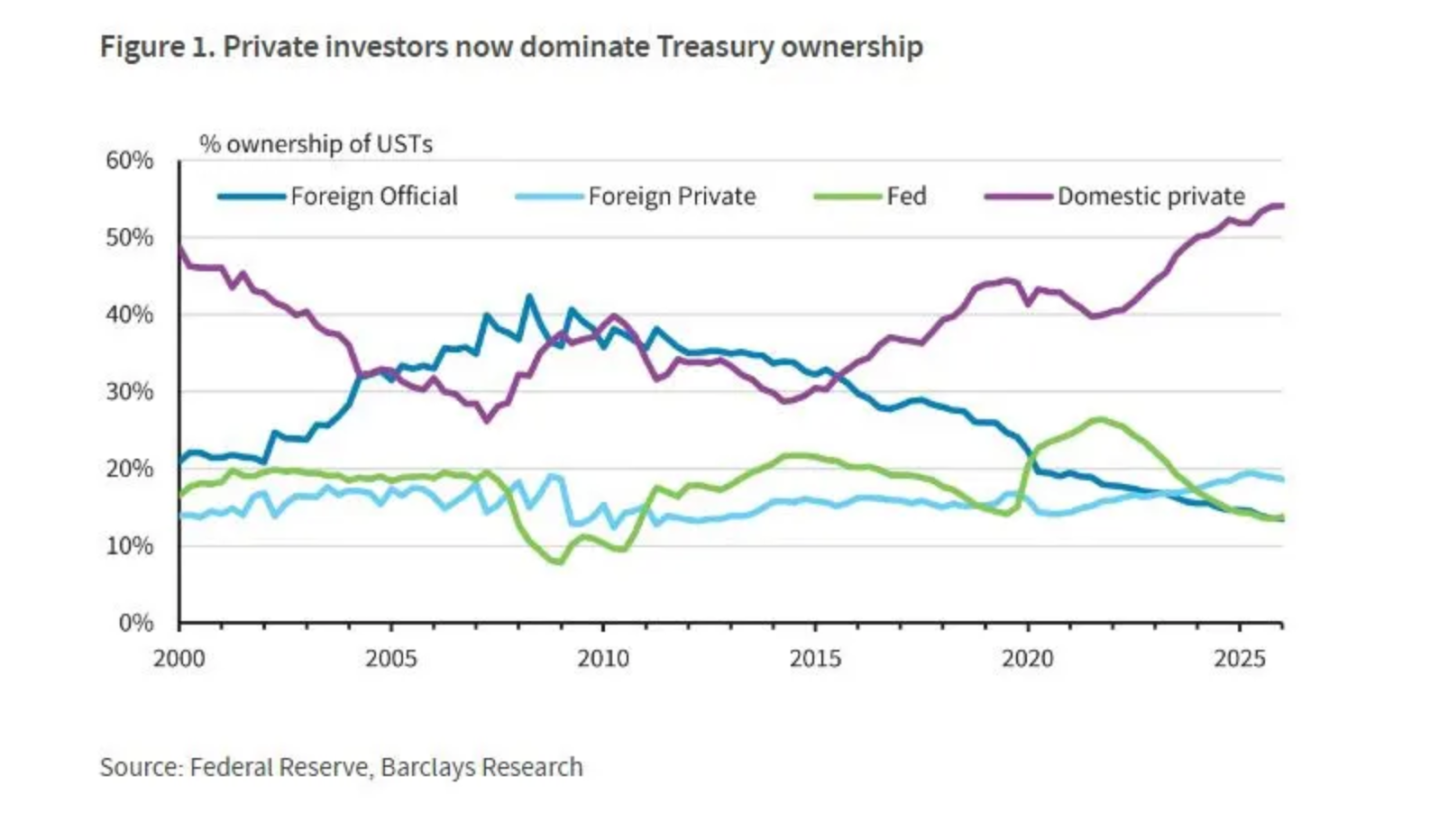
The irony is not subtle. The global-macro industry that Druckenmiller helped build—the one that made its name by betting against governments—now finances the government whose fiscal credibility it once tested. And the instruments have changed along with the players. Where Druckenmiller’s generation took outright directional positions against currencies and interest rates, today’s hedge funds increasingly participate in the Treasury market through basis trades: exploiting the spread between cash bonds and futures contracts using significant leverage. Tooze cited a New York Fed analysis estimating that hedge funds held $2.4 trillion in long Treasury exposure as of September 2025—exceeding holdings by mutual funds and U.S.-chartered depository institutions. The 50 funds with the largest gross Treasury exposures accounted for about 90% of the total. Aggregate basis-trade volume stood at roughly $830 billion, close to twice its early-2020 peak.
The precedent for what happens when that capital moves quickly is March 2020, when a rapid unwind of leveraged positions contributed to a breakdown of Treasury-market liquidity severe enough to require Federal Reserve intervention. The exposures are now substantially larger.
The macro irony
This puts Druckenmiller’s injunction to “let the bond market speak” in a more complicated light. His warning is first a fiscal one: the long bond reflects inflation, growth expectations, fiscal supply and confidence in the government’s willingness to confront its deficits. Dulling that signal, he argues, only delays the political confrontation needed to reduce the primary deficit. “If the 30-year must trade at 5.5% to clear,” he wrote in a somewhat obvious voice that’s become synonymous with the use of AI, “that isn’t a crisis. It is an invoice.”
But market prices also reflect market structure. A move in long-term yields can be a referendum on fiscal credibility, a reflection of inflation expectations, or a product of the mechanics by which leveraged positions are financed, hedged and distributed. Often it is all three. If Treasury reacts to ordinary yield increases as though they were an emergency, it may make investors doubt its commitment to price discovery. If it disregards genuine strains in the fragile architecture that now absorbs so much government debt, it risks allowing a liquidity problem to become a disorderly unwind.
The task for Bessent is to demonstrate that Treasury knows the difference. But there is an irony in the setup that Druckenmiller himself didn’t acknowledge: the investors now pressing on long-term yields are, structurally, the same kind of actor Bessent spent his career being.
The situation “has echoes of the past,” Hilsenrath said, adding that the past is never a perfect framework for thinking about the present. The Bank of England in 1992 was trying to defend a price on its currency that the market had found indefensible, he said, whereas in this case, Bessent is trying to defend a price in the Treasury market that the market found indefensible.
Beyond a currency and a Treasury bond being somewhat apples and oranges, he added, “the problem might be, we shall see, more profound in the sense that the market seems to be waking up to the idea that U.S. fiscal policy is unsustainable.” That’s the question Druckenmiller is now raising, he added: whether the United States is willing to confront a fiscal position that its own creditors are beginning to doubt. When asked about the use of AI in writing the essay, Hilsenrath said he didn’t especially care, because he thought Druckenmiller made several “brilliant” points and, ultimately, he put his name on it.
“The good news is that if you get serious about addressing these issues, you can actually fix them,” Hilsenrath said. “The problem—as anyone in Spain, Italy or Greece can tell you—is that if you let the market impose a fix on you, it’s going to be a lot more painful.”
For this story, Fortune journalists used generative AI as a research tool. An editor verified the accuracy of the information before publishing.