
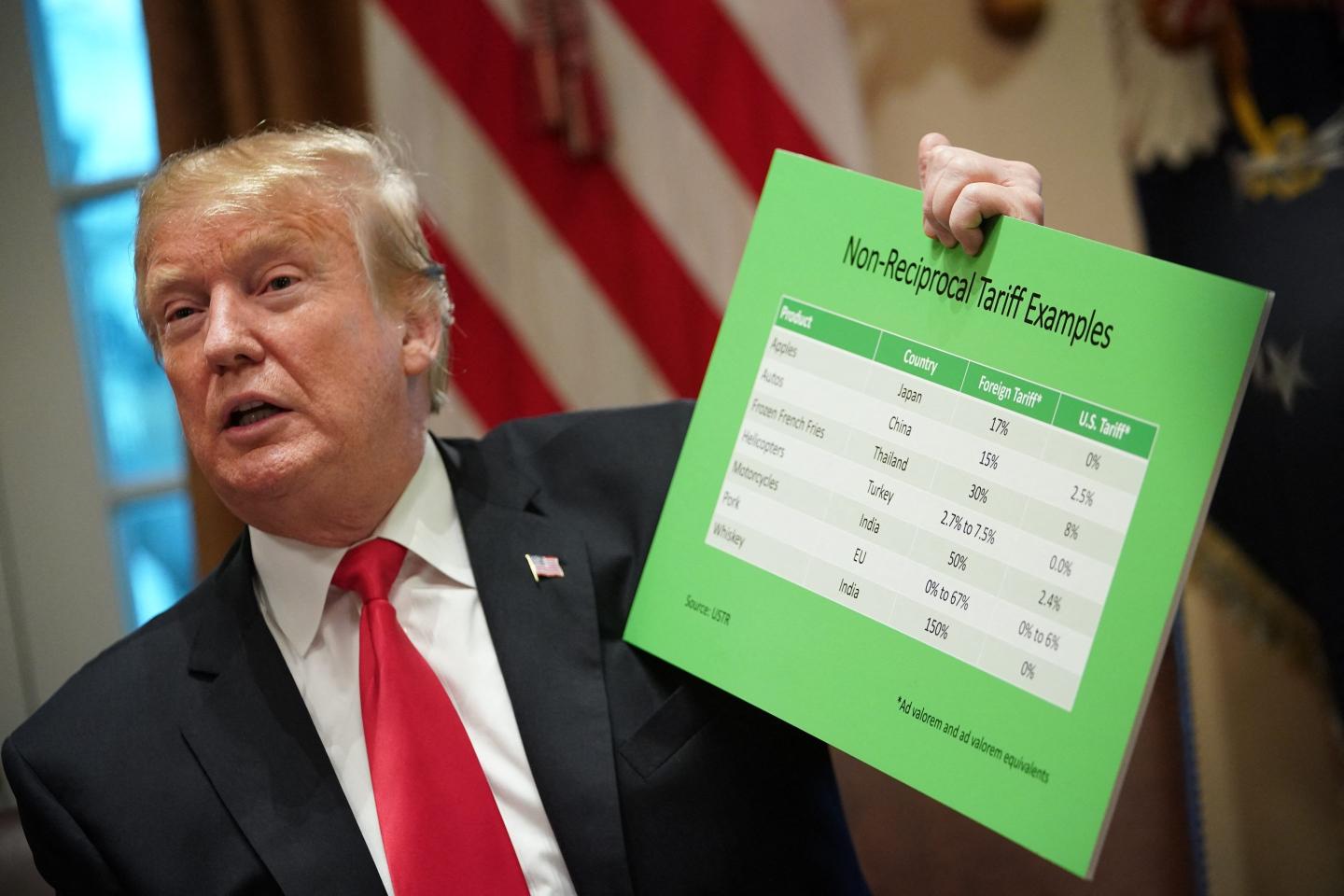
The federal government’s tariff windfall is evaporating faster than expected, and the Congressional Budget Office says it’s blowing a $200 billion hole in this year’s budget.
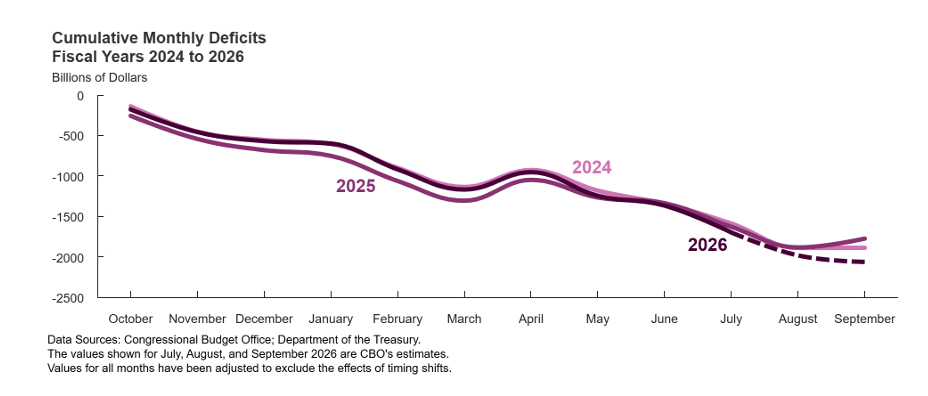
CBO now projects the fiscal 2026 deficit will hit $2.1 trillion, according to the nonpartisan scorekeeper’s Monthly Budget Review released Monday—up from the $1.9 trillion the agency forecast in February, before the Supreme Court struck down President Trump’s signature tariff program.
Federal spending is running close to its February baseline for the year, CBO noted, meaning the deficit is almost entire due to the revenue side.
CBO estimates that tariff and customs-duty collections in 2026 will come in $250 billion below its earlier projections. The 60% drop traces directly back to the Supreme Court’s Feb. 20 ruling that found the Trump administration lacked authority to impose tariffs under the International Emergency Economic Powers Act.
Stronger-than-expected income and payroll tax collections, running about $75 billion above the February baseline, have cushioned some of the blow. But CBO said the rest of the government’s revenue streams are tracking $25 billion below projections, leaving a net revenue gap of roughly $200 billion that outlays alone can’t explain.
“We’ve borrowed an astounding $1.8 trillion this fiscal year, with $431 billion in the month of July alone, and equating to nearly $6 billion per day,” said Maya MacGuineas, president of the Committee for a Responsible Federal Budget. “We’re on track to surpass $2 trillion in borrowing this fiscal year despite not being in a recession. That is not normal.”
A tariff regime in flux
The scramble to replace lost tariff revenue has been a study in improvisation. After the Supreme Court struck down the IEEPA tariffs, the administration first pivoted to duties under Section 122 of the Trade Act of 1974—a temporary authority that expired July 24—before shifting again to tariffs under Section 301 of the same law. CBO expects the new regime to recoup “a substantial share” of what was lost, but not all of it.
The scale of the reversal shows up starkly in the monthly data. Net customs-duty collections, which had outpaced last year’s totals every month through April, flipped negative as refunds tied to the Supreme Court ruling began flowing in May.
By July, the government was refunding more in tariffs than it collected: $36 billion in refunds against just $26 billion in gross collections, producing a net outflow of $9 billion for the month alone. CBO said roughly $100 billion has now been refunded on duties collected under the invalidated IEEPA authority.
“Incredibly, such an enormous level of borrowing barely scratches the surface of our fiscal deterioration,” MacGuineas said. “We are about to hit the sobering milestone of $40 trillion in gross national debt, and things are only likely to get worse.”
She urged lawmakers to target a reasonable fiscal goal, such as 3% of GDP deficits, and then to create a bipartisan commission to get there. “We can no longer afford to put off the difficult decisions. The time to act is now.”
Deficit already running hot
The tariff shortfall compounds a budget picture that was already deteriorating. The deficit totaled $1.8 trillion in the first 10 months of fiscal 2026, CBO said—$169 billion wider than the same period a year earlier. Adjusting for a technical quirk (an Aug. 1 payment deadline that fell on a weekend and pushed some outlays into July), the year-to-date gap was $71 billion wider than fiscal 2025.
July alone produced a $431 billion deficit, up $140 billion from a year earlier. Receipts actually fell $5 billion (1%) for the month even as income and payroll tax collections rose $31 billion (11%), because the customs-duty reversal overwhelmed that gain.
Where the money went
On the spending side, the usual entitlement drivers were at work for the fiscal year to date: Social Security outlays rose $70 billion (5%), Medicare climbed $66 billion (8%), and Medicaid rose $45 billion (8%)—a combined $181 billion (7%) increase across the three largest mandatory programs.
Net interest on the public debt, now one of the fastest-growing lines in the federal budget, jumped $117 billion (14%), reflecting both a larger debt load and higher long-term rates.
Beyond those, spending swung across several agencies for reasons unrelated to tariffs or entitlements:
- Department of Education outlays fell $79 billion (60%), largely because the agency recorded a $53 billion net reduction in estimated student loan costs in June 2026 versus a $24 billion increase booked in July 2025.
- Department of Housing and Urban Development spending rose $17 billion (43%) because it did not repeat a 2025 downward revision to the estimated cost of housing loan guarantees.
- Environmental Protection Agency outlays dropped $20 billion (59%) because of lower clean-energy grant disbursements.
- Small Business Administration spending rose $10 billion—roughly six times last year’s total—after the agency raised its cost estimate for outstanding disaster loans.
- Defense Department military spending rose $39 billion (5%) on personnel and R&D; Veterans Affairs outlays rose $34 billion (11%) on more beneficiaries and higher per-person costs.
On revenue, corporate income tax receipts fell $89 billion (23%) for the year, which CBO attributed to expanded deductions for corporate investment—a decline that would otherwise have been offset by rising corporate income.
The bigger picture
The report underscores how central tariff policy has become to the government’s fiscal trajectory, and how exposed that revenue stream is to legal and political risk. Just months ago, tariffs were being pitched by the administration as a meaningful offset to the cost of tax cuts. The Supreme Court’s ruling has scrambled that math, and the replacement tariffs leave the durability of that revenue very much in question heading into fiscal 2027.
For this story, Fortune journalists used generative AI as a research tool. An editor verified the accuracy of the information before publishing.