
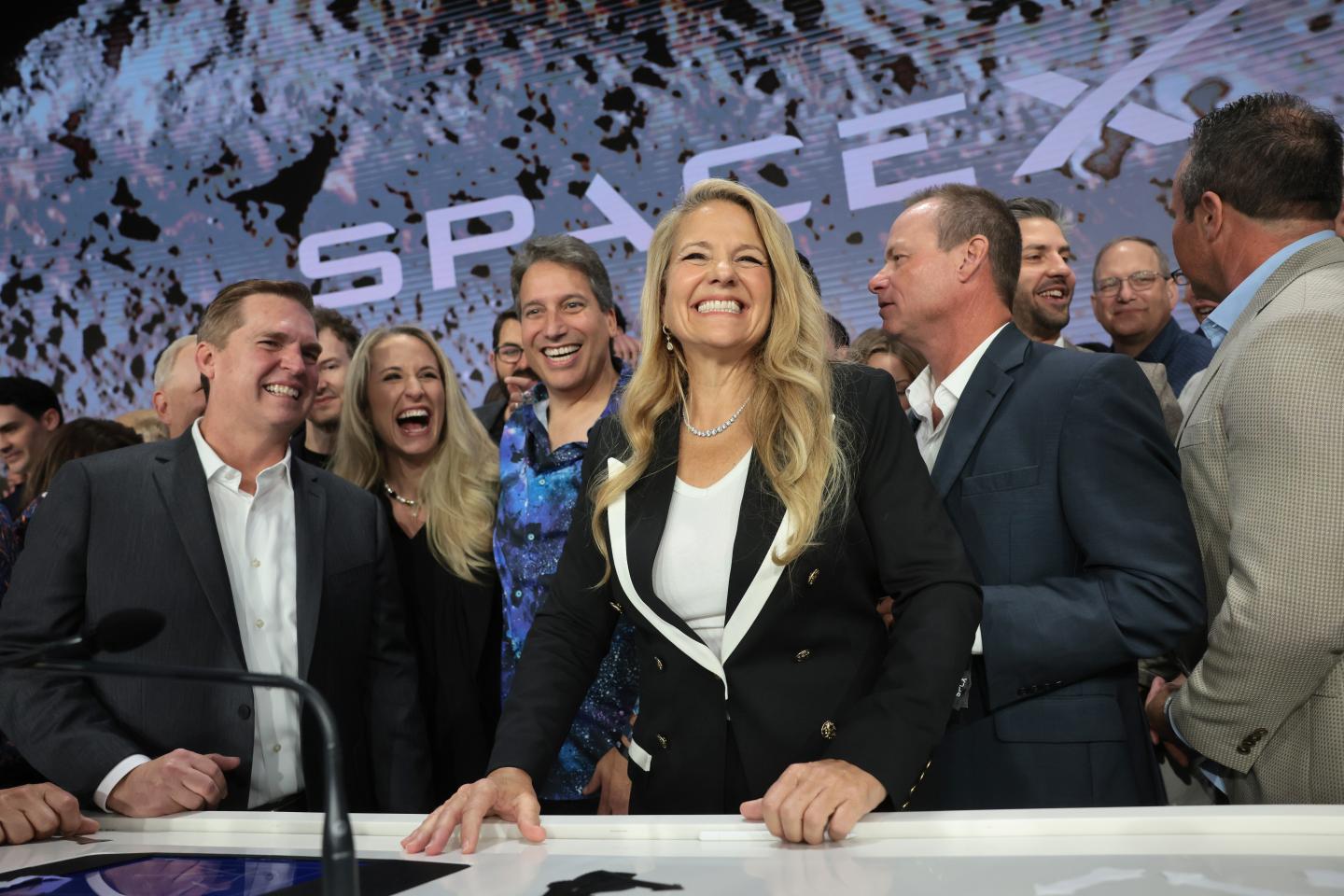
After markets closed yesterday, Wall Street analysts and journalists gathered for a notable earnings call: the first of of the newly public SpaceX.
SpaceX grew revenue 92% to $7.8 billion, but shares slid more than 5% after the results were released and kept dipping. SpaceX has been on that slide since hitting a $2 trillion valuation in its June IPO, losing close to $500 billion in market cap. Despite narrowing its losses, investors continue to worry about capital expenditures and slow return on spending.
But more than market results, we got a peek into the dynamic between Elon Musk and SpaceX president and COO Gwynne Shotwell during yesterday’s earnings call. While Musk is SpaceX’s CEO, Shotwell has been known as the exec running SpaceX’s day-to-day while the world’s richest man splits his attention across his businesses (and, for a time, politics). Shotwell was No. 32 on the 2026 Most Powerful Women list.
Indeed, Musk spoke first on yesterday’s earnings call and mainly set the long-term vision for SpaceX. He argued that SpaceX (which in addition to its rocket/space business, includes the merged AI company xAI) is “building AI compute capacity at scale faster than anyone else.” He recounted some Starship flight milestones, before arguing for the “magnitude of the impact Starship will have on the future of civilization.” He called out competitors again—arguing that SpaceX would be too far off the chart on a basic bar graph to depict its payload mass in orbit alongside any other businesses. Then he turned to SpaceX’s satellite internet service Starlink. “It’s kind of hard for people to wrap their minds around this, but it’s not out of the question that at some point Starlink will deliver a majority of the world’s internet,” he said. He emphasized that this was not a possibility in some distant “infinity future,” but something SpaceX could achieve in less than 10 years.
Multiple times during the call, Musk argued that the vision he was describing was not science fiction. “I know this sounds totally nuts,” he said at one point, responding to a question about robotics with an explanation of his plan to scale to “1,000 times the economy of Earth” and build factories on the moon.
Meanwhile, Shotwell reported on what’s happening with the SpaceX business here on Earth (or at least starting here on Earth). Her prepared remarks covered operational and commercial highlights, as well as top business initiatives in the near term. She reported on rocket launches (78 in the first half of this year), new Starlink customers (1.7 million added in the second quarter), and government contracts ($6 billion in new U.S. contracts in Q2).
Overall, Shotwell’s critical role at SpaceX was clear. She fielded questions from analysts as much as Musk did. We saw their productive working relationship, with the pair sometimes tag-teaming answers.
Before SpaceX’s IPO, Shotwell said she was excited about a new way of running companies. Yesterday was the public’s first view at how she’s doing just that. “I could not be more excited about the months ahead with all the exciting and amazing things going on,” she said. “It really feels like we’re just getting started all over again.”
Emma Hinchliffe
emma.hinchliffe@fortune.com
The Most Powerful Women Daily newsletter is Fortune’s daily briefing for and about the women leading the business world. Subscribe here.
ALSO IN THE HEADLINES
Uber's lawyers asked a sexual assault survivor what she was wearing. Uber has been overhauling its handling of assault and harassment claims against drivers after more attention was put on the issue. There have been new instructional videos for drivers and promises to respond to such incidents in a "trauma-informed" way. But those pledges don't seem to have translated to court, where in a civil lawsuit for negligence, Uber's attorney asked the woman how much vodka she drank, what dress she was wearing, whether she was wearing heels, whether she felt abandoned or degraded by either of her parents, and whether she had ever had sex in exchange for money. In this case, the driver in question has already pled guilty to rape and is serving a 10-year sentence. Uber's chief legal officer said the U.S.'s "adversarial legal system can be particularly tough for survivors."
A McTurnaround. My colleague Phil Wahba dives into McDonald's appointment of Skye Anderson as its new U.S. president. Anderson is a "proven change agent who can act with urgency to mobilize our system," McDonald's CEO Chris Kempczinski said. He touted her record modernizing 5,700 restaurants in McDonald's West Coast business.
Lauren Sánchez Bezos's next move. The Bezos Earth Fund (of which Sánchez Bezos is vice chair) launched a $200 million initiative called the Phoenix Species Project to revive 100 of Earth’s most threatened species.
Claire Stapleton led the 2018 Google employee walkout. Now she's written a new book about leaving Big Tech behind. Her memoir is called Don’t Be Evil: Bad Bosses, Fake Promises, and My Escape from Big Tech. Her biggest lesson, she says, is that "institutions are not people." They "don’t really have a conscience, they have an incentive structure."
ON MY RADAR
Gracie Abrams built a career on honesty. She's going even deeper now Rolling Stone
The tradwife illusion meets the anti-Trump reality NYT
Inside the Golden State Valkyries’ billion-dollar success that’s setting a new WNBA bar The Athletic
PARTING WORDS
"Ballet’s future can hold so many different voices and identities and aesthetics and experiences, and it should be as rich as our world."
— Misty Copeland, who after retiring from American Ballet Theater is curating the Ballet Festival at the Joyce Theater