
• Home
  • Latest
  • Fortune 500
  • Finance
  • Tech
  • Leadership
  • Lifestyle
  • Rankings
  • Multimedia

New

Watch Fortune Daily, our new video show that brings you inside the Fortune newsroom and the boardroom

Watch Fortune Daily, our new video show that brings you inside the Fortune newsroom and the boardroom

Watch Fortune Daily, our new video show that brings you inside the Fortune newsroom and the boardroom

Watch Fortune Daily, our new video show that brings you inside the Fortune newsroom and the boardroom

Watch Fortune Daily, our new video show that brings you inside the Fortune newsroom and the boardroom

Watch Fortune Daily, our new video show that brings you inside the Fortune newsroom and the boardroom

Watch Fortune Daily, our new video show that brings you inside the Fortune newsroom and the boardroom

Watch Fortune Daily, our new video show that brings you inside the Fortune newsroom and the boardroom

Watch Fortune Daily, our new video show that brings you inside the Fortune newsroom and the boardroom

Watch Fortune Daily, our new video show that brings you inside the Fortune newsroom and the boardroom

CommentaryU.S. Department of the Treasury
Asia

Bessent’s Yen gamble is a warning sign — buckle up

By
Steve H. Hanke
Steve H. Hanke
and
Roger Koppl
Roger Koppl
Down Arrow Button Icon
By
Steve H. Hanke
Steve H. Hanke
and
Roger Koppl
Roger Koppl
Down Arrow Button Icon
August 4, 2026, 1:22 PM ET
bessent
Treasury Secretary Scott Bessent walks away after a television interview on the North Lawn of the White House on July 30, 2026 in Washington, DC. Andrew Harnik/Getty Images
Add Fortune on Google for similar content.

Last week, U.S. Treasury Secretary Bessent joined with Japan’s Ministry of Finance to intervene in currency markets in an effort to boost the yen to levels that Bessent proclaimed would be more appropriate. Bessent decided that markets are not valuing the yen correctly. Apparently, a host of traders with skin in the game have it all wrong; Bessent knows better. Bessent started tongues wagging by saying in a Fox Business interview that the yen was “very undervalued” and “excess volatility” isn’t healthy.

Recommended Video

There is no question that Bessent’s activity in the yen market qualifies as that of a Big Player. Recall our earlier piece in Fortune, in which we laid out the characteristics of a Big Player. Big Players are big because their words and deeds move markets. They are insensitive to profit and loss. They are also discretionary because they are not bound by any simple, understandable rules. They act on judgments that oscillate with their mood swings. So, fasten your seat belts. Forget the exchange rates thrown up by the markets. Bessent will act to move the yen to levels he deems appropriate, whatever they might happen to be.

Following the intervention of Bessent and Japan’s Ministry of Finance, the yen strengthened in what may or may not turn out to be a dead cat bounce. Just why did the yen strengthen? First, there was the actual intervention, which consisted of direct purchases of the yen. Second, and more importantly, there was jawboning from U.S. Treasury Secretary Scott Bessent and Japanese Finance Minister Satsuki Katayama. Both made it clear that they wanted a stronger yen and that they were going to intervene to give the dying yen a little life. Big Players’ say-so moves markets. This sort of manipulation produces volatility and perplexes markets. 

As it turns out, Bessent is following an old and discredited playbook. In 1887, Ivan Vyshnegradsky replaced Nicolai Bunge as czarist Imperial Russia’s finance minister. Bunge was a principled non-interventionist. He was not a Big Player. Vyshnegradsky, however, was the very archetype of a Big Player. He eagerly manipulated the ruble’s exchange rate against the gold-based German mark. He was even reported to have rubbed his hands in glee once when he thought he had gotten the better of Berlin speculators. Just take a look at the accompanying figure. It shows what Big Player Vyshnegradsky’s interventions accomplished.
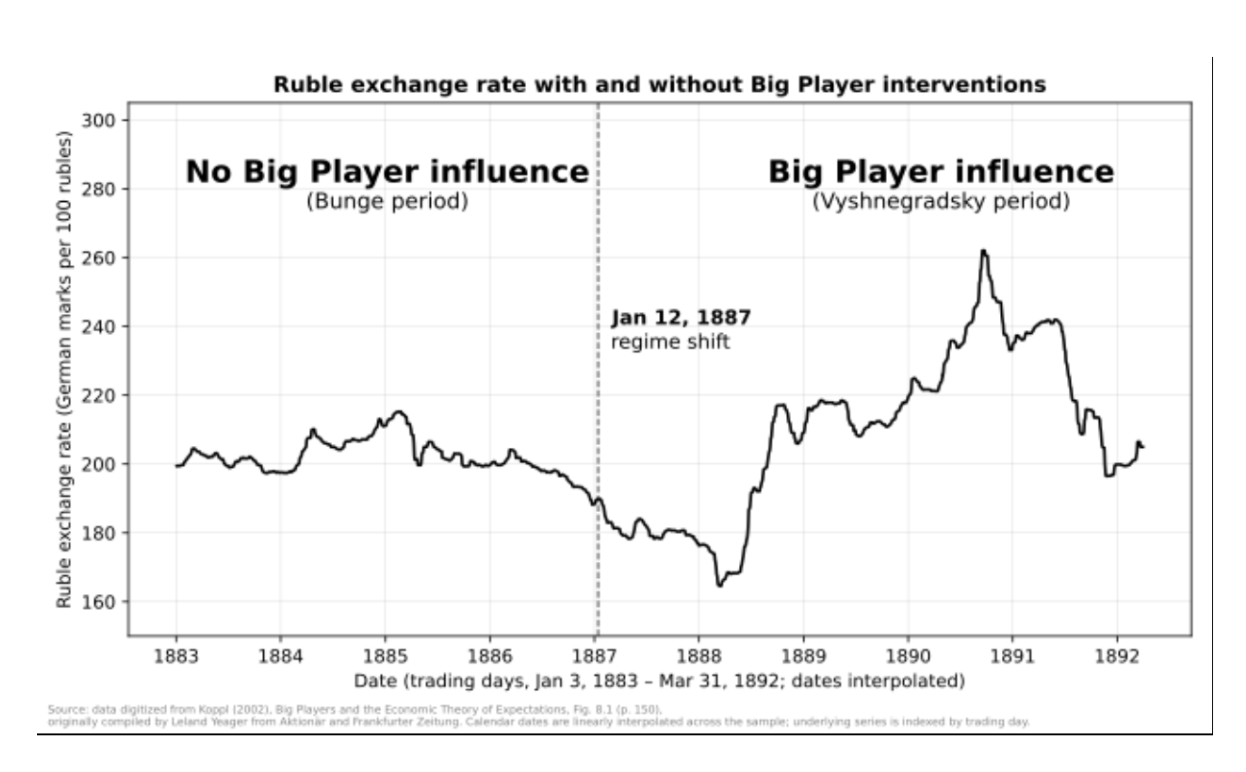
Vyshnegradsky’s interventions increased volatility. Vyshnegradsky’s successor, Sergei Witte, offers the counterpoint. Rather than freelancing with discretionary interventions, Witte committed the ruble to the gold standard in 1897. For Witte, the rule-based gold standard was a symbol of Imperial Russia’s standing and equality with others in the international capitalist order. The calm that followed was no accident: research on central bank interventions shows they work far better when defending a currency’s rise than when trying to force it down, exactly the kind of asymmetry a rules-based system sidesteps entirely. Rules constrain; Big Players improvise. This is just what the economic theory of Big Players predicts. Contrary to Bessent’s assertions, Big Player interventions in currency markets create more volatility, not less.

This is just what the economic theory of Big Players predicts. Contrary to Bessent’s assertions, Big Player interventions in currency markets create more volatility, not less. 

Now that he’s become a Big Player in currency markets, Bessent will launch a whole new industry of Treasury watching. Traders will hang on every word slipping from Bessent’s lips, every passing remark and every whispered rumor.  

What counts the most will no longer be “underlying fundamentals.” What counts the most will be the moves of the Big Player, guesses about those moves, and guesses about those guesses. All that guessing will create herding and noise trading as the crowd chases the crowd like a dog chases its tail, in a futile attempt to get ahead of the next unpredictable change in what humors the Big Player. Economic fundamentals, in the meantime, will fade into irrelevancy.  Welcome to the age of Big Players.

The opinions expressed in Fortune.com commentary pieces are solely the views of their authors and do not necessarily reflect the opinions and beliefs of Fortune.
Fortune Daily breaks the traditional barrier between audience and newsroom. The show transforms Fortune’s trusted reporting into actionable, conversational, and entertaining insights for an emerging class of business leaders. Watch here.
About the Authors
Steve H. Hanke
By Steve H. Hanke
Twitter icon
See full bioRight Arrow Button Icon
By Roger Koppl
See full bioRight Arrow Button Icon
Add Fortune on Google for similar content.

Latest in Commentary

Finance
Lorem ipsum dolor sit amet, consectetur adipiscing elit, sed do eiusmod tempor incididunt ut labore et dolore magna aliqua. Ut enim ad minim veniam
By Fortune Editors
October 20, 2025
Finance
Lorem ipsum dolor sit amet, consectetur adipiscing elit, sed do eiusmod tempor incididunt ut labore et dolore magna aliqua. Ut enim ad minim veniam
By Fortune Editors
October 20, 2025
Finance
Lorem ipsum dolor sit amet, consectetur adipiscing elit, sed do eiusmod tempor incididunt ut labore et dolore magna aliqua. Ut enim ad minim veniam
By Fortune Editors
October 20, 2025
Finance
Lorem ipsum dolor sit amet, consectetur adipiscing elit, sed do eiusmod tempor incididunt ut labore et dolore magna aliqua. Ut enim ad minim veniam
By Fortune Editors
October 20, 2025
Finance
Lorem ipsum dolor sit amet, consectetur adipiscing elit, sed do eiusmod tempor incididunt ut labore et dolore magna aliqua. Ut enim ad minim veniam
By Fortune Editors
October 20, 2025
Finance
Lorem ipsum dolor sit amet, consectetur adipiscing elit, sed do eiusmod tempor incididunt ut labore et dolore magna aliqua. Ut enim ad minim veniam
By Fortune Editors
October 20, 2025

Most Popular

Finance
Lorem ipsum dolor sit amet, consectetur adipiscing elit, sed do eiusmod tempor incididunt ut labore et dolore magna aliqua. Ut enim ad minim veniam
By Fortune Editors
October 20, 2025
Finance
Lorem ipsum dolor sit amet, consectetur adipiscing elit, sed do eiusmod tempor incididunt ut labore et dolore magna aliqua. Ut enim ad minim veniam
By Fortune Editors
October 20, 2025
Finance
Lorem ipsum dolor sit amet, consectetur adipiscing elit, sed do eiusmod tempor incididunt ut labore et dolore magna aliqua. Ut enim ad minim veniam
By Fortune Editors
October 20, 2025
Finance
Lorem ipsum dolor sit amet, consectetur adipiscing elit, sed do eiusmod tempor incididunt ut labore et dolore magna aliqua. Ut enim ad minim veniam
By Fortune Editors
October 20, 2025
Finance
Lorem ipsum dolor sit amet, consectetur adipiscing elit, sed do eiusmod tempor incididunt ut labore et dolore magna aliqua. Ut enim ad minim veniam
By Fortune Editors
October 20, 2025
Finance
Lorem ipsum dolor sit amet, consectetur adipiscing elit, sed do eiusmod tempor incididunt ut labore et dolore magna aliqua. Ut enim ad minim veniam
By Fortune Editors
October 20, 2025
Fortune Secondary Logo
Rankings
  • 100 Best Companies
  • Fortune 500
  • Global 500
  • Fortune 500 Europe
  • Most Powerful Women
  • World's Most Admired Companies
  • See All Rankings
  • Lists Calendar
Sections
  • Finance
  • Fortune Crypto
  • Features
  • Leadership
  • Health
  • Commentary
  • Success
  • Retail
  • Mpw
  • Tech
  • Lifestyle
  • CEO Initiative
  • Asia
  • Politics
  • Conferences
  • Europe
  • Newsletters
  • Personal Finance
  • Environment
  • Magazine
  • Education
Customer Support
  • Frequently Asked Questions
  • Customer Service Portal
  • Privacy Policy
  • Terms Of Use
  • Single Issues For Purchase
  • International Print
Commercial Services
  • Advertising
  • Fortune Brand Studio
  • Fortune Analytics
  • Fortune Conferences
  • Business Development
  • Group Subscriptions
About Us
  • About Us
  • Press Center
  • Work At Fortune
  • Terms And Conditions
  • Site Map
  • About Us
  • Press Center
  • Work At Fortune
  • Terms And Conditions
  • Site Map
  • Facebook icon
  • Twitter icon
  • LinkedIn icon
  • Instagram icon
  • TikTok icon
  • YouTube icon

Steve Hanke is a Senior Contributing Columnist at Fortune, a Professor of Applied Economics at Johns Hopkins University. His most recent book, co-authored with Matt Sekerke, is Making Money Work: How to Rewrite the Rules of Our Financial System. 

Roger Koppl is a Professor of Finance at Syracuse University’s Whitman School of Management and author of Big Players and the Economic Theory of Expectations.


Latest in Commentary

d
CommentaryMedia
Why Paramount might win its case and still run out of time to acquire Warner Bros. Discovery
By Paul HardartAugust 4, 2026
4 hours ago
agent
CommentaryAI agents
Your AI agent can be a teammate. But it still needs a boss
By Keith Ferrazzi and Wendy SmithAugust 4, 2026
6 hours ago
dan
Commentarydisruption
How AI turned your best work into the bare minimum
By Dan SchawbelAugust 4, 2026
6 hours ago
owen
CommentaryLeadership
Your AI strategy isn’t failing because of bad design. It’s because your team doesn’t believe in you
By Owen FitzpatrickAugust 4, 2026
7 hours ago
The AI race isn’t about models, it’s about infrastructure—and the U.S. is still far ahead
CommentarySemiconductors
The AI race isn’t about models, it’s about infrastructure—and the U.S. is still far ahead
By Alex CapriAugust 4, 2026
15 hours ago
e
CommentaryAntitrust
Careful what you bid for: The Ellisons’ Paramount/WBD deal is slipping toward a costly legal and financial cliff
By Jeffrey Sonnenfeld, Nell Minow and Stephen HenriquesAugust 3, 2026
1 day ago

Most Popular

How Zohran Mamdani's pied-à-terre tax exposed an epidemic of 'ghost cars' instead
Personal Finance
How Zohran Mamdani's pied-à-terre tax exposed an epidemic of 'ghost cars' instead
By Catherina GioinoAugust 4, 2026
12 hours ago
Bars, bowling alleys, and movie theaters cost too much to run and visit. Americans have run out of places to hang out and we're paying with our health
North America
Bars, bowling alleys, and movie theaters cost too much to run and visit. Americans have run out of places to hang out and we're paying with our health
By Catherina GioinoAugust 2, 2026
2 days ago
Wall Street bulls are starting to admit the earnings bubble is real—and the 60/40 portfolio may be the first casualty
Investing
Wall Street bulls are starting to admit the earnings bubble is real—and the 60/40 portfolio may be the first casualty
By Nick LichtenbergAugust 3, 2026
1 day ago
Ray Dalio on the AI bubble nearing 1929, 2000 levels and the lesson people always forget: 'Wealth is not the same as money'
Investing
Ray Dalio on the AI bubble nearing 1929, 2000 levels and the lesson people always forget: 'Wealth is not the same as money'
By Nick LichtenbergAugust 4, 2026
12 hours ago
The Iran war already has a winner: The world’s largest shipbroker notching record earnings from the 'exceptional volatility' in the Strait of Hormuz
Energy
The Iran war already has a winner: The world’s largest shipbroker notching record earnings from the 'exceptional volatility' in the Strait of Hormuz
By Sasha RogelbergAugust 3, 2026
1 day ago
Electric air taxis are finally ready for takeoff
Magazine
Electric air taxis are finally ready for takeoff
By Alexei OreskovicAugust 3, 2026
2 days ago

© 2026 Fortune Media IP Limited. All Rights Reserved. Use of this site constitutes acceptance of our Terms of Use and Privacy Policy | CA Notice at Collection and Privacy Notice | Do Not Sell/Share My Personal Information
FORTUNE is a trademark of Fortune Media IP Limited, registered in the U.S. and other countries. FORTUNE may receive compensation for some links to products and services on this website. Offers may be subject to change without notice.