• Home
  • Latest
  • Fortune 500
  • Finance
  • Tech
  • Leadership
  • Lifestyle
  • Rankings
  • Multimedia

Trendingnow

1

He worked 100-hour weeks to save a nearly bankrupt boat company. At 83, he’s just turned down $400 million for it—and gave it all to charity instead

2

Costco's $14 million email settlement: Who qualifies for an up-to $500 payment and how to claim before the Aug. 24 deadline

3

Mamdani’s pied-à-terre tax was designed to hit the wealthy, but it’s sending most New Yorkers to their estate lawyers

1

He worked 100-hour weeks to save a nearly bankrupt boat company. At 83, he’s just turned down $400 million for it—and gave it all to charity instead

2

Costco's $14 million email settlement: Who qualifies for an up-to $500 payment and how to claim before the Aug. 24 deadline

3

Mamdani’s pied-à-terre tax was designed to hit the wealthy, but it’s sending most New Yorkers to their estate lawyers
RetailGen Z

The rise of ‘conspicuous waiting’: The 19th-century economic theory that explains why Gen Z posts their place in line

By
Tatiana Sataua
Tatiana Sataua
News Fellow
Down Arrow Button Icon
By
Tatiana Sataua
Tatiana Sataua
News Fellow
Down Arrow Button Icon
July 31, 2026, 3:00 AM ET
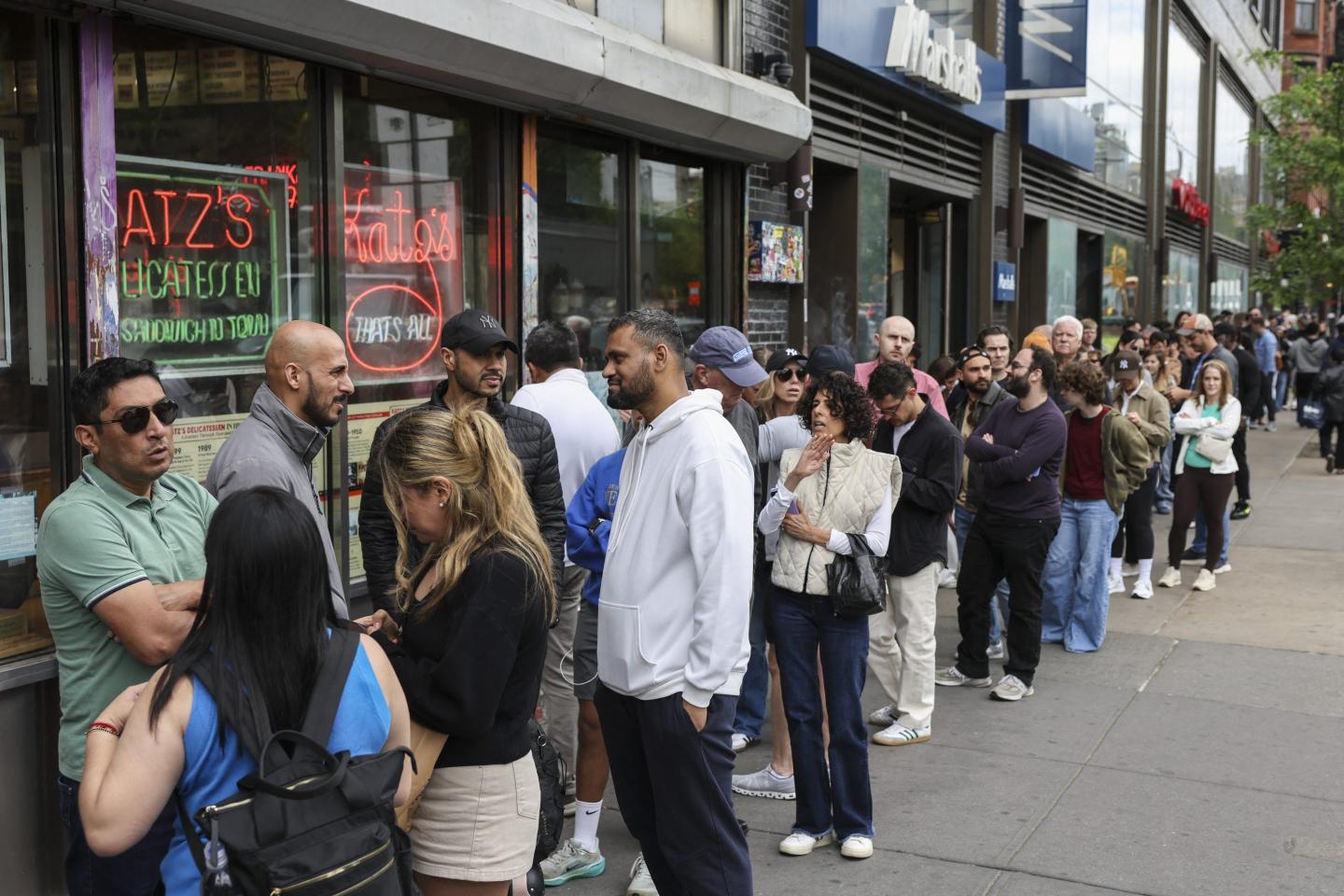
People wait in line outside Katz's Delicatessen in New York City on May 15, 2026.
People wait in line outside Katz's Delicatessen in New York City on May 15, 2026.Angela Weiss/AFP via Getty Images
Add Fortune on Google for similar content.

The Gilded Age economist Thorstein Veblen famously wrote about “conspicuous consumption,” the idea that people signal status by buying expensive, exclusive things. If he were witnessing the behavior of Gen Z in urban areas today, he might need to coin a new phrase: conspicuous waiting. Or maybe, democratized snobbery.

Recommended Video

Companies have spent decades racing to shave seconds off the checkout line, the drive-through, the loading spinner. Every second longer that a customer waits is a second closer to losing the sale — or so the thinking has gone. But businesses have also always known that captive attention has value. The candy bars and celebrity gossip magazines arranged at eye level beside every checkout lane weren’t put there by accident: a waiting customer is a customer whose attention can still be monetized. Businesses figured that out long before smartphones arrived. What they didn’t anticipate was that consumers would eventually turn the wait into content themselves.

“Forget about just reducing the cost,” said Subodha Kumar, a professor of statistics, operations and data science at Temple University’s Fox School of Business. “We can have a line as a signal of value.” 

As technology removes friction from nearly every transaction, the experiences people still willingly wait for have become increasingly valuable — and increasingly public. They’re not just posting what they bought. They’re posting the line.

“They are also posting pictures of the line,” Kumar said. That shift matters. Social media has changed the role a queue can play: instead of only documenting what they bought, consumers increasingly turn the entire experience into content — from getting ready and waiting to trying the product itself. The line is no longer something that happens before the experience. For many consumers, it is the experience.

For businesses, Kumar said, those lines have become an asset. Rather than viewing every minute in a queue as a cost to eliminate, businesses can think about lines in three ways: as an experience, as a signal, and as a commitment device.

The line as an experience

Richard Larson, the MIT operations researcher known as “Dr. Queue,” has spent his career thinking about what happens when people wait. Lately, it’s been making him a little sad.

“As Dr. Queue, I get quite depressed sometimes,” he told Fortune. “If I’m at my Stop & Shop supermarket and I see a line of, let’s say, nine people, and they all have their heads bowed, looking at their hands, checking their cell phones — I find that quite depressing.” In the old days, he said, strangers in a queue would talk to each other. They’d pass the time discussing the weather, sports, whatever was nearby. “When you’re waiting, you’re looking for distractions, you’re looking around — because the idea of waiting by yourself with a blank stare is not good for most people.” The phone filled that void, but at a cost.

Larson is part of a lineage dating back more than a century, when Danish mathematician Agner Krarup Erlang invented “classical queueing theory” — he was working for a telephone company and his formulas for managing congestion remain the dominant framework for understanding queues today. For Dr. Queue’s part, he has helped make data‑driven queue management a mainstream operations research application rather than a purely academic exercise. Favorite examples include installing mirrors in elevators and enticing customers to tolerate waits with the promise of free goods or services.

Larson draws a sharp distinction between kinds of waiting. A supermarket queue brings together strangers with nothing in common, heads bowed, disengaged. A DMV line is a shared nuisance. But outside a Broadway theater, a concert venue, or a bakery that has gone viral, something different happens. Everyone is there for the same thing. “Everyone in the queue shares the same enthusiasm,” Larson said. “The wait becomes part of the event.”

That dynamic plays out vividly on social media, where videos of fans camping overnight for concert tickets, theatergoers tracking Broadway rush lines, and food lovers documenting viral bakery queues often devote as much attention to the wait as to the product. The line becomes a narrative with a beginning, middle, and end — content in its own right.

This is the irony at the heart of conspicuous waiting: the same phones that Larson finds depressing in the supermarket line are what transform a bakery queue into a social occasion. Gen Z isn’t bowing their heads to disengage — they’re posting the wait, turning it into content, broadcasting their presence in the line to an audience that never showed up. The phone killed one kind of social waiting and created another.

“What if, when the people are waiting, they can do something which is entertaining?” Kumar said. “Then, maybe the waiting isn’t so bad.” The businesses that have figured this out — the ones with performers in the queue, immersive environments, or lines that have become destinations in themselves — aren’t just reducing the pain of waiting. They’re selling it.

The line as a signal

Waiting an hour for an $11 sprinkle-covered cake may look like a peculiarly modern affliction. In reality, the behavior is old; only the props have changed.

When Veblen wrote about the leisure class, he was writing about aristocrats who signaled status through expensive, exclusive goods. The display wasn’t just about what they owned, but about demonstrating they had enough leisure to spend time on pursuits others couldn’t afford. The viral line is the same instinct, scaled down and democratized. A bakery queue doesn’t require inherited wealth — only a phone to post with and time to spare. Call it democratized snobbery: what was once a marker of aristocratic display now belongs to anyone willing to wait.

Buying an $11 cake is accessible to many consumers. Spending an hour in line for it isn’t. The scarce resource on display isn’t money. It’s time — and posting the wait is how you spend it publicly.

For businesses, the signal cuts both ways. “If people don’t know the quality of what you’re selling, then lines sometimes give a perception — if a line is so long, then the product or service must be good,” Kumar said. A line communicates value before the customer has experienced anything. Apple product launches have historically used this logic deliberately, creating anticipation through limited availability before consumers ever held the device. Other times, Kumar noted, scarcity happens organically.

Either way, the signal only works if it’s credible. “A line is only a signal when it is credible,” Kumar said. That credibility can disappear fast.

After videos of long lines outside New York City’s Sprinkle Cake spread across TikTok this spring, some users pushed back.“All that for sprinkles? On cake?” one user wrote on a TikTok video posted by the account @whatisthislinefor.nyc. Another noted: “Last week, people stood in line for a $400 plastic pocket watch. This week, it’s a mini cake covered in sprinkles.”

But once the line becomes the point, the thing at the end starts to matter less — and consumers notice. When they decide the wait reflects poor operations rather than genuine scarcity, the signal breaks down. 

What reads as exclusivity reads as incompetence instead.

The line as a commitment device

Waiting doesn’t just shape the experience before a purchase. It can change how consumers value what comes after.

Investing time before a Broadway performance, sporting event, or another sought-after experience can make the payoff feel more rewarding, because consumers have already invested something irreplaceable: their time. The wait creates a stake. “Line adds value when the wait is chosen by the customers,” Kumar said.

That distinction — chosen versus imposed — is what separates a line that builds anticipation from one that simply frustrates. Waiting because of genuine scarcity, or because the wait itself is an experience, can deepen the value of what follows. Waiting because of poor operations or unnecessary bottlenecks has the opposite effect. The same queue, different signal.

Kumar pointed to the FIFA World Cup as a case where both things happened simultaneously. Waiting to buy tickets built excitement, because fans expected limited availability and chose to engage with that scarcity. But long waits to enter the stadium — delays that stemmed from operational failures rather than genuine demand — frustrated the same fans who had willingly queued for tickets weeks earlier. “The line created value, but the line also destroyed value,” Kumar said.

The Veblenian instinct that drives conspicuous waiting is real, and businesses that understand it can design around it. But it only holds as long as customers believe the wait is worth their time — that what’s at the end of it is genuinely scarce, genuinely good, or genuinely theirs to brag about. When that belief cracks, the line stops being a signal and starts being a complaint.

Veblen thought status was for sale. Now, increasingly, it’s for the wait.

The Fortune 500 Innovation Forum will convene Fortune 500 executives, U.S. policy officials, top founders, and thought leaders to help define what’s next for the American economy, Nov. 16-17 in Detroit. Apply here.
About the Author
By Tatiana SatauaNews Fellow

Tatiana Sataua is a News Fellow at Fortune covering breaking news, policy, and business.

See full bioRight Arrow Button Icon
Add Fortune on Google for similar content.

Latest in Retail

Finance
Lorem ipsum dolor sit amet, consectetur adipiscing elit, sed do eiusmod tempor incididunt ut labore et dolore magna aliqua. Ut enim ad minim veniam
By Fortune Editors
October 20, 2025
Finance
Lorem ipsum dolor sit amet, consectetur adipiscing elit, sed do eiusmod tempor incididunt ut labore et dolore magna aliqua. Ut enim ad minim veniam
By Fortune Editors
October 20, 2025
Finance
Lorem ipsum dolor sit amet, consectetur adipiscing elit, sed do eiusmod tempor incididunt ut labore et dolore magna aliqua. Ut enim ad minim veniam
By Fortune Editors
October 20, 2025
Finance
Lorem ipsum dolor sit amet, consectetur adipiscing elit, sed do eiusmod tempor incididunt ut labore et dolore magna aliqua. Ut enim ad minim veniam
By Fortune Editors
October 20, 2025
Finance
Lorem ipsum dolor sit amet, consectetur adipiscing elit, sed do eiusmod tempor incididunt ut labore et dolore magna aliqua. Ut enim ad minim veniam
By Fortune Editors
October 20, 2025
Finance
Lorem ipsum dolor sit amet, consectetur adipiscing elit, sed do eiusmod tempor incididunt ut labore et dolore magna aliqua. Ut enim ad minim veniam
By Fortune Editors
October 20, 2025

Most Popular

Finance
Lorem ipsum dolor sit amet, consectetur adipiscing elit, sed do eiusmod tempor incididunt ut labore et dolore magna aliqua. Ut enim ad minim veniam
By Fortune Editors
October 20, 2025
Finance
Lorem ipsum dolor sit amet, consectetur adipiscing elit, sed do eiusmod tempor incididunt ut labore et dolore magna aliqua. Ut enim ad minim veniam
By Fortune Editors
October 20, 2025
Finance
Lorem ipsum dolor sit amet, consectetur adipiscing elit, sed do eiusmod tempor incididunt ut labore et dolore magna aliqua. Ut enim ad minim veniam
By Fortune Editors
October 20, 2025
Finance
Lorem ipsum dolor sit amet, consectetur adipiscing elit, sed do eiusmod tempor incididunt ut labore et dolore magna aliqua. Ut enim ad minim veniam
By Fortune Editors
October 20, 2025
Finance
Lorem ipsum dolor sit amet, consectetur adipiscing elit, sed do eiusmod tempor incididunt ut labore et dolore magna aliqua. Ut enim ad minim veniam
By Fortune Editors
October 20, 2025
Finance
Lorem ipsum dolor sit amet, consectetur adipiscing elit, sed do eiusmod tempor incididunt ut labore et dolore magna aliqua. Ut enim ad minim veniam
By Fortune Editors
October 20, 2025
Fortune Secondary Logo
Rankings
  • 100 Best Companies
  • Fortune 500
  • Global 500
  • Fortune 500 Europe
  • Most Powerful Women
  • World's Most Admired Companies
  • See All Rankings
  • Lists Calendar
Sections
  • Finance
  • Fortune Crypto
  • Features
  • Leadership
  • Health
  • Commentary
  • Success
  • Retail
  • Mpw
  • Tech
  • Lifestyle
  • CEO Initiative
  • Asia
  • Politics
  • Conferences
  • Europe
  • Newsletters
  • Personal Finance
  • Environment
  • Magazine
  • Education
Customer Support
  • Frequently Asked Questions
  • Customer Service Portal
  • Privacy Policy
  • Terms Of Use
  • Single Issues For Purchase
  • International Print
Commercial Services
  • Advertising
  • Fortune Brand Studio
  • Fortune Analytics
  • Fortune Conferences
  • Business Development
  • Group Subscriptions
About Us
  • About Us
  • Press Center
  • Work At Fortune
  • Terms And Conditions
  • Site Map
  • About Us
  • Press Center
  • Work At Fortune
  • Terms And Conditions
  • Site Map
  • Facebook icon
  • Twitter icon
  • LinkedIn icon
  • Instagram icon
  • TikTok icon
  • YouTube icon

Latest in Retail

Meet the jet-setting fashion editor who turned a New York manicure at 23 into Nails.Inc—Despite selling for $40 million, she still wakes at 5:45 a.m.
SuccessFortune The Good Life
Meet the jet-setting fashion editor who turned a New York manicure at 23 into Nails.Inc—Despite selling for $40 million, she still wakes at 5:45 a.m.
By Orianna Rosa RoyleJuly 31, 2026
43 minutes ago
The rise of ‘conspicuous waiting’: The 19th-century economic theory that explains why Gen Z posts their place in line
RetailGen Z
The rise of ‘conspicuous waiting’: The 19th-century economic theory that explains why Gen Z posts their place in line
By Tatiana SatauaJuly 31, 2026
44 minutes ago
tb
North AmericaRestaurants
Taco Bell’s quick action on removing lettuce, $1 Mexican Pizza special work to win over diners, investors
By Dee-Ann Durbin and The Associated PressJuly 30, 2026
17 hours ago
The only thing more surprising than Cracker Barrel CEO’s exit may be its pick to replace her
C-Suitechief executive officer (CEO)
The only thing more surprising than Cracker Barrel CEO’s exit may be its pick to replace her
By Phil WahbaJuly 30, 2026
17 hours ago
A United Parcel Service Inc. logo is displayed on a truck.
RetailCFO Daily
UPS CFO on the lessons learned from scaling back Amazon—and why the strategy is paying off
By Sheryl EstradaJuly 30, 2026
19 hours ago
za
RetailGen Z
‘Am I paying for the vibes?’ Gen Z says it hates capitalism, but their spending patterns show they just don’t like being ripped off
By Nick LichtenbergJuly 30, 2026
21 hours ago

Most Popular

He worked 100-hour weeks to save a nearly bankrupt boat company. At 83, he’s just turned down $400 million for it—and gave it all to charity instead
Success
He worked 100-hour weeks to save a nearly bankrupt boat company. At 83, he’s just turned down $400 million for it—and gave it all to charity instead
By Preston ForeJuly 29, 2026
2 days ago
Costco's $14 million email settlement: Who qualifies for an up-to $500 payment and how to claim before the Aug. 24 deadline
Retail
Costco's $14 million email settlement: Who qualifies for an up-to $500 payment and how to claim before the Aug. 24 deadline
By Sydney LakeJuly 29, 2026
2 days ago
Mamdani’s pied-à-terre tax was designed to hit the wealthy, but it’s sending most New Yorkers to their estate lawyers
Real Estate
Mamdani’s pied-à-terre tax was designed to hit the wealthy, but it’s sending most New Yorkers to their estate lawyers
By Catherina GioinoJuly 30, 2026
1 day ago
Current price of oil as of July 30, 2026
Personal Finance
Current price of oil as of July 30, 2026
By Joseph HostetlerJuly 30, 2026
21 hours ago
'Am I paying for the vibes?' Gen Z says it hates capitalism, but their spending patterns show they just don't like being ripped off
Retail
'Am I paying for the vibes?' Gen Z says it hates capitalism, but their spending patterns show they just don't like being ripped off
By Nick LichtenbergJuly 30, 2026
21 hours ago
The millennial generation is split in 2: an older crowd with boomer-style comfort, a younger set going 'back to the early 1900s'
Real Estate
The millennial generation is split in 2: an older crowd with boomer-style comfort, a younger set going 'back to the early 1900s'
By Nick LichtenbergJuly 25, 2026
6 days ago

© 2026 Fortune Media IP Limited. All Rights Reserved. Use of this site constitutes acceptance of our Terms of Use and Privacy Policy | CA Notice at Collection and Privacy Notice | Do Not Sell/Share My Personal Information
FORTUNE is a trademark of Fortune Media IP Limited, registered in the U.S. and other countries. FORTUNE may receive compensation for some links to products and services on this website. Offers may be subject to change without notice.