

People are sick of AI; they’re sick of predictions that AI will take your job, and they’re sick of the supposedly smartest economists around failing to explain what is happening. Perfect timing, then, for a new theory that ties all of the threads together in an elegant explanation: AI isn’t wiping out jobs, but it is cutting wages. No wonder workers are in revolt.
New research from Apollo Global Management shows the technology’s earliest measurable damage isn’t job losses, but smaller paychecks. That finding arrives in the middle of one of the most fractured debates in economics right now — one where even the people building the AI systems can’t agree on what their own data shows.
An economist changes his mind
Apollo chief economist Torsten Slok has spent much of 2026 arguing that the macroeconomic impact of AI on the labor market was essentially invisible. In April, he wrote that “AI is everywhere except in the incoming macroeconomic data” and you just couldn’t see it in data on employment, productivity or inflation.
At the same time, the influential analyst, known for his Daily Spark blog and for his Chart of the Day in a previous stint at Deutsche Bank, has been predicting an “industrial renaissance” and a prediction that AI will lead to a boom of entrepreneurship for small businesses. As recently as May 29, he published a Spark titled “Zero Evidence of AI-Related Job Losses,” arguing AI was creating more jobs than it destroyed. He invoked the Jevons Paradox, as he has done since April, helping to popularize the idea that efficiency gains expand overall demand rather than shrinking the workforce. None other than Dario Amodei, the Anthropic CEO, started using the term shortly afterward, as he walked back his own predictions of the massive job-destroying impact of his technology.
In mid-July, Slok signaled his annoyance with the lack of clarity from the economics field on AI’s impact, noting that “the experts can’t agree” on what is actually happening in the corporate sector with AI and jobs. On July 30, Slok and co-author Sania Edlich published a paper that seems to tie all the contrasting theories together. Rather than relying on the theoretical “exposure” scores that have dominated AI labor research for years, the team used observed usage data from Anthropic’s Economic Index — actual Claude interaction logs — to measure what workers are doing with AI rather than what they theoretically could do. What they found wasn’t job losses, but “wage compression.”
“Analysis of actual Claude usage data shows workers in AI-exposed occupations are experiencing slower wage growth, while employment levels in these occupations remain unchanged, suggesting companies are capturing AI productivity gains through wage compression rather than workforce reduction,” Slok wrote. This would also explain the backlash — even outright resistance — to AI adoption in the wider economy. Workers seem to know that these machines will make them poorer.
Workers feel it regardless of what economists conclude
A separate June 2026 survey of 1,005 employed U.S. workers by Software Finder captured this ground-level anxiety, independent of any academic model. Half of workers described themselves as actively resisting new AI tools, and some findings sit in some tension with Slok’s paper — while Apollo’s data shows AI exposure compressing wages regardless of adoption, Software Finder’s snapshot shows current adopters out-earning resisters, a gap likely explained by who tends to adopt (managers, higher earners with more job security) rather than evidence that adoption itself protects pay.
For instance, Software Finder reports that workers who resist AI earn roughly 20% less on average than those who embrace it, $65,645 versus $81,526. Forty-five percent cite fear of becoming replaceable as their reason for holding back, and only 16% believe their company is adopting AI for genuine business value rather than hype or competitive pressure. The two effects can coexist: resisters may be penalized on pay even as the wages offered for AI-exposed work drift lower, per Slok’s research. AI just might be a wage-eating machine.
There is also a lot of AI shame going on: 13% admitted they’ve faked AI use — appearing to use a tool while doing the task manually — and only 6% believe their managers accurately understand how often employees actually use the tools they’ve rolled out.
Fortune‘s own reporting shows this resistance can escalate well past quiet avoidance into deliberate sabotage. An April 2026 survey of 2,400 knowledge workers across the U.S., U.K., and Europe — including 1,200 C-suite executives — conducted by Writer and Workplace Intelligence found that 29% of employees admitted to actively sabotaging their company’s AI strategy, a figure that jumps to 44% among Gen Z workers. The sabotage takes concrete forms: entering proprietary company information into unapproved public AI tools, using unauthorized “shadow AI” systems, refusing outright to engage with company-mandated tools, and in some cases tampering with performance reviews or deliberately producing low-quality work to make AI look ineffective. Of the workers who admitted to sabotage, 30% cited fear that AI would take their job as their primary motivation — the same fear driving the Software Finder resisters.
What the data shows
Using a difference-in-differences model across 321 occupations matched to Bureau of Labor Statistics data from 2015 to 2025, the Apollo paper found that workers in high-AI-exposure occupations saw real wage growth slow by 6.7 percentage points relative to less-exposed workers after 2023 — with no statistically significant employment effect. That is the crux of the argument: the productivity gains are real, but they are landing with employers rather than employees. This aligns with what Fortune reported in March: AI is shrinking work, which means companies can assign more work to their workers.
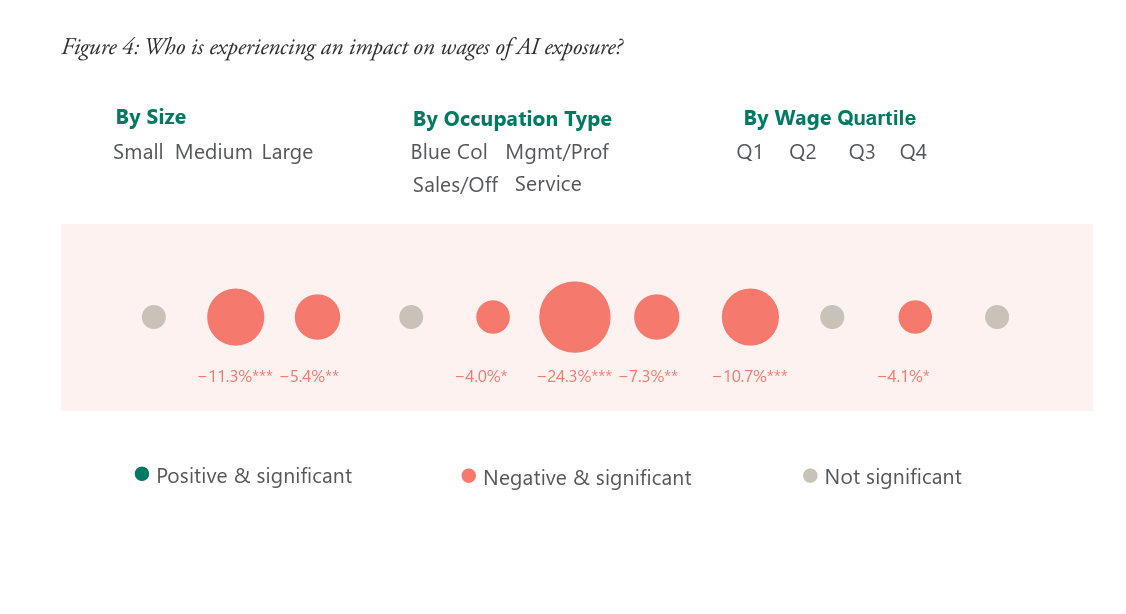
The pain is concentrated at the bottom of the income ladder:
- Bottom wage quartile: down 10.7% relative to low-exposure occupations
- Second quartile: down 5.4%; third quartile: down 4.0%
- Top quartile: no statistically significant effect — high earners appear better positioned to absorb or benefit from AI adoption
- Service occupations: down 24.3%, though the authors caution this is based on a small subsample
- Management and professional occupations: down 4.1%; blue-collar workers: no significant effect
Today, roughly 5.8 million U.S. workers — about 3.7% of the labor force — sit in occupations exposed enough to feel this squeeze, amounting to a conservative $28 billion in annual labor income loss, a number the authors said they expect to keep climbing.
Anthropic’s own economist says something different
Complicating things further: the very data underlying Slok’s paper comes from Anthropic, whose head of economics offered his own take in a lengthy essay on X in late July. Drawing on 18 months of internal research, he concluded that the U.S. labor market has “not yet taken a visible hit from AI,” pointing to a 4.2% unemployment rate — a level the Federal Reserve considers full employment — with job openings roughly matching the number of unemployed workers and prime-age employment near multi-decade highs.
McCrory and Slok aren’t necessarily contradicting each other, though — they’re answering different questions with overlapping data. It’s entirely possible for a labor market to show flat unemployment and quietly falling relative pay at the same time — which is exactly the distinction that’s easy to lose in a debate where “no jobs crisis” and “workers are getting squeezed” get treated as if they can’t both be true.
That confusion isn’t unique to Anthropic. A comprehensive literature review cited by Reuters in July found “most datasets find little evidence of economy-wide job loss or wage decline,” attributing AI’s impact so far to “task reallocation and within-firm productivity gains, rather than mass displacement” — a conclusion that sits uneasily next to Slok’s wage-compression findings.
A quieter, harder-to-see threat
AI’s wage-compressing effect, if Slok’s data holds up, would fit a much older pattern rather than break from one. Throughout the 20th and 21st centuries, successive waves of technology — mechanized agriculture, industrial automation, computing, and offshoring-enabled supply chains — have repeatedly lowered the cost of production and, in doing so, put downward pressure on wages in the occupations they touched, even as they expanded overall economic output.
Infamously, textile mechanization crushed wages for hand-loom weavers well before it created higher-paying factory jobs elsewhere, giving rise to the Luddite movement, so often recalled in the AI age. Over 100 years later, use of industrial robotics in manufacturing during the 1980s and ’90s coincided with decades of stagnant real wages for blue-collar workers even as productivity climbed steadily. This is where the “Rust Belt” originated.
The Financial Times‘ Joel Suss recently argued that gains from new technology have not automatically flowed to the workers producing them since around 1970, as labor’s share of GDP has fallen relative to capital’s. This time is turning out to be no different, he found in an analysis of data across the U.S., Japan and most of Europe. “Insofar as advances in AI constitute capital-biased technological change,” he argued, “the pay-productivity gulf will widen further.”
What emerges from all of this is a labor story that resists the clean narrative either side wants to tell. It’s not the mass-layoffs scenario Amodei has warned about, nor is it the all-clear McCrory’s unemployment data suggests. It’s something quieter and more corrosive: a mechanism that shows up in paychecks rather than pink slips, one indistinct enough that reasonable economists looking at adjacent data can reach opposite-sounding conclusions.
That ambiguity may be precisely why worker anxiety remains so widespread yet so hard to substantiate in the aggregate numbers — and why, even as Slok’s own paper acknowledges its limits (the exposure measure relies solely on Anthropic’s data, and only 321 of roughly 800 BLS occupations could be matched), he remains unambiguous about the stakes of getting this wrong: “The critical policy question is not whether AI will reshape the labor market more broadly, but how quickly, and whether workers will have the support they need when it does”.