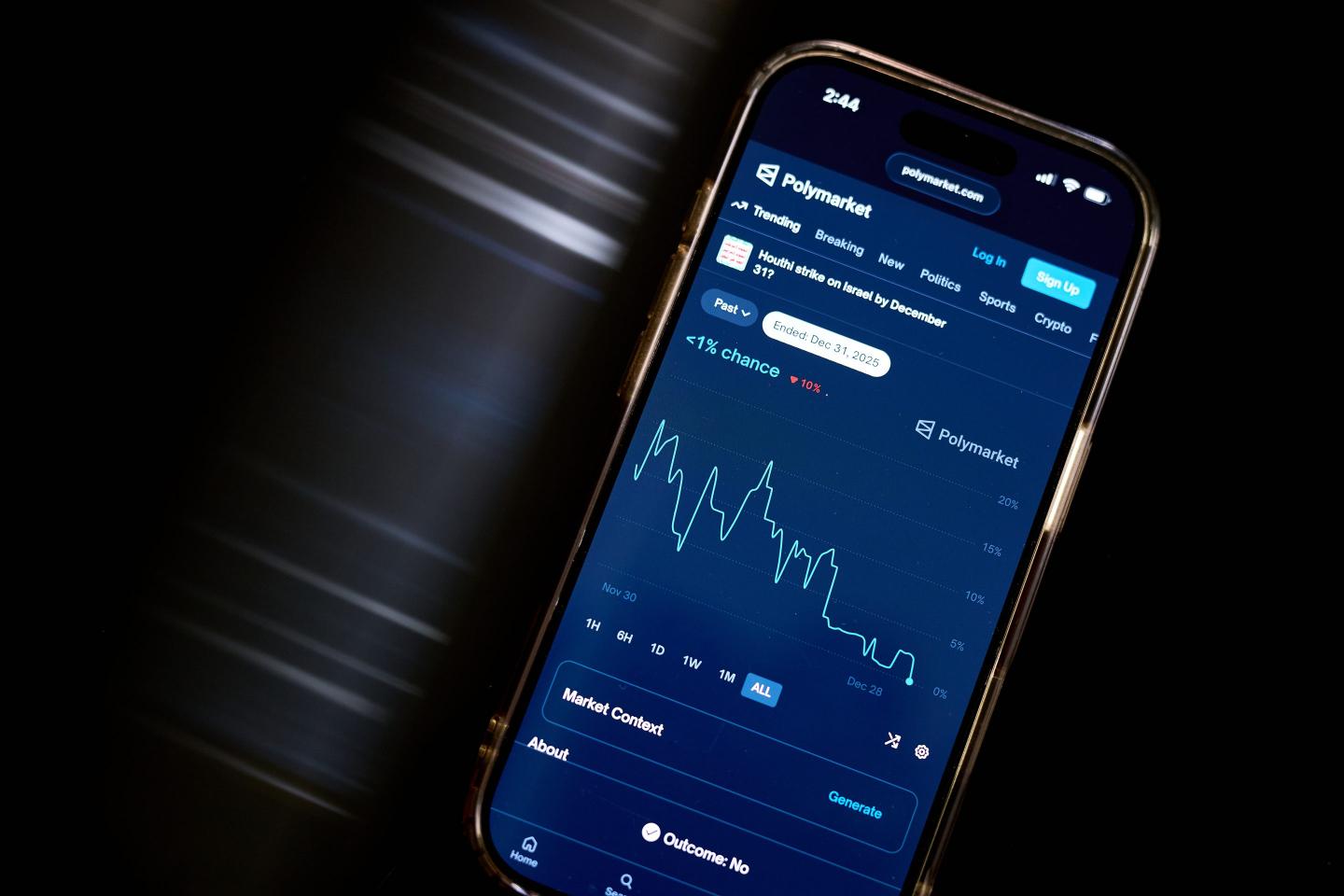
Prediction markets are redefining how society assesses uncertainty. In recent years, these markets have often proved uncannily accurate, and challenged more traditional metrics for assessing public sentiment such as polls. On Wednesday, Polymarket, one of the sector’s largest players, announced the Polymarket Institute, a new body dedicated to studying the ways in which prediction markets can forecast and discover information.
“We really want to establish this institute as a partnership between industry and academia to give people a lot of time to think about what the implications of this technology [are],” said Kai Brusch, Polymarket’s head of data.
The research initiative will operate as a branch of Polymarket and aims to provide the institutional rigor and infrastructure necessary to measure how prediction markets can function at scale. Polymarket will fully fund the initiative, though it declined to disclose its total investment toward the institute.
The announcement comes as Polymarket and its chief rival, Kalshi, make daily headlines for contracts that invite users to wager on everything from sports to interest rate cuts to elections. In the process, they’ve begun to upend the polling and survey industry, emerging as an alternative data source to traditional projection models. In July, Polymarket’s global decentralized finance platform averaged 586,000 monthly active users, according to blockchain data provider Token Terminal. Major publications like The Wall Street Journal and Yahoo Finance have also partnered with the platform to feature its odds in their coverage.
Brusch will serve as the Polymarket Institute’s managing director while Brian Jabarian, an assistant professor in economics and technology at Carnegie Mellon University, will serve as its scientific director. To avoid conflicts of interest, Jabarian will not receive personal compensation for his role.
The institute will support academic work through the Polymarket Science Fellowship, a one-year program for doctoral researchers in fields like information economics, market design, forecasting, and prediction markets. Its first cohort will include 12 fellows, who will receive a one-time $10,000 grant. Formal applications will open Aug. 18 via a dedicated website. Though the institute will host its workshops in New York, fellows can participate remotely or in person. Once selected, fellows will study how markets aggregate information, manage risk, and intersect with AI, policy, and crypto, using expanded Polymarket data access.
Ensuring impartiality
Brusch spent months looking for the right academic leader for the Polymarket Institute, speaking with candidates across multiple universities. He eventually connected with Jabarian through a mutual contact. Brusch said the two “clicked from the beginning,” quickly recognizing their shared interest in treating prediction markets as a serious subject of study.
To keep the research impartial, all researchers must sign a legal agreement that bars them from trading on Polymarket or similar platforms while they are involved with the institute. They are also required to publish their work alongside GitHub repositories containing their code and methods, so the broader scientific community can access the results. Each fellow will also retain the unconditional right to publish in any journal, even if the findings are critical of Polymarket.
“If they find some results that are not great for Polymarket in some way, we don’t really care,” Jabarian said. “The fact that you create an institute shows that you are committed more to the process than the outcome.”
The fellows will receive funding through a university gift model rather than through sponsored research. According to Jabarian, this distinction is critical, because a gift legally ensures that Polymarket has no “editorial influence” or jurisdiction over the research results.
Clarification, July 29, 2026: This article has been updated to provide additional information about Polymarket’s user numbers.