
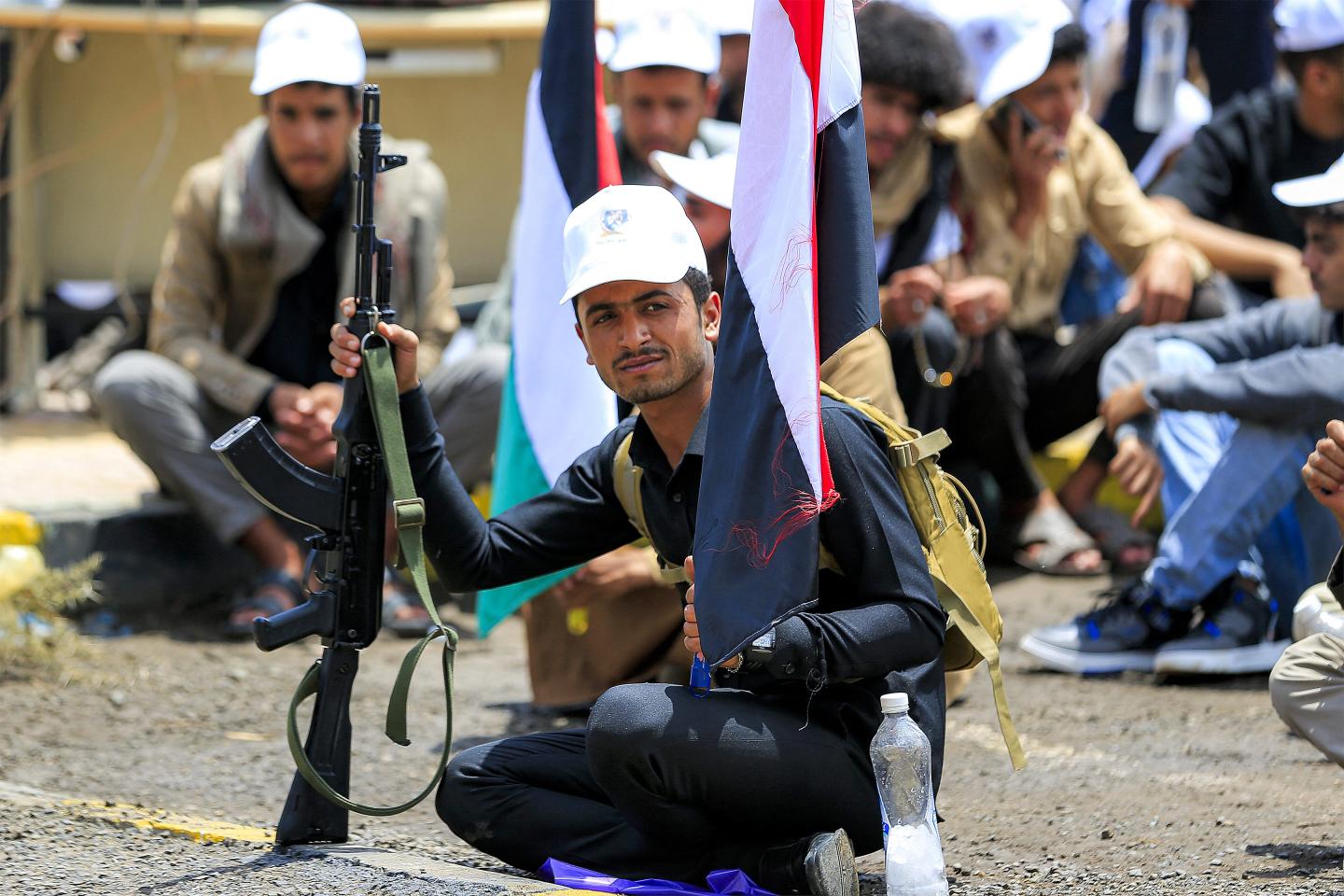
The war in Iran has officially expanded into Saudi Arabia and the Red Sea as Yemeni Houthis attacked Saudi tankers avoiding the dangerous Strait of Hormuz and oil prices rose above $100 per barrel Thursday for the first time since early June.
The Iran-allied Houthi attacks followed the U.S. signing a nuclear power agreement with the Saudis on Wednesday to develop a civilian nuclear program in the kingdom—just as the U.S. aims to prevent the Saudis’ Iranian rivals from expanding their nuclear ambitions.
“The net effect of this nuclear deal is escalatory,” said Jennifer Li, senior geopolitical analyst for the Rystad Energy research firm. “There isn’t really a scenario in which the Iranians will view this favorably. The Iranians have positioned the Houthis, in theory, to go out and target this embargo specifically of Saudi vessels.
“From the perspective of Tehran, there’s more willingness to escalate in terms of this whole ‘Who blinks first?’ dilemma,” Li told Fortune. “I think it forces both sides to become more maximalist.”
The new Houthi attacks in the Red Sea’s Bab el-Mandeb Strait off Yemen force Saudi tankers to instead trek north to the shallower Suez Canal and into the Mediterranean Sea. To access Asian markets, tankers must then travel all the way around Africa, adding substantial time as well as fuel and insurance costs to shipments. Saudi Arabia already was diverting much more of its oil via pipelines to the Red Sea specifically to avoid Iranian attacks in the Persian Gulf’s Strait of Hormuz.
Bab el-Mandeb translates to “gate of tears” in Arabic, referring to the historical, naturally occurring dangers of traveling through the strait.
While the nuclear deal may represent added motivation, Fernando Ferreira, director of the geopolitical risk service at Rapidan Energy Group, said he sees the Houthis acting of their own accord from decades of preexisting conflict with the Saudis and choosing to attack at an opportune time of a broader escalation in the Iran war.
“The risk here is certainly skewed towards a return of a regional war in the Middle East that could be more disruptive than what we saw in the first round of the confrontation,” Ferreira said. “The [Red Sea] is a big new factor that we didn’t have to deal with in phase one.”
With the global benchmark for oil prices now hovering near $100 per barrel, Ferreira warned that further escalation could push prices closer to $120—near the late-April high of $124 per barrel. Already, the average price of a gallon of regular unleaded gasoline in the U.S. is back up to $4.09 and rising rapidly.
The extra whammy on oil markets is that Ukraine’s drone attacks on terminals off Russia’s Black Sea prompted Kazakhstan on July 23 to reduce its oil production to prevent storage facilities from overflowing.
And there is again growing concern over a bigger war, with U.S. boots on the ground in Iran.
In the meantime, Ferreira still expects the Houthis to be relatively measured in their blockade and their attacks.
“In a final round, we could start seeing attacks on Saudi energy facilities, but the Houthis understand this is the greatest point of leverage that they have over Riyadh,” he said.
Nuclear coming to a head
Already, the new nuclear deal with the Saudis could be at risk with President Donald Trump potentially adding new conditions as of July 23. Trump said the Saudis would have to join the Abraham Accords to normalize relations with Israel, and that the civil nuclear deal would not include uranium enrichment.
The original terms announced a day prior seemingly included a potential path to uranium enrichment and less stringent oversight than typical U.S. nuclear deals.
Critics were inflamed by the deal in the first place. Democratic Connecticut Sen. Chris Murphy said the deal would trigger a major reaction from Iran, citing concerns about the U.S. abandoning its nonproliferation objectives in the Middle East.
“This agreement will set off a nuclear race in the region, further disincentivizing Iran from limiting its own program,” Murphy said in a statement.
Rystad’s Li said the nuclear deal is an expedited concession to the Saudis during the war and that there are national security arguments to be made in terms of pushing U.S. nuclear supply chains into the kingdom as opposed to Russian or Chinese suppliers.
And, of course, Trump further warned of escalation by threatening the Houthis and Iran following the attacks on Saudi tankers.
“If they do this again, the U.S. will hold Iran responsible, in that the Houthis are a surrogate and/or proxy of Iran, and major military punishment will be inflicted upon Iran and, of course, the Houthis, themselves,” Trump said on social media.
Given everything transpiring, Ferreira argued that any peace deal between the U.S. and Iran seems “very unlikely” amid this “unsustainable status quo”—at least in the near term.
“Well into 2027, we are likely in a world where Hormuz flows will remain constrained, there will remain risk, and we’ll continue to see sporadic attacks on shipments,” Ferreira said.