
Good morning. On Fortune’s radar today:
- Federal judge pours scorn on Elon Musk settlement.
- Iran and the U.S. enter second day of renewed missile strikes.
- Markets: Climbing the wall of worry.
- Investors balk at Amazon’s ‘surprise’ new debt.
- Confusing evidence on whether the World Cup creates jobs.
- CEO of $4.8 billion software company secretly tracks down your ex-bosses.
📬 Would you prefer to receive this information in your email inbox every morning before the markets open in New York? Sign up here.
ONE BIG THING
Federal judge throws serious shade on Musk’s tiny settlement in Twitter lawsuit

A federal judge reluctantly signed off on the settlement of an SEC lawsuit against Elon Musk, using language suggesting that the deal was a lousy one for shareholders. The SEC alleged he broke the law in 2022 by failing to disclose that his stake in Twitter had crossed a 5% threshold. Musk didn’t make the disclosure because he knew it would drive up the stock price and thus cost him more to continue increasing his stake in Twitter, the suit claimed. Authorities claimed he bought $500 million worth of Twitter shares after he was supposed to publicly disclose his portion of the company, and saved himself $150 million by not doing so—value that could have gone to shareholders had it been disclosed.
The settlement was for just $1.5 million, Fortune’s Amanda Gerut reports.
The judge said she had “serious misgivings" and saw “red flags” in the settlement, given its small size. “That bears repeating: Elon Musk, the richest person in the world with a net worth close to $1 trillion, allegedly ignored his obligation to file SEC disclosures at the expense of other investors to the tune of $150 million,” she wrote. “Whether the Executive Branch (through the SEC) has done enough to hold Mr. Musk to account for his alleged violations is, like many other issues, for our citizenry to decide at the ballot box.”
THE MARKETS
Asia leads global stock rally as price of oil declines despite renewed attacks in the Middle East
After yesterday’s losses, stocks clawed back some ground today, ignoring a new round of U.S. missile strikes on Iran. The price of oil declined despite the reclosure of the Strait of Hormuz.
Why are investors so bullish when there is so much bad news? Because retail investors have returned to the market, according to Arun Jain at J.P. Morgan. In the week through July 8, mom-and-pop traders net bought $8.9 billion in stocks, way above the average of $6.8 billion, Jain said in an email.
- S&P 500 futures were up 0.24% this morning. The index lost 0.28% yesterday.
- In Europe, the Stoxx 600 was up 0.32% in early trading and the U.K.’s FTSE 100 was down 0.45% before lunch.
- Asia: South Korea’s KOSPI was up 0.62%. Japan’s Nikkei 225 was up 1.38%. India’s Nifty 50 was up 0.77%. China’s CSI 300 was up 2.54%.
- Brent crude was $77 this morning from a high of $80 yesterday.
- Bitcoin rose to $62.8K.
Investors balk at Amazon’s 'surprise' new AI debt
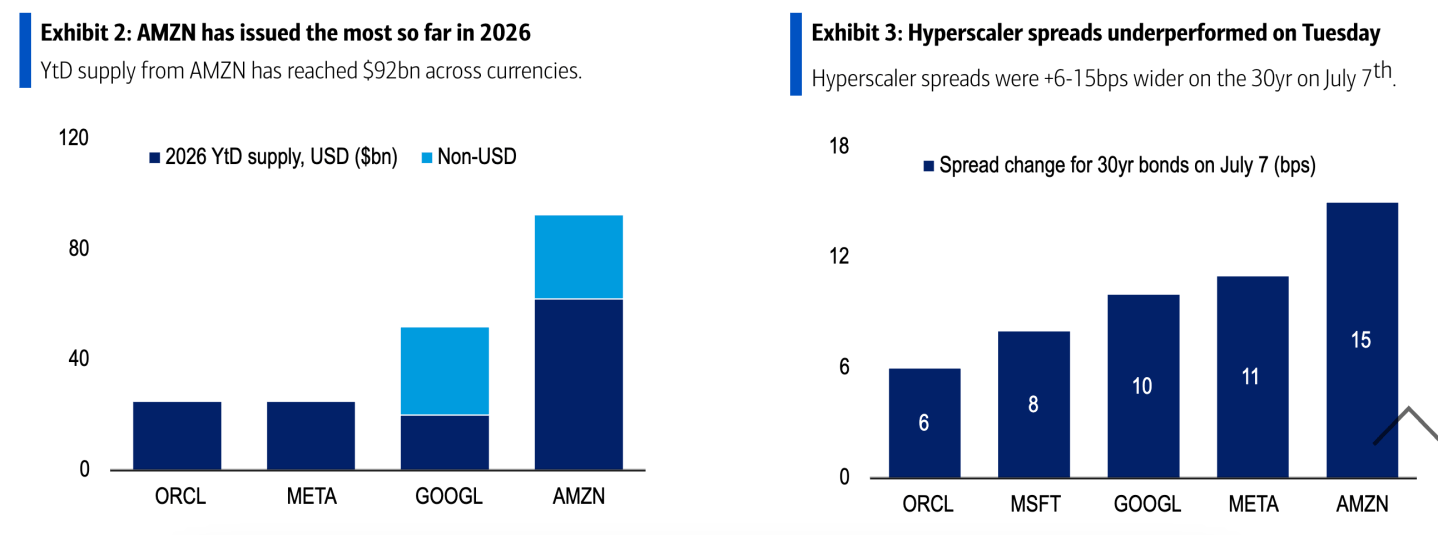
On Tuesday, Amazon issued $25 billion in new debt, and investors choked. The offering came as a “surprise,” according to Bank of America analysts Yuri Seliger and Sohyun Marie Lee. The company had already issued $67 billion this year. “Investors are pushing back,” they said in a note sent to Fortune.
That pushback came in the form of widening “spreads,” the extra risk premium that investors demand for buying debt. “The unexpected bond deal pushed 30-year hyperscaler spreads from +6 to 15 basis points wider on the day [and] contributed to the +8 basis point jump in 10-year Treasury yield,” they said.
On top of that, “the oversubscription level [the excess of demand for the debt] was the lowest among all the recent deals.”
MORE FROM FORTUNE
Chief sustainability officers’ new pitch to CEOs: climate action isn’t about morals—it’s about money - Diane Brady
Trump has created a ‘trickle up’ tariff economy that means U.S. companies aren’t done hiking consumer prices over import taxes - Sasha Rogelberg
Microsoft’s Brad Smith on Washington’s AI policy: ‘Regulation without transparent or complete rules’ - Beatrice Nolan
America’s bone health is quietly headed for a $19 billion crisis - Matthew T. Drake
750 million fans and 2.7 million data points: How IBM’s AI powers Wimbledon from hidden ‘Court 19’ - Sam Birchall
IRAN
Trump’s 'memorandum of understanding' is being bombed to smithereens
The U.S. military hit 90 targets in Iran overnight in retaliation for yesterday’s attacks by Iran on various U.S. sites in the Gulf region. The U.S. has now unleashed 170 strikes on Iran over the last two days. In response, Iran said it had targeted U.S. bases in Qatar, Kuwait, and Bahrain.
President Trump said he was not hopeful that Iran would be willing to finalize a peace deal and that he was ready to continue the war.
“This is in retribution for yesterday’s bombing of ships by Iran. If it happens again, it will get much worse!”, he said on social media.
Speaking at the NATO summit in Turkey, Trump said Iran wants "to make a deal" but "I don't know if they're worthy" and that talks are a "waste of time," the BBC reported. "We just hit them very hard, and I say we hit them 20 to 1," he said. "They hit us, we’re going to hit them 20".
Trump has largely abandoned the “Memorandum of Understanding” that was supposed to be a framework to end the conflict, the Wall Street Journal reports: “To me, I think it’s over,” he said. “I don’t want to deal with them …They’re liars, they’re cheats, they’re sick people.”
Ship traffic in the Strait of Hormuz is back down to single figures. Surprisingly, the price of a barrel of Brent Crude oil sank to $77 this morning from a high of $80 yesterday.
- How global energy markets built the ‘Amazon of oil’ logistics to keep prices from spiraling - Jordan Blum
QUOTE OF THE DAY
- “If the peace deal breaks, and it’s too early to tell, it won’t just raise oil prices; it would also increase pressure on AI supply chains in Asia, force central banks to be hawkish, tighten financial conditions, and could shift the outcome of the U.S. midterms. The cascade runs fast.”—Ryan Sweet, chief global economist at Oxford Economics.
CHART OF THE DAY
The oil market briefly forgot to measure risk
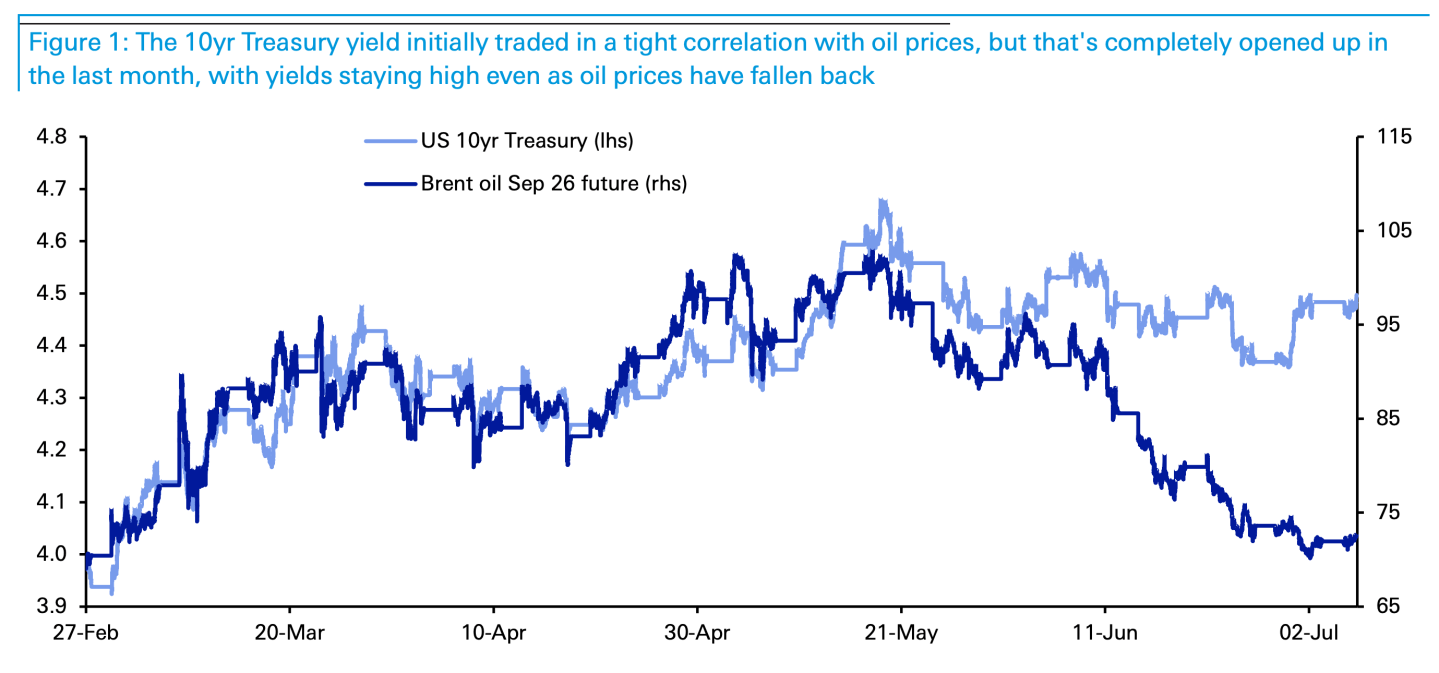
Among many assets that attempt to price “risk,” there are two that usually move in tandem. One is the yield on the 10-year Treasury. The other is the price of Brent crude oil. As this chart from Deutsche Bank shows, after the war with Iran started, the price of oil went up, and the amount of yield demanded for the risk of holding U.S. debt went up with it. But at the beginning of July, with major actions in the conflict seemingly in the rearview mirror, the price of oil fell, but the yield on the 10-year did not.
The price of oil surged again yesterday after the U.S. and Iran resumed bombing each other—reminding oil traders that the Strait of Hormuz injects risk into the market whether the two sides are fighting or not.
VAR, BUT FOR JOBS!
Has the World Cup somehow managed to reduce employment in the hotel and restaurant sector?
An interesting puzzle buried in the most recent employment report from the U.S. Bureau of Labor Statistics was how on earth America managed to see a decline in leisure and hospitality jobs while hosting the World Cup. Yesterday, two sets of analysts at Bank of America came to opposing conclusions on that issue.
BoA’s U.S. economist Shruti Mishra published data showing that private payroll data collectors generally show the same trend as the government’s nonfarm payrolls number: leisure jobs are down across the board:
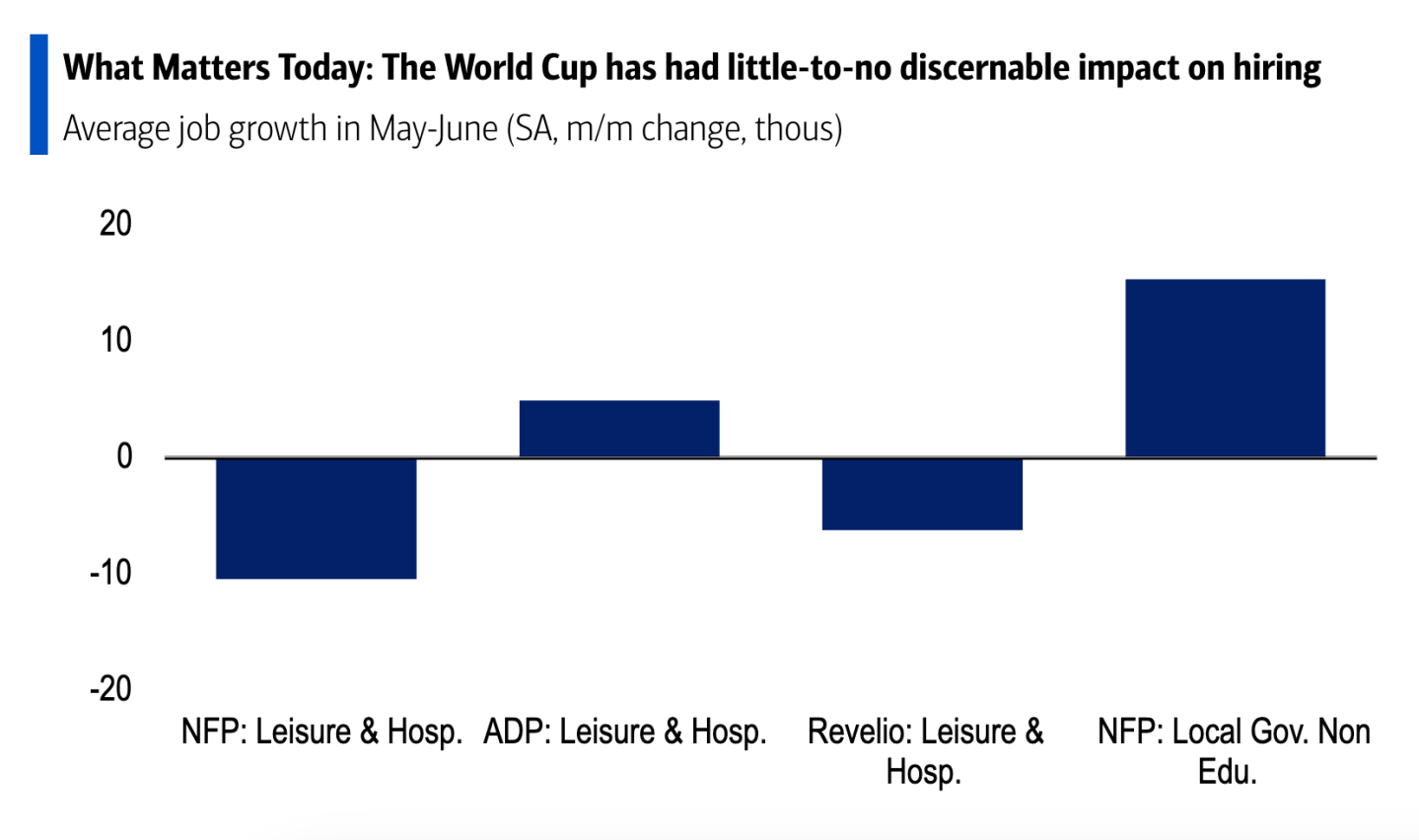
But over at Bank of America Institute (the bank’s think tank), Liz Everett Krisberg and David Tinsley produced these charts based on payroll data that the bank can see via transactions in its customer accounts. “While host cities have seen a larger pickup in job growth in 2026 relative to the second half of 2025, non-hosts have also seen an acceleration,” they said in a note:
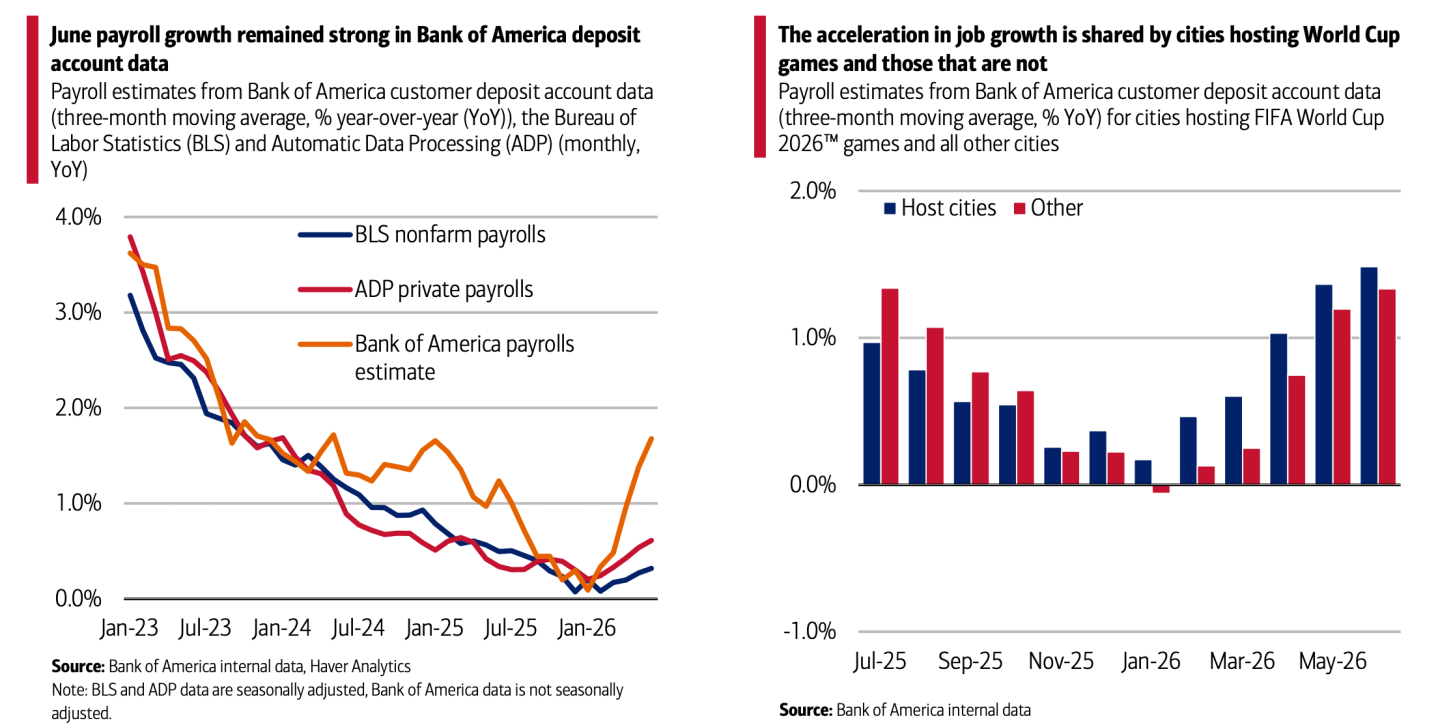
- Caveats: Private payroll data is notoriously volatile and unreliable compared to the official BLS numbers; and the official number will probably be revised two or three times as new data comes in. So we will get an answer as to whether the World Cup somehow reduced hospitality jobs in the U.S. … several months from now.
NUMBER OF THE DAY
$600 billion
The amount of AI-related debt that has been issued since 2024 by hyperscaler companies, according to Shamshad Ali and his team at Goldman Sachs.
THE FRONT PAGES TODAY
Trump says US will give Ukraine license to produce Patriot defense systems - AP
Ukraine’s drone playbook is wreaking havoc in Russia — and upending where NATO wants to invest - CNBC
GOP megadonor Ken Griffin says he'd back Rubio over Vance in 2028 - Axios
He Earns $33 an Hour as a Costco Cashier. Now He’s a Millionaire - WSJ
SK Hynix US Offering Is More Than Seven Times Oversubscribed - Bloomberg
‘Hysteria’ Grips San Francisco’s Housing Market as A.I. Wealth Pours In - NYT
ONE MORE THING
The toxic manager you deliberately left off your reference list might already be on the phone with your future boss
Netskope chief Sanjay Beri told Fortune’s Orianna Rosa Royle that when job candidates give him their references, he doesn’t just call the names candidates hand over—he also tracks down the ones they left off, to find out what they’re really like.
“We do a heck of a lot of background checks and references, and a lot of those references are literally just on cultural fit,” the CEO of the $4.8 billion software company said. “So we will try to find people they know, maybe the references they didn’t give.” It means (for Netskope applicants, anyway) the coworker you butted heads with two jobs ago or the manager you conveniently left off the reference list could already be on a phone call about you before you’ve even had your final interview.