
• Home
  • Latest
  • Fortune 500
  • Finance
  • Tech
  • Leadership
  • Lifestyle
  • Rankings
  • Multimedia

Trendingnow

1

MacKenzie Scott alone accounted for one-third of America's $19.2 billion in megagifts last year

2

Now worth $200 million, Sarah Jessica Parker credits being ‘one of eight kids that struggled financially’ for her hunger, ambition, and work ethic

3

Ray Dalio says the U.S. just had its 'Suez moment'—and history says what comes next could end an empire

1

MacKenzie Scott alone accounted for one-third of America's $19.2 billion in megagifts last year

2

Now worth $200 million, Sarah Jessica Parker credits being ‘one of eight kids that struggled financially’ for her hunger, ambition, and work ethic

3

Ray Dalio says the U.S. just had its 'Suez moment'—and history says what comes next could end an empire
Economybaby boomers

One chart explains the economy’s terrible baby boomer hangover, Gen X’s invisibility, and millennial and Gen Z irrelevance

By
Tristan Bove
Tristan Bove
Contributing Reporter
Down Arrow Button Icon
By
Tristan Bove
Tristan Bove
Contributing Reporter
Down Arrow Button Icon
June 26, 2026, 12:52 PM ET
Young and old in America are at a crossroads.
Young and old in America are at a crossroads.Getty Images
Add Fortune on Google for similar content.

The Census Bureau is out with new data, documenting how America has grown over the past six years — or not. One takeaway is clear: the Baby Boomer generation is so massive and has such a stranglehold on the economy that essentially no part of the country is seeing any real population growth among younger people. The only, partial exception is in exurban areas in the Sun Belt, where regulations encourage affordability for young Americans starting out in their careers.

Recommended Video

Just consider one fact: 39.4 the age of the average American. That’s the median age as of July 2025, up from 38.6 just five years ago. Half the country is now on the far side of 40. And buried inside the Census Bureau’s freshly released Vintage 2025 population estimates is a map of how America got here.

The data, released Thursday, tells a story about four generations and one fundamental imbalance: a country whose dominant demographic cohort is exiting productive economic life while retaining nearly all of its productive economic assets — and where every generation in its wake is either too small, too dispersed, or too financially constrained to fill the void.

America has an economic boomer hangover — the data is plain to see.
The pig in the python

It’s well known that baby boomers dominate most of the traditional statistics of economic empowerment. The generation owns one third of the nation’s housing stock and are responsible for most homebuying activity. They remain largely in control of the country’s political machine, despite the cohort’s youngest now having aged well into their 60s. The sheer size of the demographic and its staying power has also reshaped labor markets—possibly for the foreseeable future, by distorting the need for workers junior to them.

But the Census data make it overwhelmingly clear: In every region of the U.S., boomers have become more entrenched over the past few years while most other demographic groups have struggled to grow. And spare a thought for Gen X or anyone under the age of 18, who are losing ever more ground in the country’s demographic makeup. It’s the lingering effect of what Russell Baker, a New York Times humorist, termed “pigs in a python” in the 1970s. Baby boomers (the pigs) have spent decades moving through the U.S. economy (python), distorting everything in their path and leaving behind something unrecognizable.

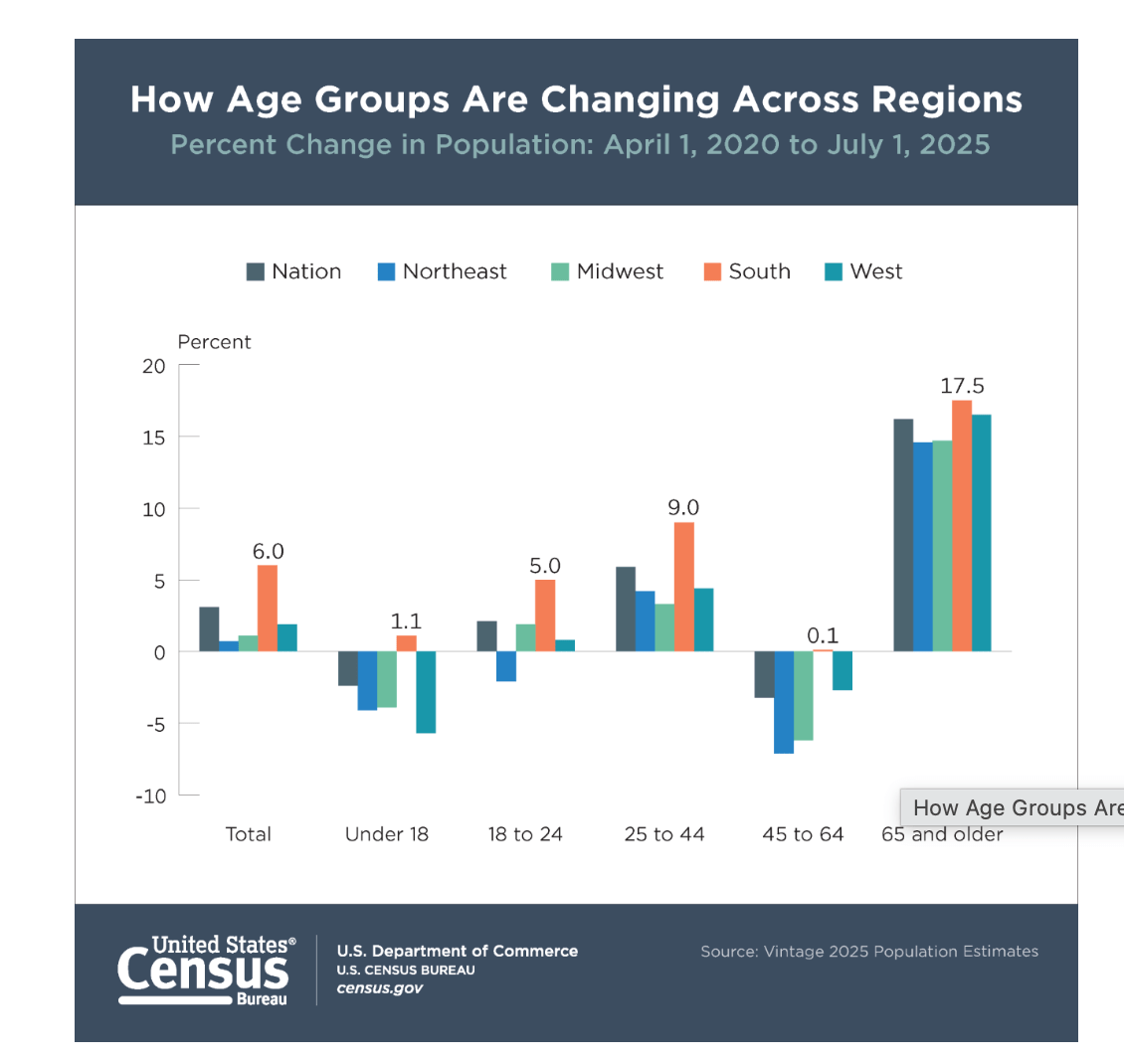
Between 2020 and 2025, the number of people older than 65 rose 16.2%, according to the Census. The number of people between the ages of 25 and 44, broadly in line with the millennial cohort, increased 5.9%. Young adults barely held on to their ranks, with the 18-24 age range only rising 2.1%. 

The country is underwater, meanwhile, when it comes to kids and oft-neglected Gen Xers. The number of under-18-year-olds in the U.S. dipped 2.4%, while the population aged 45 to 64 declined 3.2%. These two demographic groups are shrinking in every part of the country except the South, the only corner of the U.S. that seems to be growing consistently at all. The region’s under-18 population grew 1.1%, while the number of Gen X-aged Americans rose a fractional 0.1%.

In the Census Bureau’s regional age breakdown, the South is the only region in the country that grew in all five age cohorts — children, young adults, early-career adults, midlife adults, and retirees — between April 2020 and July 2025. Every other region bled population in at least two categories, often more.

The South grew by 6% over that period. The nation as a whole grew by 3.1%.

The Northeast lost 4.1% of its under-18 population and 7.1% of its 45-to-64-year-olds — the steepest midlife decline of any region. The Midwest shed 3.9% of its children and 6.2% of its midlife cohort. The West, long the country’s demographic frontier, posted the worst child-population decline of any region: -5.7%.

“Regional age patterns are changing for a few key reasons,” said Lauren Bowers, chief of the Census Bureau’s Population Estimates branch. “The continued transition of baby boomers into retirement age, compounded by local migration and fertility patterns, is shifting the demographic makeup of the country.”

The Invisible Generation

There is a cohort in the middle of all of this that rarely gets a headline. Gen X — born roughly between 1965 and 1980, now aged 45 to 61 — maps almost precisely onto the Census Bureau’s 45-to-64 age bracket. And that bracket is shrinking in three of the country’s four regions: down 7.1% in the Northeast, 6.2% in the Midwest, 2.7% in the West. The South is the sole exception, and barely: a gain of 0.1%, roughly 19,000 people.

As the successors to baby boomers, Gen X never really stood a chance. The cohort was born during a period of plummeting fertility rates and changes to immigration policy. At around 65 million, the generation is smaller than both the baby boomers and the millennials that succeeded them. Statisticians have even referred to Gen X as the country’s forgotten “middle child,” given their ongoing struggle for relevance in demographic maps and the economy at large.

Gen X was always the overlooked cohort — sandwiched between the boomer cultural colossus and the millennial media obsession. Demographically, they are simply too small, compared to 76 million boomers and 72 million millennials. There weren’t enough of them to sustain regional population bases as boomers aged out, and there aren’t enough of them now to absorb the institutional, economic, and political weight that boomers are vacating.

They are also, in a quiet and underappreciated way, the load-bearing generation of the current American economy. Gen Xers are running the middle and upper-middle layers of corporate America — the VP floors, the managing director ranks, the regional leadership roles — while boomers hold on to the corner offices and millennials wait in line. When boomers finally cede control, Gen X won’t have the numbers to hold it for long.

Not all of the Census findings were necessarily surprises. The postwar boom in birth rates yielded one of the largest generations of all time as a share of the country at large. By the time the last baby boomer was born in 1964, the cohort comprised more than a third of the entire U.S. population. As immigrants added to the generation’s ranks over the years, baby boomers peaked in the 1990s at a massive 79 million.

The Peripheral Majority

Millennials — roughly 25 to 44 years old today — are the largest living generation in America. They are also, by the evidence of this data, the most economically sidelined.

The 25-to-44 cohort is growing fastest in the South. But that growth is concentrated in outlying metro counties — the exurban fringes of cities like Atlanta, Charlotte, Dallas, and Nashville. 

“The South’s growth from 2020 to 2025 has been particularly prominent in its metro areas’ outlying counties,” Bowers noted. “These outlying counties grew the fastest across all age groups, and often by a large margin, suggesting that they are attracting or retaining people of all ages.”

Why would that be? The economic answer is obvious. Millennials didn’t move to the exurbs of Raleigh and San Antonio because of opportunity. They moved because they were priced out of the cities where boomers own the housing stock and Gen X anchors the professional networks. The largest generation in American history is diffusing into economic margins, gaining square footage and losing proximity to power.

America’s aging population comes with real stakes for the country’s economy and political scene, a shift compounded by the steep decline in young populations almost anywhere in the country. But for now, the U.S. demographic shift is mostly representative of a baby boomer generation that remolded the country in its image, and of younger generations struggling to carve a piece out of it.

Subscribe to Fortune Gulf Brief. Every Tuesday, this new newsletter delivers clear-eyed, authoritative intelligence on the deals, decisions, policies, and power shifts shaping one of the world’s most consequential regions, written for the people who need to act on it. Sign up here.
About the Author
By Tristan BoveContributing Reporter
LinkedIn iconTwitter icon
See full bioRight Arrow Button Icon
Add Fortune on Google for similar content.

Latest in Economy

Finance
Lorem ipsum dolor sit amet, consectetur adipiscing elit, sed do eiusmod tempor incididunt ut labore et dolore magna aliqua. Ut enim ad minim veniam
By Fortune Editors
October 20, 2025
Finance
Lorem ipsum dolor sit amet, consectetur adipiscing elit, sed do eiusmod tempor incididunt ut labore et dolore magna aliqua. Ut enim ad minim veniam
By Fortune Editors
October 20, 2025
Finance
Lorem ipsum dolor sit amet, consectetur adipiscing elit, sed do eiusmod tempor incididunt ut labore et dolore magna aliqua. Ut enim ad minim veniam
By Fortune Editors
October 20, 2025
Finance
Lorem ipsum dolor sit amet, consectetur adipiscing elit, sed do eiusmod tempor incididunt ut labore et dolore magna aliqua. Ut enim ad minim veniam
By Fortune Editors
October 20, 2025
Finance
Lorem ipsum dolor sit amet, consectetur adipiscing elit, sed do eiusmod tempor incididunt ut labore et dolore magna aliqua. Ut enim ad minim veniam
By Fortune Editors
October 20, 2025
Finance
Lorem ipsum dolor sit amet, consectetur adipiscing elit, sed do eiusmod tempor incididunt ut labore et dolore magna aliqua. Ut enim ad minim veniam
By Fortune Editors
October 20, 2025

Most Popular

Finance
Lorem ipsum dolor sit amet, consectetur adipiscing elit, sed do eiusmod tempor incididunt ut labore et dolore magna aliqua. Ut enim ad minim veniam
By Fortune Editors
October 20, 2025
Finance
Lorem ipsum dolor sit amet, consectetur adipiscing elit, sed do eiusmod tempor incididunt ut labore et dolore magna aliqua. Ut enim ad minim veniam
By Fortune Editors
October 20, 2025
Finance
Lorem ipsum dolor sit amet, consectetur adipiscing elit, sed do eiusmod tempor incididunt ut labore et dolore magna aliqua. Ut enim ad minim veniam
By Fortune Editors
October 20, 2025
Finance
Lorem ipsum dolor sit amet, consectetur adipiscing elit, sed do eiusmod tempor incididunt ut labore et dolore magna aliqua. Ut enim ad minim veniam
By Fortune Editors
October 20, 2025
Finance
Lorem ipsum dolor sit amet, consectetur adipiscing elit, sed do eiusmod tempor incididunt ut labore et dolore magna aliqua. Ut enim ad minim veniam
By Fortune Editors
October 20, 2025
Finance
Lorem ipsum dolor sit amet, consectetur adipiscing elit, sed do eiusmod tempor incididunt ut labore et dolore magna aliqua. Ut enim ad minim veniam
By Fortune Editors
October 20, 2025
Fortune Secondary Logo
Rankings
  • 100 Best Companies
  • Fortune 500
  • Global 500
  • Fortune 500 Europe
  • Most Powerful Women
  • World's Most Admired Companies
  • See All Rankings
  • Lists Calendar
Sections
  • Finance
  • Fortune Crypto
  • Features
  • Leadership
  • Health
  • Commentary
  • Success
  • Retail
  • Mpw
  • Tech
  • Lifestyle
  • CEO Initiative
  • Asia
  • Politics
  • Conferences
  • Europe
  • Newsletters
  • Personal Finance
  • Environment
  • Magazine
  • Education
Customer Support
  • Frequently Asked Questions
  • Customer Service Portal
  • Privacy Policy
  • Terms Of Use
  • Single Issues For Purchase
  • International Print
Commercial Services
  • Advertising
  • Fortune Brand Studio
  • Fortune Analytics
  • Fortune Conferences
  • Business Development
  • Group Subscriptions
About Us
  • About Us
  • Press Center
  • Work At Fortune
  • Terms And Conditions
  • Site Map
  • About Us
  • Press Center
  • Work At Fortune
  • Terms And Conditions
  • Site Map
  • Facebook icon
  • Twitter icon
  • LinkedIn icon
  • Instagram icon
  • Pinterest icon

Latest in Economy

One chart explains the economy’s terrible baby boomer hangover, Gen X’s invisibility, and millennial and Gen Z irrelevance
Economybaby boomers
One chart explains the economy’s terrible baby boomer hangover, Gen X’s invisibility, and millennial and Gen Z irrelevance
By Tristan BoveJune 26, 2026
2 hours ago
gavin
PoliticsTaxes
Newsom calls for a national billionaires’ tax — just not the one his state’s voters are about to pass
By Jonathan J. Cooper and The Associated PressJune 26, 2026
3 hours ago
b
PoliticsTaxes
After flirting with Gavin Newsom rollback idea, union is ‘all in’ on full billionaires’ tax for California
By Sophie Austin and The Associated PressJune 26, 2026
3 hours ago
Current price of oil as of June 26, 2026
Personal FinanceOil
Current price of oil as of June 26, 2026
By Joseph HostetlerJune 26, 2026
6 hours ago
The New York Stock Exchange is seenduring morning trading on May 26, 2026 in New York City.
EconomyConsumer Spending
The richest 20% are the only ones powering the U.S. economy, says top economist, but their prospects are entirely reliant on teetering stock prices
By Eleanor PringleJune 26, 2026
8 hours ago
Photo: Sam Altman
EconomyMarkets
‘Memory supply crisis’: Wall Street triggers huge selloff in fear of looming chip shortages
By Jim EdwardsJune 26, 2026
9 hours ago

Most Popular

MacKenzie Scott alone accounted for one-third of America's $19.2 billion in megagifts last year
Success
MacKenzie Scott alone accounted for one-third of America's $19.2 billion in megagifts last year
By Sydney LakeJune 25, 2026
1 day ago
Now worth $200 million, Sarah Jessica Parker credits being ‘one of eight kids that struggled financially’ for her hunger, ambition, and work ethic
Success
Now worth $200 million, Sarah Jessica Parker credits being ‘one of eight kids that struggled financially’ for her hunger, ambition, and work ethic
By Orianna Rosa RoyleJune 24, 2026
2 days ago
Ray Dalio says the U.S. just had its 'Suez moment'—and history says what comes next could end an empire
Economy
Ray Dalio says the U.S. just had its 'Suez moment'—and history says what comes next could end an empire
By Nick LichtenbergJune 26, 2026
12 hours ago
Trump turns on Big Oil donors who spent nearly $100 million to get him elected—now he wants the DOJ to investigate them for price gouging
Economy
Trump turns on Big Oil donors who spent nearly $100 million to get him elected—now he wants the DOJ to investigate them for price gouging
By Tristan BoveJune 25, 2026
22 hours ago
The bond market knows something about the $39 trillion national debt that Washington doesn’t
Economy
The bond market knows something about the $39 trillion national debt that Washington doesn’t
By Eva RoytburgJune 25, 2026
21 hours ago
Current price of oil as of June 25, 2026
Personal Finance
Current price of oil as of June 25, 2026
By Joseph HostetlerJune 25, 2026
1 day ago

© 2026 Fortune Media IP Limited. All Rights Reserved. Use of this site constitutes acceptance of our Terms of Use and Privacy Policy | CA Notice at Collection and Privacy Notice | Do Not Sell/Share My Personal Information
FORTUNE is a trademark of Fortune Media IP Limited, registered in the U.S. and other countries. FORTUNE may receive compensation for some links to products and services on this website. Offers may be subject to change without notice.