
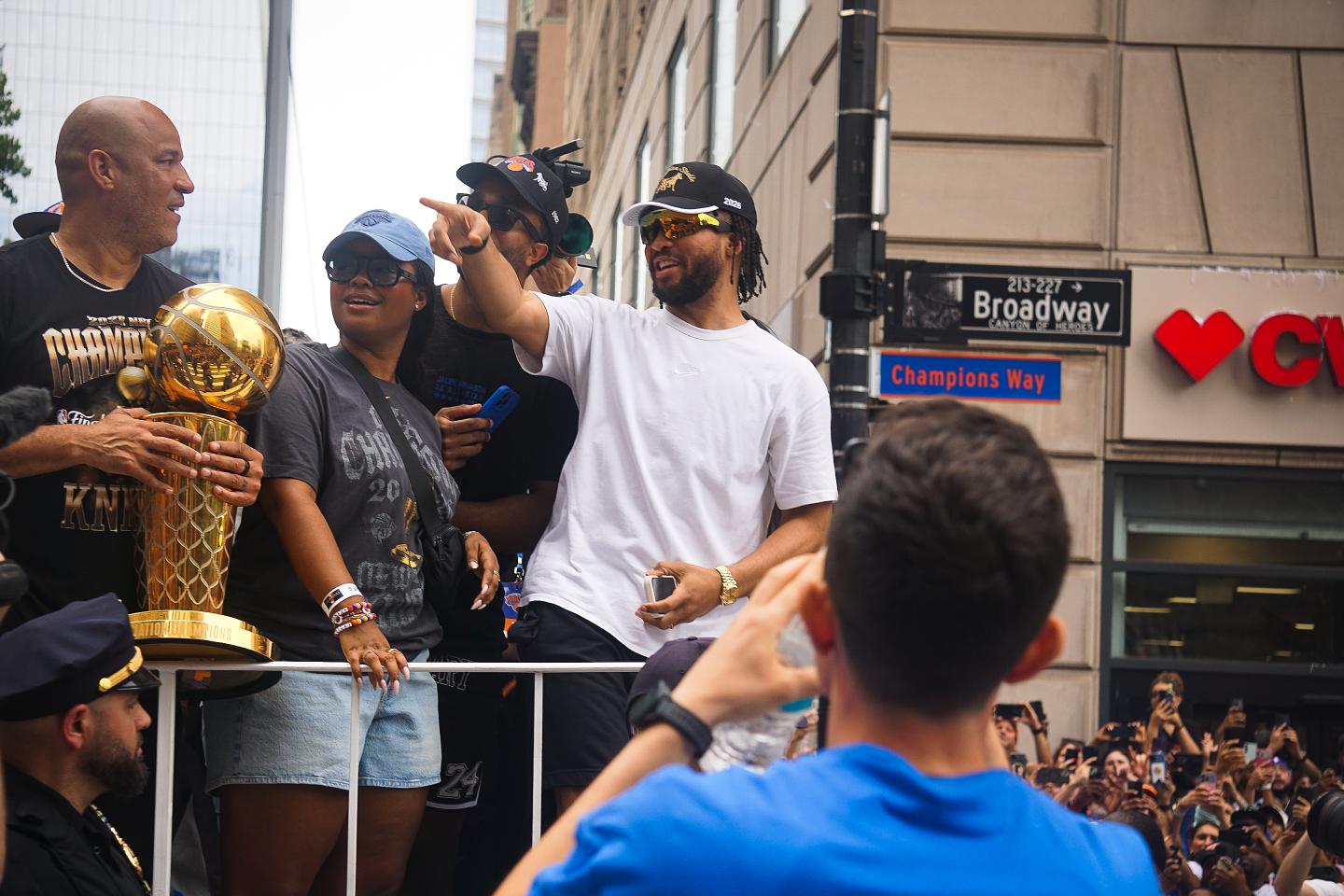
The Earth formed 4.5 billion years ago, the first Olympic Games were held in 776 B.C., James Naismith invented basketball in 1891, and the five boroughs of New York City were unified in 1898. And yet, in the time that’s passed, the New York Knicks have never once had a ticker-tape parade.
Until today.
When the team won titles in 1970 and 1973, then-Mayor John Lindsay passed on the downtown spectacle entirely. The ’70 team got a reception at Gracie Mansion; the ’73 squad got a luncheon and a City Hall ceremony that drew roughly 2,000 people. This year, Mayor Zohran Mamdani had no such ambivalence. Minutes after Jalen Brunson sealed the title in San Antonio last Saturday, he posted three words on X: “Parade. Thursday. Manhattan.”
By 7:30 a.m. Thursday, the NYPD had announced that all viewing pens were full, more than two hours before the first float moved, with subway service suspended south of Canal Street to manage the crush. At City Hall this afternoon, after the confetti crews were already at work, Mamdani explained what the run had meant.
“The Knicks did not just win for New York City,” he said. “They won like New York City. What is New York if not your back up against the wall, a dream that feels just out of reach, a rent payment you don’t know how you’ll ever make, 99.6% of the world stacked against you. And who are New Yorkers if not people who hear those odds and smile and ask, ‘Why are you giving me a head start?'”
According to the New York City Economic Development Corporation, the Knicks’ post-season run generated an $380 million in economic activity during home games. During the Finals, each home game was worth $90 million. For context: when the Milwaukee Bucks won the championship in 2021, the entire NBA playoff run generated $57.6 million in economic activity for that city.
Part of that gap is because of how the games were structured. NBA Finals tickets are typically priced 200% higher than regular season equivalents, and New York commands a premium on top of that premium—floor seats at the Garden this year ran a minimum of $10,000. The more meaningful driver, though, is out-of-town visitors: roughly 20% of Game 1 purchases in San Antonio came from New York billing zip codes, meaning fans flew to Texas just to keep the money flowing. When visitors travel in from outside the five boroughs, that’s net new money entering the local economy—not a reallocation from one city restaurant to another.
What it costs to host a historic day
The parade itself comes with its own price tag. The total cost for logistics, preparations, and cleanup is expected to surpass $2 million, based on outlays for previous events. Security alone was historic: more than 10,000 officers were deployed—the largest planned deployment in NYPD history, nearly one-third of the department’s entire uniformed force, exceeding even New Year’s Eve in Times Square. The operation included aviation teams, drones, heavy weapons units, explosive detection K-9s, and a plainclothes unit working inside the crowd—all mobilized after 63 people were arrested and 10 officers injured during street celebrations following the Game 5 championship-clinching win.
The net arithmetic still clearly favors the city. A $2 million logistics tab against $380 million in economic activity is a return ratio most investments would envy. The 347,000 applications for just 600 tickets to the City Hall ceremony tells you everything about the demand. The 2026 NBA Finals averaged more than 20 million viewers on ABC/ESPN—the most-watched postseason since 1998—a national broadcast that doubled as a sustained advertisement for New York City at a scale no tourism campaign can replicate.
The Keys to the City that Mamdani presented to the Knicks today were commissioned months in advance, manufactured by Azra Khalfan, designed by Aneesh Bhoopathy, with typography by Tobias Frere-Jones—the designer behind the typefaces of the 9/11 Museum and NYU. The first keys of the Mamdani administration, given to the team that made the biggest city in the country feel, for a few weeks at least, like it had something to prove.