
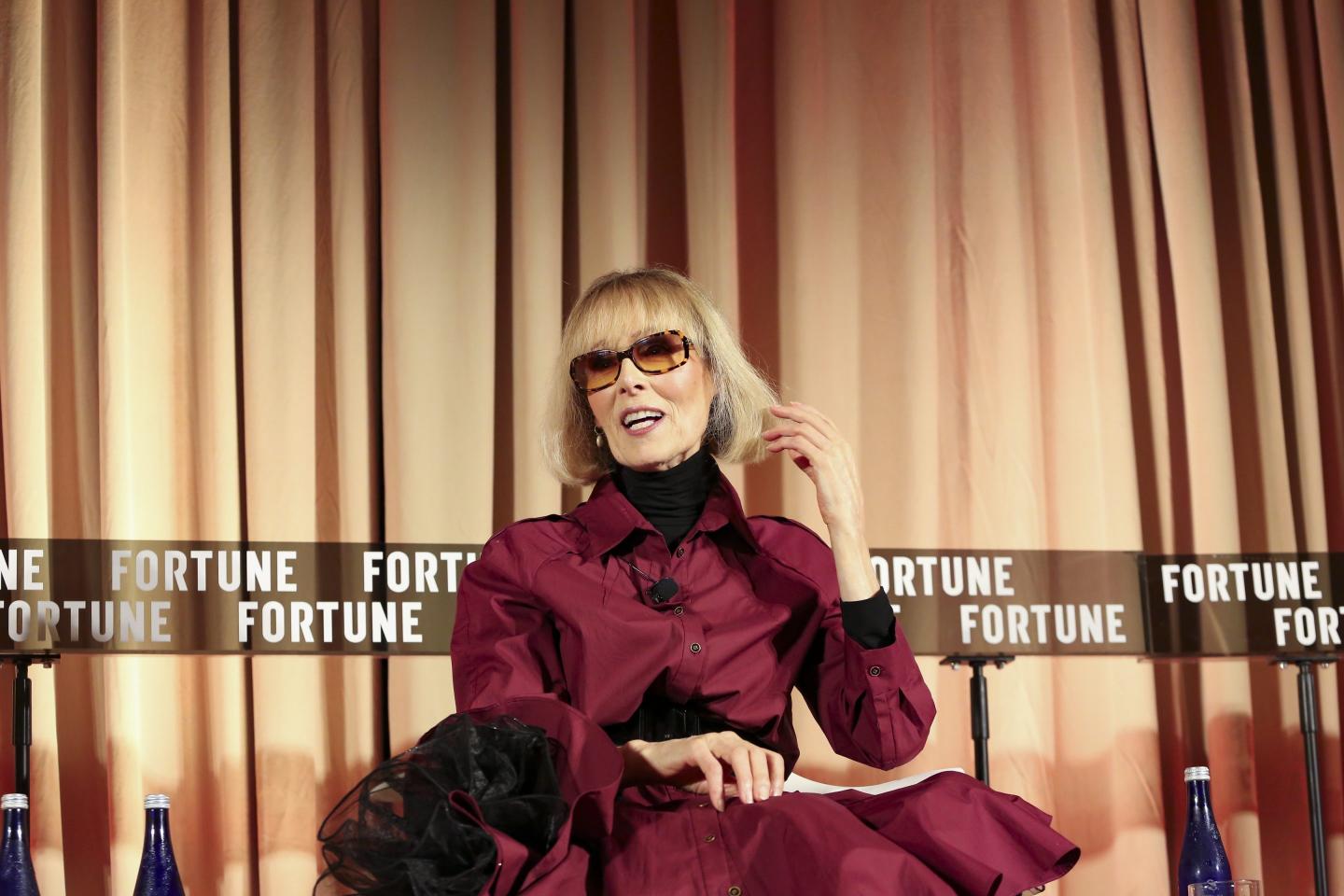
Last fall, I went to see a documentary at the Montclair Film Festival in New Jersey. I was rapt, watching the film, when I was struck with a surprise: I was in it!
The documentary was Ask E. Jean, which follows E. Jean Carroll, from her career as a writer, to her alleged sexual assault by President Trump in the 1990s (he was found liable for sexual abuse in 2023), to the toll of his constant insults to her $83.3 million victory against him in a defamation lawsuit. I interviewed Carroll about those same topics with her winning attorney Robbie Kaplan onstage at a Fortune Most Powerful Women dinner in New York in 2024, clips of which the filmmakers used to close out the doc.
Since seeing the film in October, I’ve been eager to talk more about it. There was just one problem: for months, the documentary couldn’t find distribution. Director Ivy Meeropol wrote a NYT op-ed about all the challenges she faced bringing the film to viewers beyond the festival circuit, and I caught up with her recently about the long journey as well. The film first screened at the Telluride Film Festival. “People were so excited to see her there, the responses were so great—and we didn’t get any offers,” Meeropol remembers. After a lot of work, the film got one offer—and then that buyer completely ghosted. Meanwhile, last spring about five people associated with the film—from executive producers to young crew on green cards—asked to have their names scrubbed from the credits.
Eventually, Abramorama agreed to distribute the documentary. Over the past two weekends, Ask E. Jean started playing in New York and L.A. Audiences are showing up to watch a story that reveals a lot more about who Carroll is than her past few years as a Trump enemy—and one of few to hold Trump accountable in court. She’s had a fascinating life and career, from her time as a well-known advice columnist and talk show host to writing a biography of Hunter S. Thompson.
So what were people so afraid of? Last week, the Trump administration made clear the lengths it’s willing to go to punish Carroll. The DOJ launched a criminal investigation of Carroll examining whether she committed perjury in lawsuits over both sexual abuse and defamation. The premise for the allegation is that she said she received no outside funding for the suit, but billionaire Reid Hoffman paid some expenses. Trump has also asked the Supreme Court to allow the DOJ to take over his appeal of the verdict, which would change Carroll’s fight from one against Trump, the individual, to one against the U.S. government on behalf of the president. And the federal government can’t be sued for defamation.
During the process of trying to find distribution, Meeropol remembers, “No one said to me, ‘We’re not doing this because of Trump, We’re not doing this because we’re afraid of what he’ll do or we’re not doing this because of a big merger deal that he could actually affect,’ but that’s all that was in the air.” She’s careful not to make assumptions that was the only reason the film had a tough road; it’s also a really bad market for documentaries overall.
But all that is still “in the air,” as Meeropol puts it. “As far as streamers, we don’t have any offers,” she confirms. (By contrast, Amazon paid more than $40 million for the Melania documentary.) If no streamer steps up, the filmmakers are going to work to get the film on video-on-demand for an affordable price.
If you’re in a market where the doc is playing now, I highly suggest you go see it. Otherwise, stay tuned for the next chapter in the E. Jean Carroll story.
Emma Hinchliffe
emma.hinchliffe@fortune.com
The Most Powerful Women Daily newsletter is Fortune’s daily briefing for and about the women leading the business world. Subscribe here.
ALSO IN THE HEADLINES
Anthropic filed for its IPO. It's a confidential filing, with draft paperwork submitted as of now (so we haven't learned that much that's new about the company behind Claude—or cofounder Daniela Amodei—yet). The company said in a blog post that the number of shares to be offered and the price have not yet been set.
Pete Hegseth blocked the promotion of female and Black admirals. His intervention seems to violate rules that govern the Navy's promotion system. Overall, almost 60% of officers Hegseth has fired across the military have been women or Black; those groups account for less than 20% of generals and admirals. The Pentagon's spokesman said "the department will never consider the color of a service member’s skin or their gender as a factor in promotions."
A top Taiwanese politician embarks on a U.S. tour. Cheng Li-wun is a possible 2028 presidential contender in Taiwan. She recently became the first leader of her opposition party (which supports reconciliation with China) to meet with Xi Jinping in a decade. But she's not expected to meet with President Trump or top U.S. officials.
Melinda French Gates gets into sports. She's a new minority owner in the men's hockey team the Seattle Kraken. The team is co-owned by Samantha Holloway, the only female governor in the NHL and one of few female owners. French Gates says her stake is an "investment in our city and its future."
A tennis player just got fined $65,000 for being sexist to an umpire. After he lost, Paraguayan player Adolfo Daniel Vallejo said his match at the French Open shouldn't have been umpired by a woman. "It has to be refereed by a man, because it’s a very demanding crowd and you need a lot of strength to go against the crowd," he said. The fine is about half his prize money for reaching the second round.
ON MY RADAR
What's your 'mom aesthetic'? NYT
D.C. progressives' great socialist hope The Atlantic
Ann Patchett opened a bookstore everyone said would fail. Now it’s a blueprint Fortune
PARTING WORDS
"[She] represented everything my parents stood for in her beautiful, amazing and too-short life."
— Caroline Kennedy, remembering her late daughter Tatiana Schlossberg. She spoke at the John F. Kennedy Profile in Courage Award ceremony.