• Home
  • Latest
  • Fortune 500
  • Finance
  • Tech
  • Leadership
  • Lifestyle
  • Rankings
  • Multimedia

Trendingnow

1

He worked 100-hour weeks to save a nearly bankrupt boat company. At 83, he’s just turned down $400 million for it—and gave it all to charity instead

2

Costco's $14 million email settlement: Who qualifies for an up-to $500 payment and how to claim before the Aug. 24 deadline

3

Mamdani’s pied-à-terre tax was designed to hit the wealthy, but it’s sending most New Yorkers to their estate lawyers

1

He worked 100-hour weeks to save a nearly bankrupt boat company. At 83, he’s just turned down $400 million for it—and gave it all to charity instead

2

Costco's $14 million email settlement: Who qualifies for an up-to $500 payment and how to claim before the Aug. 24 deadline

3

Mamdani’s pied-à-terre tax was designed to hit the wealthy, but it’s sending most New Yorkers to their estate lawyers
CommentaryTariffs

The Supreme Court handed Trump a Golden Chariot on tariffs — now he just has to take it

By
Jeffrey Sonnenfeld
Jeffrey Sonnenfeld
and
Steven Tian
Steven Tian
Down Arrow Button Icon
By
Jeffrey Sonnenfeld
Jeffrey Sonnenfeld
and
Steven Tian
Steven Tian
Down Arrow Button Icon
May 26, 2026, 6:30 AM ET
t
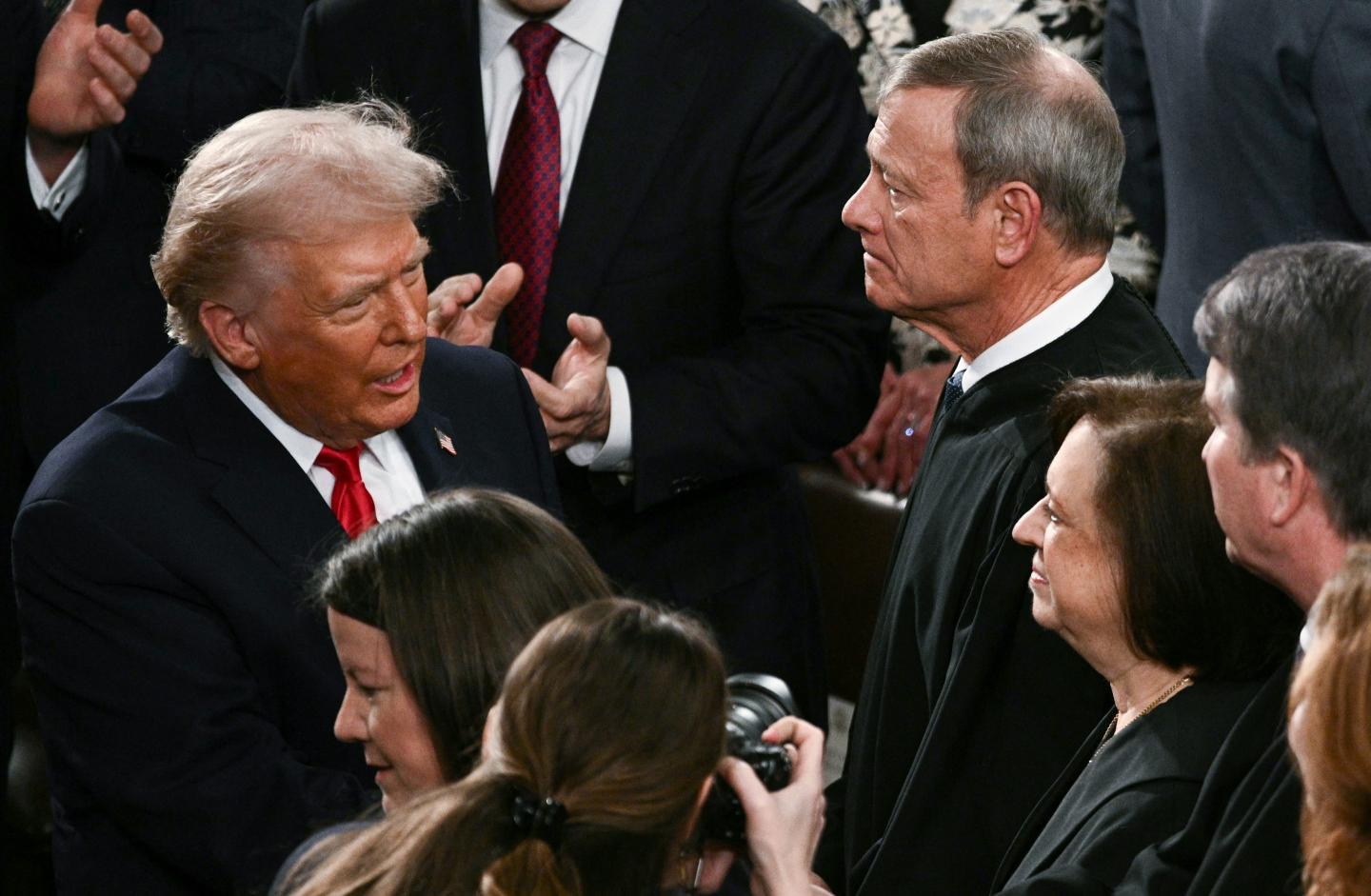
US President Donald Trump greets Chief Justice John Roberts, Associate Justices Elena Kagan and Brett Kavanaugh as he arrives to deliver the State of the Union address in the House Chamber of the US Capitol in Washington, DC, on February 24, 2026. Brendan SMIALOWSKI / AFP via Getty Images
Add Fortune on Google for similar content.

In Greek theater, a deus ex machina arrives when a protagonist is hopelessly trapped — and a golden chariot descends from the heavens to rescue them from a conflict they cannot escape on their own. That is precisely what the Supreme Court has delivered to Donald Trump on trade. With his IEEPA tariff authority struck down as an illegal tax on American businesses and consumers, Trump has been handed an exit ramp from a trade war that was failing on nearly every front: alienating allies, stoking inflation, revolting bond markets, and uniting the American business community against him in rare collective opposition. The question now is whether Trump will climb into the chariot — or stand in the street and argue with the driver.

Recommended Video

The ruling has set three consequential developments in motion simultaneously, each of which reshapes the economic outlook for the better.

Companies Are Collecting — and the Earnings Boost Is Enormous

Ever since the Customs and Border Protection agency opened a refund portal on April 20 for the more than 330,000 firms that paid over $166 billion in import taxes under Trump’s court-invalidated use of the International Emergency Economic Powers Act, corporate America has moved with striking unanimity. Walmart, Apple, Home Depot, General Motors, John Deere, FedEx, and Costco have all confirmed they are applying for refunds. Not a single major company has publicly declined to pursue the money owed to them — nor should any expect to, given the fiduciary obligations executives hold to their shareholders.

More than $35 billion has already been processed and is on its way to business bank accounts, according to a CBP court filing. The government owes roughly $166 billion plus interest in total — a one-time windfall equivalent to nearly a quarter of S&P 500 earnings in the first quarter of 2026. With earnings season approaching, that is a potential 25% boost to company earnings: a remarkable and largely unheralded tailwind. As former Under Secretary of State for Economic Affairs Robert Hormats noted in Fortune, consumers are unlikely to see those refunds directly — but the boost to corporate balance sheets is real and imminent.

Trump has responded with characteristic bravado, calling the refund-seekers people who “hate our country” and threatening to “remember” companies that pursue the money legally owed them. But the unified response from corporate America illustrates one of the central lessons of collective action against Trump’s divide-and-conquer instincts: when business, trade groups, and civil society move together — as the National Association of Manufacturers, the Chamber of Commerce, and eventually the Business Roundtable did — Trump has little political ground on which to stand. That coalition, validated by the Supreme Court, is why he has had to move on.

The collective action from the business community – and Trump’s predictable response- draws from key lessons from our book, Trump’s Ten Commandments. 

Trump Has Lost the Log — and Found a Better Tool

As we reveal in our book, Trump’s favored negotiating style is always to start with a punch to the face rather than what most negotiation experts would advise: building trust. Instead, Trump always seeks to grab the biggest log he can find and smack his counterparty in the nose as his preferred opening move. That was exactly the shock and awe approach Trump defaulted to with his whopping Liberation Day tariffs, the purest expression of that instinct: maximum shock, maximum leverage, maximum chaos.

The Supreme Court has taken that log from his hands. And without it, something more interesting has emerged. Trump has pivoted — whether by necessity or genuine strategic recalibration — toward a more constructive, incremental deal-making posture. His more diplomatic trade advisors are now ascendant, with the bellicose faction represented by Commerce Secretary Howard Lutnick and Trade Counselor Peter Navarro increasingly sidelined.

The China Deals Show What the New Playbook Looks Like

The clearest evidence of this shift is Trump’s recent visit to China, where — instead of wielding 145% tariff threats or escalating a tit-for-tat trade war — he secured incremental agreements for China to purchase more American agricultural products and defense exports, including 200 Boeing airplanes. For American manufacturers, farmers, and aerospace workers, that is tangible. Boeing had been caught in the crossfire of the tariff war for two years; a 200-plane order restores visibility to a supply chain that had been paralyzed by uncertainty.

More broadly, the deals signal something the business community has been desperate for: predictability. CEOs don’t just need low tariffs — they need stable ones. A trade environment where deals are struck incrementally and held is worth more to capital allocation decisions than any single rate reduction. That is the new playbook imposed on Trump, and it is one American industry can actually build around.

That is what trade diplomacy can look like when the log is put down.

The irony is almost too clean. A Supreme Court ruling that Trump publicly condemned as a “terrible decision” may prove to be the most economically useful thing that happened to his second term. The ruling hands him three gifts at once: a villain to blame for the tariff retreat (the Court), a set of wins to claim credit for (the deals), and a business community that — despite two years of friction — is now rooting for his trade pivot to succeed because their earnings depend on it. Trump didn’t engineer this exit ramp. But it’s there, and it leads somewhere better than where he was headed.

History will likely record less about how the log was taken from his hands and more about whether he had the discipline to negotiate without it.

The golden chariot is waiting — and for once, Trump doesn’t need to fight his way into it. The Supreme Court, the bond markets, the business community, and now his own trade advisors are all pointing in the same direction. The economic tailwinds are real: $166 billion flowing back to companies, earnings season approaching with an unexpected boost, and a China relationship that looks more transactional than adversarial for the first time in years, despite his instincts.

Trump has spent two years swinging the biggest log he could find. Now the Court has taken it — and handed him something more useful: a deal to close.

The opinions expressed in Fortune.com commentary pieces are solely the views of their authors and do not necessarily reflect the opinions and beliefs of Fortune.

About the Authors
By Jeffrey Sonnenfeld

Jeffrey Sonnenfeld is the Lester Crown Professor in Management Practice and Senior Associate Dean at Yale School of Management.

See full bioRight Arrow Button Icon
By Steven Tian

Steven Tian is the director of research at the Yale Chief Executive Leadership Institute.

See full bioRight Arrow Button Icon
Add Fortune on Google for similar content.

Latest in Commentary

Finance
Lorem ipsum dolor sit amet, consectetur adipiscing elit, sed do eiusmod tempor incididunt ut labore et dolore magna aliqua. Ut enim ad minim veniam
By Fortune Editors
October 20, 2025
Finance
Lorem ipsum dolor sit amet, consectetur adipiscing elit, sed do eiusmod tempor incididunt ut labore et dolore magna aliqua. Ut enim ad minim veniam
By Fortune Editors
October 20, 2025
Finance
Lorem ipsum dolor sit amet, consectetur adipiscing elit, sed do eiusmod tempor incididunt ut labore et dolore magna aliqua. Ut enim ad minim veniam
By Fortune Editors
October 20, 2025
Finance
Lorem ipsum dolor sit amet, consectetur adipiscing elit, sed do eiusmod tempor incididunt ut labore et dolore magna aliqua. Ut enim ad minim veniam
By Fortune Editors
October 20, 2025
Finance
Lorem ipsum dolor sit amet, consectetur adipiscing elit, sed do eiusmod tempor incididunt ut labore et dolore magna aliqua. Ut enim ad minim veniam
By Fortune Editors
October 20, 2025
Finance
Lorem ipsum dolor sit amet, consectetur adipiscing elit, sed do eiusmod tempor incididunt ut labore et dolore magna aliqua. Ut enim ad minim veniam
By Fortune Editors
October 20, 2025

Most Popular

Finance
Lorem ipsum dolor sit amet, consectetur adipiscing elit, sed do eiusmod tempor incididunt ut labore et dolore magna aliqua. Ut enim ad minim veniam
By Fortune Editors
October 20, 2025
Finance
Lorem ipsum dolor sit amet, consectetur adipiscing elit, sed do eiusmod tempor incididunt ut labore et dolore magna aliqua. Ut enim ad minim veniam
By Fortune Editors
October 20, 2025
Finance
Lorem ipsum dolor sit amet, consectetur adipiscing elit, sed do eiusmod tempor incididunt ut labore et dolore magna aliqua. Ut enim ad minim veniam
By Fortune Editors
October 20, 2025
Finance
Lorem ipsum dolor sit amet, consectetur adipiscing elit, sed do eiusmod tempor incididunt ut labore et dolore magna aliqua. Ut enim ad minim veniam
By Fortune Editors
October 20, 2025
Finance
Lorem ipsum dolor sit amet, consectetur adipiscing elit, sed do eiusmod tempor incididunt ut labore et dolore magna aliqua. Ut enim ad minim veniam
By Fortune Editors
October 20, 2025
Finance
Lorem ipsum dolor sit amet, consectetur adipiscing elit, sed do eiusmod tempor incididunt ut labore et dolore magna aliqua. Ut enim ad minim veniam
By Fortune Editors
October 20, 2025
Fortune Secondary Logo
Rankings
  • 100 Best Companies
  • Fortune 500
  • Global 500
  • Fortune 500 Europe
  • Most Powerful Women
  • World's Most Admired Companies
  • See All Rankings
  • Lists Calendar
Sections
  • Finance
  • Fortune Crypto
  • Features
  • Leadership
  • Health
  • Commentary
  • Success
  • Retail
  • Mpw
  • Tech
  • Lifestyle
  • CEO Initiative
  • Asia
  • Politics
  • Conferences
  • Europe
  • Newsletters
  • Personal Finance
  • Environment
  • Magazine
  • Education
Customer Support
  • Frequently Asked Questions
  • Customer Service Portal
  • Privacy Policy
  • Terms Of Use
  • Single Issues For Purchase
  • International Print
Commercial Services
  • Advertising
  • Fortune Brand Studio
  • Fortune Analytics
  • Fortune Conferences
  • Business Development
  • Group Subscriptions
About Us
  • About Us
  • Press Center
  • Work At Fortune
  • Terms And Conditions
  • Site Map
  • About Us
  • Press Center
  • Work At Fortune
  • Terms And Conditions
  • Site Map
  • Facebook icon
  • Twitter icon
  • LinkedIn icon
  • Instagram icon
  • TikTok icon
  • YouTube icon
Jeffrey Sonnenfeld is Lester Crown Professor of Leadership Practice at the Yale School of Management and founder of the Yale Chief Executive Leadership Institute. A leadership and governance scholar, he created the world’s first school for incumbent CEOs and he has advised five U.S. presidents across political parties. His latest book, Trump’s Ten Commandments, was published by Simon & Schuster in March 2026. Steven Tian is Director of Research at the Yale Chief Executive Leadership Institute.

Latest in Commentary

Asia drives 60% of global growth, but the region’s CEOs can’t escape geopolitics. Here’s how they can stay competitive
Commentarygeopolitics
Asia drives 60% of global growth, but the region’s CEOs can’t escape geopolitics. Here’s how they can stay competitive
By Yasushi SasakiJuly 30, 2026
4 hours ago
byd
CommentaryChina
McKinsey auto leader: China’s auto industry is faster, cheaper and better. Here’s how the West can close the gap 
By Philipp KampshoffJuly 30, 2026
15 hours ago
f
CommentaryPandemic
Dr. Fauci, the Lockdown Czar, just won’t go away
By Steve H. HankeJuly 29, 2026
1 day ago
f
CommentaryMarkets
Dr. Fauci, the Age of Big Players in science and what his diary reveals about the disputed origins of Covid
By Steve H. Hanke and Roger KopplJuly 29, 2026
2 days ago
Nnamdi Iregbulem is a partner at Lightspeed Venture Partners
CommentaryVenture Capital
Button-mashing never worked in StarCraft. Tokenmaxxing won’t work in AI
By Nnamdi IregbulemJuly 29, 2026
2 days ago
orla
Commentarybenefits
The Benefits Activation Gap: what claims data teaches us about employee engagement
By Orla NixonJuly 29, 2026
2 days ago

Most Popular

He worked 100-hour weeks to save a nearly bankrupt boat company. At 83, he’s just turned down $400 million for it—and gave it all to charity instead
Success
He worked 100-hour weeks to save a nearly bankrupt boat company. At 83, he’s just turned down $400 million for it—and gave it all to charity instead
By Preston ForeJuly 29, 2026
1 day ago
Costco's $14 million email settlement: Who qualifies for an up-to $500 payment and how to claim before the Aug. 24 deadline
Retail
Costco's $14 million email settlement: Who qualifies for an up-to $500 payment and how to claim before the Aug. 24 deadline
By Sydney LakeJuly 29, 2026
1 day ago
Mamdani’s pied-à-terre tax was designed to hit the wealthy, but it’s sending most New Yorkers to their estate lawyers
Real Estate
Mamdani’s pied-à-terre tax was designed to hit the wealthy, but it’s sending most New Yorkers to their estate lawyers
By Catherina GioinoJuly 30, 2026
19 hours ago
'Am I paying for the vibes?' Gen Z says it hates capitalism, but their spending patterns show they just don't like being ripped off
Retail
'Am I paying for the vibes?' Gen Z says it hates capitalism, but their spending patterns show they just don't like being ripped off
By Nick LichtenbergJuly 30, 2026
14 hours ago
Current price of oil as of July 30, 2026
Personal Finance
Current price of oil as of July 30, 2026
By Joseph HostetlerJuly 30, 2026
15 hours ago
The millennial generation is split in 2: an older crowd with boomer-style comfort, a younger set going 'back to the early 1900s'
Real Estate
The millennial generation is split in 2: an older crowd with boomer-style comfort, a younger set going 'back to the early 1900s'
By Nick LichtenbergJuly 25, 2026
6 days ago

© 2026 Fortune Media IP Limited. All Rights Reserved. Use of this site constitutes acceptance of our Terms of Use and Privacy Policy | CA Notice at Collection and Privacy Notice | Do Not Sell/Share My Personal Information
FORTUNE is a trademark of Fortune Media IP Limited, registered in the U.S. and other countries. FORTUNE may receive compensation for some links to products and services on this website. Offers may be subject to change without notice.