
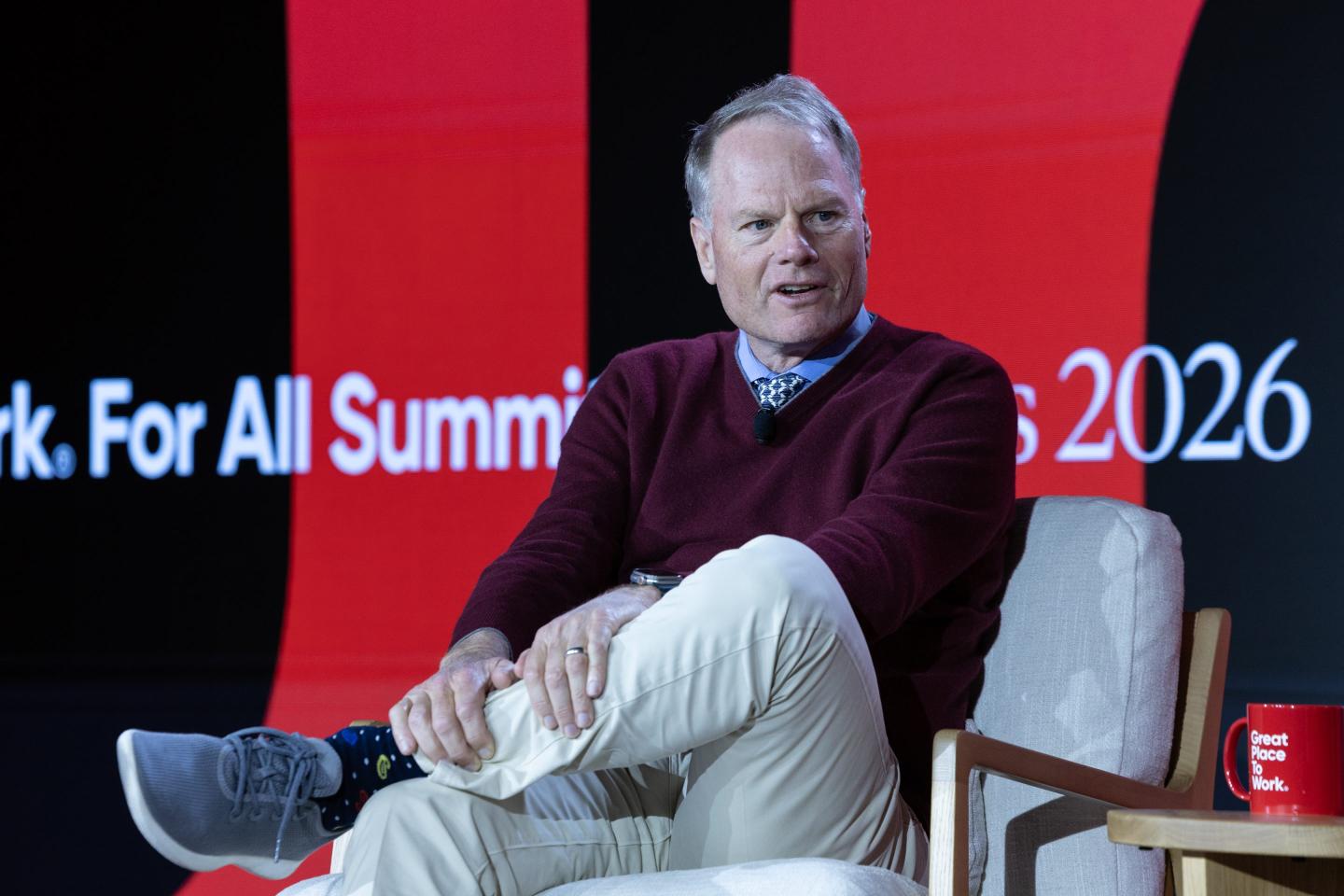
John Burke has run Trek Bicycle for nearly three decades, long enough to have lived through bike booms and busts, a pandemic that briefly made his company one of the hottest businesses in the world, and a post-COVID hangover that has left internal sales dashboards “all red” for more than a year and a half. He’s also read enough books — about 52 a year, every year, meticulously cataloged in a personal spreadsheet of 1,100 lifetime lessons — to have strong opinions about nearly everything.
One of the strongest: a company’s legacy is measured by its impact on the world, not its financial returns.
“Making a profit is the lifeblood of a business,” he told me in Las Vegas, backstage at the Great Place to Work For All Summit. “But the success of the business is not just measured in how much money you make — it’s in the impact that you make.”
Burke said he couldn’t speak for other companies, since he’s “been playing for the same team for 42 years,” but when he looks out at corporate America, he said, “there’s been a decay in the purpose of companies over the last 25 years.” And then he got historically minded. “If you go back, an economist once said that making a profit is the only responsibility of a company … and that’s not Trek.”
(The actual quote was published in a New York Times op-ed in 1970 as the great University of Chicago economist Milton Friedman wrote: “There is one and only one social responsibility of business—to use its resources and engage in activities designed to increase its profits so long as it stays within the rules of the game, which is to say, engages in open and free competition without deception or fraud.”)
Just consider, Burke said, what Trek has done for women’s cycling.
The women’s cycling moment
In 2018, he recalled, someone walked into his office and told him how women’s professional cycling teams were actually treated: flown in the night before races, competing on secondhand bikes, earning almost nothing. Burke vowed to add a full-scale women’s team from that day onward.
From that day onward, Burke said, Trek treated its women athletes the same as its men — same bikes, same resources, same investment. The team won nearly everything for three years running. And then, Burke said, something bigger happened: every other major team in professional cycling followed suit. “No Trek, no change in women’s cycling,” he said flatly. “Milton Friedman wouldn’t have approved that decision. If he was on the board, he would not have approved it.”
It’s the kind of story Burke returns to when people ask what Trek’s 50th anniversary is really about. The company is marking the occasion with a coffee-table book cataloging 50 ways it has changed the world and a 43-minute documentary premiering June 18 at the Orpheum Theatre in Madison, Wisconsin, with author Jim Collins in attendance. “What I’m most proud of at Trek is how we’ve changed the world, not what the financial results have been. When I’m gone, I don’t think anyone’s gonna make note of that.”
Riding through the bust
Trek’s current headwinds are real. After a COVID-era demand explosion that strained supply chains and pushed bikes off shelves faster than they could be built, the market reversed sharply — and Trek has been working through excess inventory and restructuring pressure ever since. The company, which generates roughly $2 billion in annual revenue and employs more than 5,000 people globally, has faced layoffs and product line reductions as it recalibrates.
But even in the downturn, Trek has been rapidly moving up the Fortune 100 Best Companies to Work For list — No. 42 in 2026, up from its first appearance at No. 94 in 2023. (It was actually No. 4 on the best places to work in retail.)
Burke said he sees the two things as connected rather than contradictory. The survey, he told Great Place to Work CEO Michael C. Bush, “is the centerpiece of how we run HR.” And the best time to take its temperature, he argued, is when things aren’t going well.
Gen Z doesn’t exist
Burke’s contrarianism extends well beyond corporate purpose. When asked what advice he would give to Gen Z workers, he nearly exploded. Burke is a no-nonsense Midwesterner, and he insisted that work has always been work, just like when he got his first job, diving ponds at a Wisconsin golf course to pick balls up off the soggy bottom.
“There’s no such thing as Gen Z,” he told me. “All this generational stuff is overblown. If you go back and study the last 100 years of what’s made successful people, it’s all the same.” He recalled being in Germany in the late 1980s as the Berlin Wall fell, listening to older Germans lament that the younger generation was lazy. “That’s what they’re saying today in America, is Gen Z doesn’t work. It’s like, that’s true. People want to be successful at work.”
“Every generation has probably had its quirks,” he allowed, but people have always had to work hard to get ahead, and that has never changed. “That doesn’t work today and it didn’t work 20 years ago. It didn’t work 50 years ago.”
A late convert to AI
On artificial intelligence, Burke said he arrived late — but he’s convinced it’s not hype. For most of the past few years, it felt abstract. His IT director kept telling him something big was coming, but the tangible applications weren’t obvious. Then, about six months ago, something clicked.
“Holy shit,” is how Burke describes the moment. “Look at what can actually be done.”
He said he thinks AI’s adoption curve will make the internet and the iPhone look gradual. “The internet affected business like this,” he said, gesturing slowly. “The iPhone, maybe a little steeper.” Then his hand shot up. “AI — I don’t know if society’s ready. But we’re going to find out, because it’s unleashed. And you’re going to know here pretty quick.”
Trek, by Burke’s own accounting, is not ready. He placed the company at 13 out of 100 for AI readiness relative to its peers, but his eyes bugged out when I told him that didn’t sound like a good rating. “Thirteen is good! It’s a great rating,” Burke said. “One of the things we do best as a company is take a concept and spread it throughout the company.” He said he’s tried to build a culture at Trek that “confronts the brutal facts,” moves fast, and always seeks to learn. When people tell him he’s wrong, he said, he gets curious. “I’m more interested in how we improve. I’m not interested in proving that we’re right.”
Burke said his office has two massive whiteboards and he spends his day framing puzzles for himself and his staff, “and getting the smartest people in the company to solve the puzzles. That’s how I spend my time.”
The phone is the problem
Burke’s embrace of AI exists in sharp tension with a deep, personal hostility toward smartphones. His conversion on that front came from an unlikely source: a chance meeting with Dr. Richard Davidson, the University of Wisconsin-Madison neuroscientist and founder of the Center for Healthy Minds, who has spent decades studying mental health and the meaning of happiness. Burke said he was ashamed because he tried to postpone the meeting, thinking he was too busy. His assistant overruled him. “She goes, ‘You know, that meeting with Dr. Richie is Wednesday, and you will be there.'”
As he got to know Davidson, he learned of a remarkable life story: graduating from high school at 16, then a PhD from Harvard by 24 years old, and a later meeting with the Dalai Lama, who told him, “Richie, your mission in life is to bring joy to the world.”
“Now I’m kind of slithering under the table as I blew this guy off,” Burke told me in his typically blunt fashion. But he had a question for Davidson: he asked where mental health in America stood today, on a scale of 100, relative to 1984. Davidson’s answer: 23, down from 100 in 1984. “It’s in the toilet. Unbelievable.” The culprit, Davidson said, was the phone.
Consider the Masters golf tournament, Burke said, one of the last major public events where phones are banned from the grounds. “What’s everybody doing? They have a smile on their face. Nobody’s trying to take a picture of somebody else. No selfies. They’re talking to each other.” He estimated the happiness level is three times what it is at a comparable phone-permitted event. “It’s the greatest experiment in the world.”
‘We’ve Pissed Off Just About Everybody’
Burke is not a politician and does not want to be one. He served on the President’s Council on Physical Fitness under George W. Bush and has written three books about American civic life, but describes himself as neither Republican nor Democrat. What he is, unmistakably, is frustrated.
The $39 trillion national debt strikes him as a moral failure as much as a fiscal one. “Somebody’s all proud they just came out with a $1.5 trillion defense budget,” he said. “You shouldn’t be proud. You should be embarrassed. We can’t afford a $1.5 trillion [budget]. Why not make it two-and-a-half [trillion dollars]? Well, you can’t make it two-and-a-half because you can’t afford it … the answer is no. We’re 5% of the world’s population, and we spend 38% of the world’s defense dollars. It makes no sense.”
On trade and geopolitics, Burke was equally unsparing. Trek manufactures globally and has navigated years of tariff disruptions, but it framed America’s current isolation as something deeper than a supply chain headache. “To accomplish things in life, you need to have friends. To accomplish things as a country, you need to have friends. And we’ve pissed off just about everybody.” He ticked through the list: Canada, Europe, Japan, South Korea, Australia. “I can’t tell you why we’re pissed off at Canada,” he said. “I genuinely cannot tell you.”
The root problem, in his view, is a leadership class that has confused self-preservation with public service. “We elect leaders whose primary motivation is not the success of the United States — it’s to perpetuate their own jobs. And it’s embarrassing. It is absolutely embarrassing.”
52 books, 1,100 lessons
Burke said he reads 52 books a year, almost exclusively nonfiction. His reading system, refined over the past four years, is rigorous. He reads the first sentence of every paragraph. If it grabs him, he reads the rest. If it doesn’t, he moves on. “I’ve never read a bad sentence to start a paragraph which turns into a good paragraph,” he said. “Doesn’t happen.” (While this might imply that he’s a skimmer or speed reader, this method suggests that he starts roughly 100 books a year, and only finished around 50.)
When he finishes a book, he goes back through his underlines and enters only the lessons he wants to carry for the rest of his life into a personal spreadsheet — now more than 1,100 entries deep. The system was inspired by Jim Collins, who visited Trek in 2018 and suggested writing down one lesson per book. Burke took it further. The impetus was a bike ride with his wife, during which she asked him to summarize the lessons from one of his favorite books, Simon Sinek’s The Infinite Game. His answer, he recalled, was “lame. Really bad retention.” He went home, reread the book, underlined it, and built the spreadsheet.
Current reading: The Algorithm, about a former Elon Musk lieutenant now on the board of General Motors, focused on simplification and speed — themes Burke is applying directly to Trek’s supply chain overhaul, which benchmarks Toyota and aims to triple the company’s operational efficiency score by 2028.
Still learning, still moving
For all his impatience with American institutions — corporate, political, technological — Burke’s worldview is ultimately an optimistic one, grounded less in ideology than in a belief that self-improvement is always available to anyone willing to do the work.
At Trek, he said, the lesson applies to the company as much as any individual in it: focus on what you can control, confront the brutal facts, and keep moving. “85% of the opportunities in the business,” he said, citing The Founder’s Mentality, “are within their four walls. And sometimes you get a lot of people who want to look out the window instead of looking in the mirror, 85% of the opportunities in the business are looking in the mirror.”
[This report has been updated to correct biographical details with respect to Dr. Richard Davidson.]