Over in Singapore’s Tuas industrial district, workers are assembling a giant floating production, storage, and offloading (FPSO) unit, part of the infrastructure that separates crude oil from what’s pulled up from offshore reservoirs. Next to it is a giant Goliath crane, which can lift up to 30,000 tons in a single heave; a gleaming white Royal Caribbean cruise ship sits just a few docks away.
This particular FPSO vessel, built by Singapore’s Seatrium, No. 42 on the Fortune Southeast Asia 500, will soon be bound for Brazil and its state-owned oil giant, Petrobras. It took around three to four years to get the ship completed, a lifetime compared to how quickly most goods get produced.
Seatrium’s most recent contract with Petrobras, a deal worth approximately 11 billion Singapore dollars ($8.2 billion) for two all-electric FPSOs, was signed back in May 2024, with first delivery expected in 2029. Much has changed since the contract was first signed. Trump’s “Liberation Day” tariffs rewired global supply chains, and the Iran war, with its closure of the Strait of Hormuz, upended the entire conversation around energy, particularly in Asia, which sources much of its oil and gas through that narrow chokepoint.
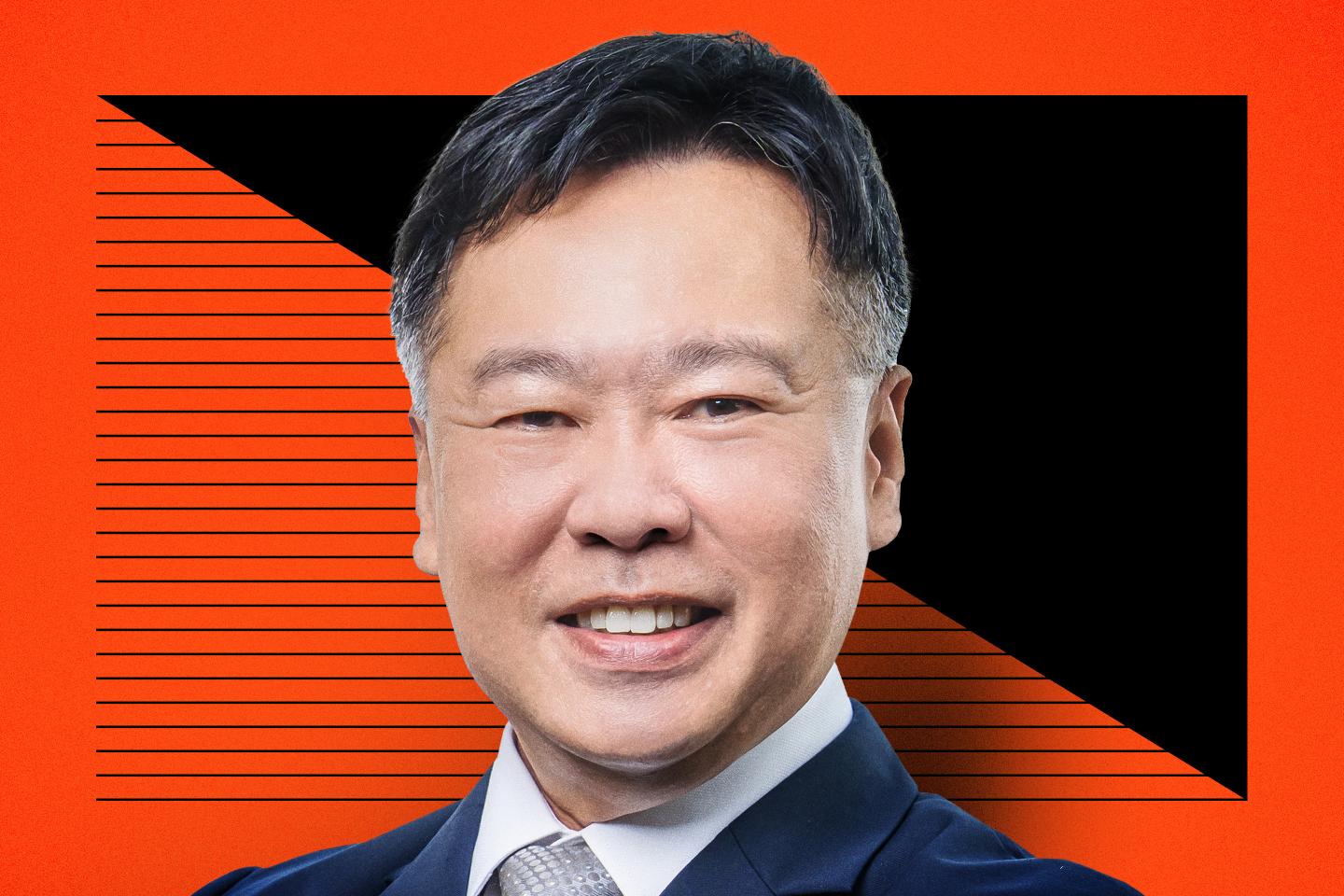
Chris Ong, Seatrium’s CEO, sees the Iran conflict sharpening what specialists call the energy trilemma, or the trade-off between energy security, affordable supply, and environmental sustainability. “The situation is now even worse because of the destruction of supply, which is still not fully priced in,” Ong says. “People don’t understand; they have been swung between different stories every day.”
Yet if oil prices stay elevated, Ong thinks that will unlock new offshore projects around the world. “I think a lot of projects would come online if the price per barrel were around $100.”
‘A builder and a businessman’
Seatrium itself is barely three years old, though its DNA stretches back to Singapore’s colonial-era naval docks, later converted by the newly independent government into commercial shipyards. The company itself was formed in 2023 when Sembcorp Marine absorbed its rival, Keppel Offshore and Marine. Sembcorp Marine was contending with COVID-era disruptions and a legal hangover from corruption investigations in Brazil; Keppel, meanwhile, had decided to reinvent itself as an asset manager and was eager to shed its manufacturing business.
As Ong explains it, Singapore couldn’t sustain two shipyards competing for the same scarce land, talent, and capital. “We were competing against each other when there’s bigger competition in China and Korea,” he says. The fight over talent had grown particularly fierce: “We were competing with data centers, other builders, even our own customers.”
A former junior engineer, Ong spent nearly three decades in the industry, rising through both predecessors before taking over the merged group. Ong knew both companies, and so knew how to stitch the two together. “You are no longer red or green,” he recalled telling staff, referring to Keppel’s and Sembcorp’s corporate colors. “You are now electric blue.”
Seatrium posted a 1.9 billion Singapore dollar ($1.5 billion) net loss in 2023, partly because of substantial write-downs on non-core assets and obsolete inventory.
Under Ong, the company has turned itself around. The company reported 11.5 billion Singapore dollars ($9.0 billion) in revenue for 2025, up 24% from the year before. Net profit more than doubled to 324 million Singapore dollars ($254 million). Oil and gas accounted for just over 70% of revenue, offshore wind just under 20%, and repairs and upgrades for clients ranging from the Singapore Navy to Royal Caribbean’s cruise fleet at roughly 7%.
Ong credits a supply chain overhaul he branded “One Seatrium” for the turnaround. Seatrium now operates like a global manufacturer: components are built wherever it makes most sense and then brought together for final integration, usually in Singapore. “That allows us to scale the order book.” Ong explains.
A decades-old relationship with Brazil
Seatrium’s relationship with Brazil reaches back to the 1980s, predating the country’s oil boom. “Fortunately, our predecessors were very farsighted,” Ong says. “They realized that if you weren’t in Brazil, you wouldn’t be part of its growth.”
Still, Seatrium has had a “love-hate relationship” with the country at times, Ong says. “There were a lot of startup and tuition costs when we went in.”
Both of Seatrium’s predecessor companies were ensnared in Operation Car Wash, Brazil’s sweeping anti-corruption investigation that eventually consumed much of the country’s political and business establishment. In July 2025, Seatrium agreed to pay approximately $190 million in fines to Brazilian and Singaporean authorities to settle the case, finally closing the matter.
“There are challenges in every geography you operate in,” Ong says, when asked on the subject. “I reckon that’s behind us.”
He adds the experience drove the company to build “one of the most structured compliance programs” in the industry. “The question was, after Operation Car Wash, do we continue our presence in Brazil? First our compliance culture had to be right, then we had to determine whether this was the right geography to focus on our value-add to the energy landscape. And the answer was yes.”
In September 2025, the company handed over the P-78 FPSO, with a production capacity of 180,000 barrels of oil per day, to Petrobras, the first in a growing line of Brazilian vessels. The two new FPSOs under construction, P-84 and P-85, will be all-electric platforms designed to cut greenhouse gas emissions by 30% per barrel.
Seatrium is also embedded in Guyana, which has gone from producing no oil in 2019 to nearly 900,000 barrels per day in 2025, and potentially 1.7 million barrels per day by 2030, according to ExxonMobil. The country’s oil windfall has tripled GDP per capita since 2020, transforming a nation of roughly 800,000 people.
“It all started when we realized that Guyana is also a former British colony,” Ong says. “Guyana and Singapore felt almost like siblings.”
Seatrium’s other bet: Offshore wind
While fossil fuels drive the bulk of Seatrium’s revenue, the company is also positioning itself as a builder of offshore wind infrastructure, including installation vessels, floating turbine carriers, and the high-voltage direct-current (HVDC) substations that transmit power back to shore.
Ong sees wind as a natural extension of the company’s engineering DNA. “You have your installation jack-ups, your foundations get bigger, and the whole infrastructure gets more complex. That complexity in engineering, proprietary technology, and execution excellence all fall in line with what we do in offshore oil and gas,” he says.
Seatrium has been involved in offshore wind since 2012, when it built its first wind turbine installation vessel. Today, it says it has contributed to projects representing nearly 16 gigawatts of offshore wind capacity worldwide.
Europe remains its strongest market. In December 2025, Seatrium and GE Vernova won a contract from Dutch transmission operator TenneT to deliver BalWin5, a 2.2-gigawatt HVDC connection linking North Sea wind farms to Germany’s onshore power grid. The project, enough to power roughly 2.75 million households, is expected to be commissioned in 2032. “Europe needs to become independent from Russian gas,” Ong says, “and Germany has said it will not go back to nuclear.”
The U.S., by contrast, has proven a more treacherous market. Trump scrapped subsidies for wind power, suspended issuing permits for new projects, and even agreed to pay nearly $1 billion for TotalEnergies to surrender its East Coast leasers.
“We originally thought the U.S. would be the next major destination that will grow,” Ong says. “But it’s still very nascent, very state-driven rather than federal-driven.”
Seatrium has had its own U.S. drama. Last year, its partner Maersk canceled an order for a wind turbine installation vessel bound for the Empire Wind 1 project, citing construction delays.The vessel, at the time, was 98.9% complete. The case went to arbitration, and eventually Seatrium delivered the vessel in February.
Long-term bets
Shipbuilding has become one of the most securitized industries in the world over the past two years, particularly as the U.S. chafes under China’s dominance of commercial shipbuilding.
Seatrium doesn’t make container ships, and so avoids the most prominent debates over shipbuilding. But Ong knows the company can’t avoid security questions—in part because the company’s clients include the Singaporean, U.S. and U.K. navies.
“If a project is sensitive to being built in China, we simply don’t build it there,” he says. “We have the flexibility to choose. Our Seatrium ‘arsenal of capacity’ gives us a very unique proposition.”
Seatrium remains closely tied to Singapore, which has long tried to take a more neutral role in world affairs, maintaining close security ties with the U.S. and close economic ties with China. Temasek, Singapore’s state investment company, holds a 36% stake.
That positioning extends to Seatrium’s longest-range bets: floating nuclear power plants and floating data centers. Onshore projects can get snarled in land permitting issues, political blowback, and policy volatility; offshore projects, in contrast, can just get moved somewhere else.
“Building offshore energy infrastructure can actually be faster than building on land,” Ong says.
In Fortune’s “Asia Agenda” column, released twice a month, we speak with Asia’s top business leaders about how they are building for the future and the lessons they’ve drawn from leading companies in one of the world’s fastest growing and most dynamic regions. Explore all of our profiles here.