
• Home
  • Latest
  • Fortune 500
  • Finance
  • Tech
  • Leadership
  • Lifestyle
  • Rankings
  • Multimedia

New

Watch Fortune Daily, our new video show that brings you inside the Fortune newsroom and the boardroom

Watch Fortune Daily, our new video show that brings you inside the Fortune newsroom and the boardroom

Watch Fortune Daily, our new video show that brings you inside the Fortune newsroom and the boardroom

Watch Fortune Daily, our new video show that brings you inside the Fortune newsroom and the boardroom

Watch Fortune Daily, our new video show that brings you inside the Fortune newsroom and the boardroom

Watch Fortune Daily, our new video show that brings you inside the Fortune newsroom and the boardroom

Watch Fortune Daily, our new video show that brings you inside the Fortune newsroom and the boardroom

Watch Fortune Daily, our new video show that brings you inside the Fortune newsroom and the boardroom

Watch Fortune Daily, our new video show that brings you inside the Fortune newsroom and the boardroom

Watch Fortune Daily, our new video show that brings you inside the Fortune newsroom and the boardroom

EconomyDebt

When interest on national debt overtook military spending, it triggered a limit where the U.S. may ‘cease to be a great power,’ warns Hoover historian

Eleanor Pringle
By
Eleanor Pringle
Eleanor Pringle
Senior Reporter, Economics and Markets
Down Arrow Button Icon
Eleanor Pringle
By
Eleanor Pringle
Eleanor Pringle
Senior Reporter, Economics and Markets
Down Arrow Button Icon
April 23, 2026, 7:09 AM ET
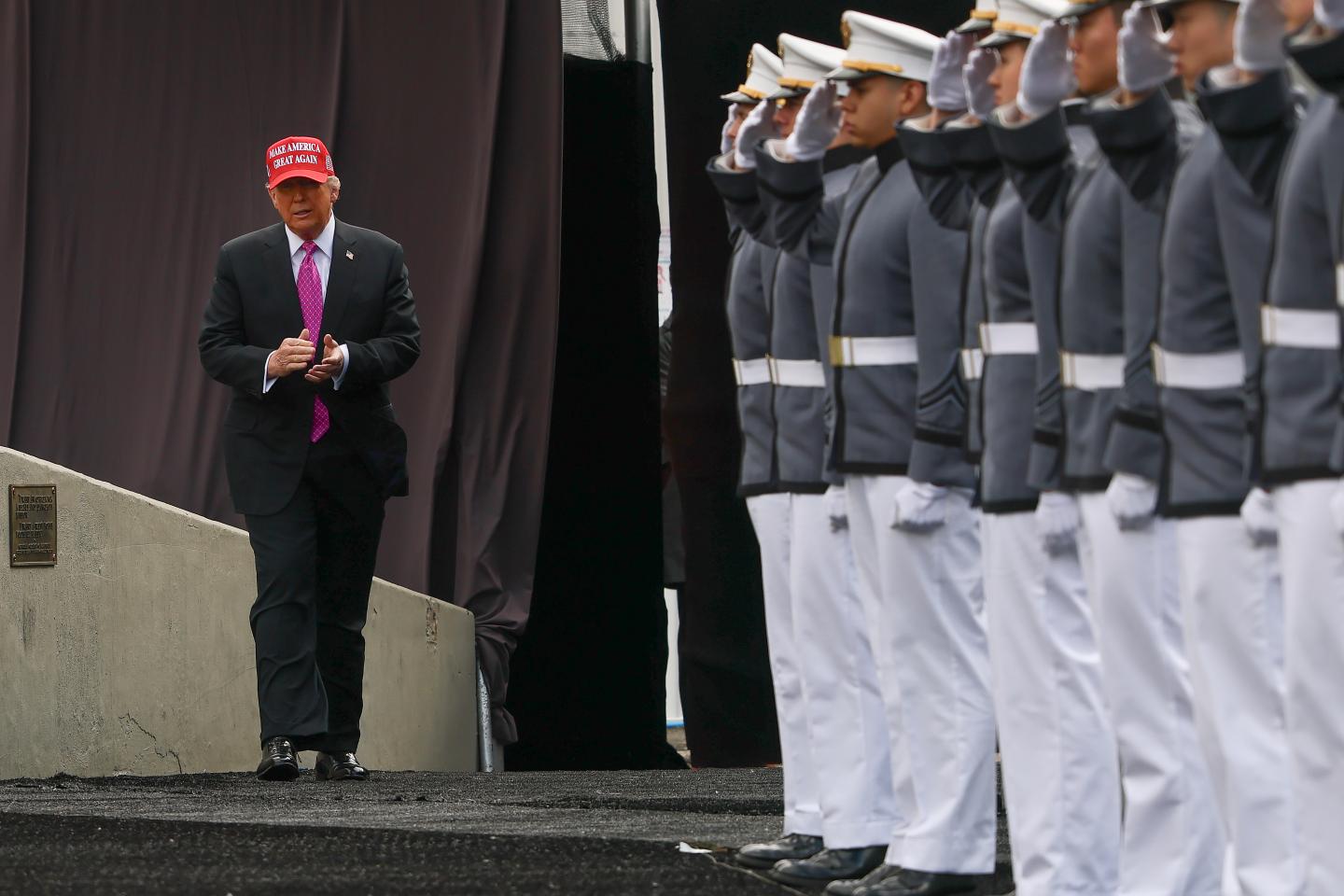
President Trump Speaks At West Point Commencement Ceremony
America risks losing its geopolitical dominance if policymakers don’t address the balance of payments between debt service and military spending.Michael M. Santiago—Getty Images
Add Fortune on Google for similar content.

Interest payments on the U.S. national debt are set to surpass $1 trillion in 2026, some $88 billion a month—equal to spending on defense and education combined.

The economy has tripped past this point before: That is, there have been brief periods in history when service payments on the debt have outweighed military spending, for example, in the postwar 1920s.

These stints have either been relatively short-lived or have not occurred in an established, advanced economy. But in 2024, under the Biden administration, the U.S. Treasury passed that threshold again, the first sustained period in recent memory where debt interest payments have outweighed military spending. Both the Republicans and Democrats have added trillions to the debt burden, though with President Trump now back in the Oval Office, pressure falls on him to address the issue.

Recommended Video

An excess of debt over defense is a violation of Ferguson’s Law, as described by Hoover Institution economic historian Sir Niall Ferguson in a working paper published earlier this year. Ferguson’s Law states that “any great power that spends more on debt servicing than on defense risks ceasing to be a great power.”

“This is because the debt burden draws scarce resources towards itself, reducing the amount available for national security, and leaving the power increasingly vulnerable to military challenge,” Ferguson explains.

Ferguson’s Law is named after the famed 18th-century philosopher rather than the paper’s author, who even centuries ago warned of the link between a nation’s debt and its decline.

In the working paper, the Milbank Family Senior Fellow at Stanford University explores historical cases where the Ferguson limit has been triggered. The Spanish empire in the 16th century provides one example, with the academic writing that the country’s leaders exhibited “overreliance on a complex and costly system of debt financing [that] ultimately undermined the position of their successors.”

Bourbon France in the late 18th century provides another example, as Ferguson writes it is perhaps the most familiar case of “a great power succumbing to fiscal constraints”—with the nation declining from a global power to overthrowing its monarchy in a revolution.

These examples, whether front of mind for today’s economists and CEOs or not, echo a growing chorus of concern in the U.S. at the time of writing. Bridgewater Associates founder Ray Dalio has warned of an “economic heart attack” in the making, in which debt-service payments crowd out public investment.

The good news

The chorus of concern is growing: The likes of JPMorgan Chase CEO Jamie Dimon have warned of a market “reckoning” and urged policymakers to act before a crisis takes hold. Even Federal Reserve Chair Jerome Powell—who has overseen the central bank dutifully buying vast swaths of Treasury debt—has warned it’s time for an “adult conversation” about deficit levels.

But Ferguson does have some reprieve for those concerned: Even the somber warning of violating the Ferguson Law doesn’t guarantee decline. Indeed, the author points to Great Britain as an example of a nation triggering the limit at various points in time without weakening its geopolitical standing. One reason for this, Ferguson says, is that Britain had access to lower borrowing costs.

This is a factor being eyed closely in the contemporary United States; the Committee for a Responsible Federal Budget highlighted only yesterday that if interest rates were to be one percentage point above projections—bringing the 10-year Treasury note from an average 4.3% over the decade to 5.3%—it would add an additional $3.5 trillion to the debt above current projections.

Examples of Ferguson’s Law being violated, but without proving fatal, shows the U.S. economy still has options. He writes: “History suggests that any sustained period when a great power spends more on interest payments than on military capabilities is likely to see its strategic rivals challenge its position.

“In the absence of radical reforms of its principal entitlement programs—which successive administrations have ruled out—the only plausible way that the United States can come back within the Ferguson limit is therefore through a productivity miracle.”

Conveniently, the U.S. economy reportedly has one on its doorstep in the form of AI—a potential which both Wall Street and Fed chair nominee Kevin Warsh are betting heavily on.

As such, “the real contest of the second quarter of the 21st century may be between artificial intelligence—and history,” concludes Ferguson.

Fortune Daily breaks the traditional barrier between audience and newsroom. The show transforms Fortune’s trusted reporting into actionable, conversational, and entertaining insights for an emerging class of business leaders. Watch here.
About the Author
Eleanor Pringle
By Eleanor PringleSenior Reporter, Economics and Markets
LinkedIn icon

Eleanor Pringle is an award-winning senior reporter at Fortune covering news, the economy, and personal finance. Eleanor previously worked as a business correspondent and news editor in regional news in the U.K. She completed her journalism training with the Press Association after earning a degree from the University of East Anglia.

See full bioRight Arrow Button Icon
Add Fortune on Google for similar content.

Latest in Economy

Finance
Lorem ipsum dolor sit amet, consectetur adipiscing elit, sed do eiusmod tempor incididunt ut labore et dolore magna aliqua. Ut enim ad minim veniam
By Fortune Editors
October 20, 2025
Finance
Lorem ipsum dolor sit amet, consectetur adipiscing elit, sed do eiusmod tempor incididunt ut labore et dolore magna aliqua. Ut enim ad minim veniam
By Fortune Editors
October 20, 2025
Finance
Lorem ipsum dolor sit amet, consectetur adipiscing elit, sed do eiusmod tempor incididunt ut labore et dolore magna aliqua. Ut enim ad minim veniam
By Fortune Editors
October 20, 2025
Finance
Lorem ipsum dolor sit amet, consectetur adipiscing elit, sed do eiusmod tempor incididunt ut labore et dolore magna aliqua. Ut enim ad minim veniam
By Fortune Editors
October 20, 2025
Finance
Lorem ipsum dolor sit amet, consectetur adipiscing elit, sed do eiusmod tempor incididunt ut labore et dolore magna aliqua. Ut enim ad minim veniam
By Fortune Editors
October 20, 2025
Finance
Lorem ipsum dolor sit amet, consectetur adipiscing elit, sed do eiusmod tempor incididunt ut labore et dolore magna aliqua. Ut enim ad minim veniam
By Fortune Editors
October 20, 2025

Most Popular

Finance
Lorem ipsum dolor sit amet, consectetur adipiscing elit, sed do eiusmod tempor incididunt ut labore et dolore magna aliqua. Ut enim ad minim veniam
By Fortune Editors
October 20, 2025
Finance
Lorem ipsum dolor sit amet, consectetur adipiscing elit, sed do eiusmod tempor incididunt ut labore et dolore magna aliqua. Ut enim ad minim veniam
By Fortune Editors
October 20, 2025
Finance
Lorem ipsum dolor sit amet, consectetur adipiscing elit, sed do eiusmod tempor incididunt ut labore et dolore magna aliqua. Ut enim ad minim veniam
By Fortune Editors
October 20, 2025
Finance
Lorem ipsum dolor sit amet, consectetur adipiscing elit, sed do eiusmod tempor incididunt ut labore et dolore magna aliqua. Ut enim ad minim veniam
By Fortune Editors
October 20, 2025
Finance
Lorem ipsum dolor sit amet, consectetur adipiscing elit, sed do eiusmod tempor incididunt ut labore et dolore magna aliqua. Ut enim ad minim veniam
By Fortune Editors
October 20, 2025
Finance
Lorem ipsum dolor sit amet, consectetur adipiscing elit, sed do eiusmod tempor incididunt ut labore et dolore magna aliqua. Ut enim ad minim veniam
By Fortune Editors
October 20, 2025
Fortune Secondary Logo
Rankings
  • 100 Best Companies
  • Fortune 500
  • Global 500
  • Fortune 500 Europe
  • Most Powerful Women
  • World's Most Admired Companies
  • See All Rankings
  • Lists Calendar
Sections
  • Finance
  • Fortune Crypto
  • Features
  • Leadership
  • Health
  • Commentary
  • Success
  • Retail
  • Mpw
  • Tech
  • Lifestyle
  • CEO Initiative
  • Asia
  • Politics
  • Conferences
  • Europe
  • Newsletters
  • Personal Finance
  • Environment
  • Magazine
  • Education
Customer Support
  • Frequently Asked Questions
  • Customer Service Portal
  • Privacy Policy
  • Terms Of Use
  • Single Issues For Purchase
  • International Print
Commercial Services
  • Advertising
  • Fortune Brand Studio
  • Fortune Analytics
  • Fortune Conferences
  • Business Development
  • Group Subscriptions
About Us
  • About Us
  • Press Center
  • Work At Fortune
  • Terms And Conditions
  • Site Map
  • About Us
  • Press Center
  • Work At Fortune
  • Terms And Conditions
  • Site Map
  • Facebook icon
  • Twitter icon
  • LinkedIn icon
  • Instagram icon
  • TikTok icon
  • YouTube icon

Latest in Economy

Photo of Bessent at a table with Trump’s cabinet
EconomyJapan
Scott Bessent is using moves from his hedge fund days to prop up Japan’s yen—and America’s $40 trillion national debt
By Mia OsmonbekovAugust 4, 2026
3 hours ago
bessent
CommentaryU.S. Department of the Treasury
Bessent’s Yen gamble is a warning sign — buckle up
By Steve H. Hanke and Roger KopplAugust 4, 2026
5 hours ago
Federal Reserve Chair Kevin Warsh speaks during a news conference at Federal Reserve Headquarters on July 29, 2026 in Washington, DC.
EconomyFed
Kevin Warsh told Wall Street he’d be sharing less—Goldman Sachs fears a void of Fed facts will only amplify misinformation and instability
By Eleanor PringleAugust 4, 2026
6 hours ago
jobs
EconomyJobs
Why a measly 100,000 job openings is normal for the Trump economy
By Paul Wiseman and The Associated PressAugust 4, 2026
7 hours ago
JPMorgan Chase, Accenture and others are teaming up on a new venture to standardize how AI token use is measured
AICFO Daily
JPMorgan Chase, Accenture and others are teaming up on a new venture to standardize how AI token use is measured
By Sheryl EstradaAugust 4, 2026
9 hours ago
t
EconomyWhite House
Trump called his own housing bill a ‘yawn.’ Now he’s heading for a west coast tour with a 32% approval rating on the economy
By Darlene Superville and The Associated PressAugust 4, 2026
10 hours ago

Most Popular

How Zohran Mamdani's pied-à-terre tax exposed an epidemic of 'ghost cars' instead
Personal Finance
How Zohran Mamdani's pied-à-terre tax exposed an epidemic of 'ghost cars' instead
By Catherina GioinoAugust 4, 2026
15 hours ago
Bars, bowling alleys, and movie theaters cost too much to run and visit. Americans have run out of places to hang out and we're paying with our health
North America
Bars, bowling alleys, and movie theaters cost too much to run and visit. Americans have run out of places to hang out and we're paying with our health
By Catherina GioinoAugust 2, 2026
3 days ago
Wall Street bulls are starting to admit the earnings bubble is real—and the 60/40 portfolio may be the first casualty
Investing
Wall Street bulls are starting to admit the earnings bubble is real—and the 60/40 portfolio may be the first casualty
By Nick LichtenbergAugust 3, 2026
1 day ago
Ray Dalio on the AI bubble nearing 1929, 2000 levels and the lesson people always forget: 'Wealth is not the same as money'
Investing
Ray Dalio on the AI bubble nearing 1929, 2000 levels and the lesson people always forget: 'Wealth is not the same as money'
By Nick LichtenbergAugust 4, 2026
15 hours ago
The Iran war already has a winner: The world’s largest shipbroker notching record earnings from the 'exceptional volatility' in the Strait of Hormuz
Energy
The Iran war already has a winner: The world’s largest shipbroker notching record earnings from the 'exceptional volatility' in the Strait of Hormuz
By Sasha RogelbergAugust 3, 2026
1 day ago
Electric air taxis are finally ready for takeoff
Magazine
Electric air taxis are finally ready for takeoff
By Alexei OreskovicAugust 3, 2026
2 days ago

© 2026 Fortune Media IP Limited. All Rights Reserved. Use of this site constitutes acceptance of our Terms of Use and Privacy Policy | CA Notice at Collection and Privacy Notice | Do Not Sell/Share My Personal Information
FORTUNE is a trademark of Fortune Media IP Limited, registered in the U.S. and other countries. FORTUNE may receive compensation for some links to products and services on this website. Offers may be subject to change without notice.