
• Home
  • Latest
  • Fortune 500
  • Finance
  • Tech
  • Leadership
  • Lifestyle
  • Rankings
  • Multimedia

Trendingnow

1

AI CEOs from OpenAI, Anthropic, and Microsoft set aside their rivalry to warn Congress AI is making it too easy to design and create bioweapons

2

MacKenzie Scott's approach to her $26 billion giving spree was inspired by a book she read in college about writing

3

Social Security faces a 24% cut in 2032—that's a $345 billion hit to retirees nationwide, watchdog says

1

AI CEOs from OpenAI, Anthropic, and Microsoft set aside their rivalry to warn Congress AI is making it too easy to design and create bioweapons

2

MacKenzie Scott's approach to her $26 billion giving spree was inspired by a book she read in college about writing

3

Social Security faces a 24% cut in 2032—that's a $345 billion hit to retirees nationwide, watchdog says
Economynational debt

The director of the Congressional Budget Office—known for its gloomy national debt data—is very optimistic that a crisis will be avoided entirely

Eleanor Pringle
By
Eleanor Pringle
Eleanor Pringle
Senior Reporter, Economics and Markets
Down Arrow Button Icon
Eleanor Pringle
By
Eleanor Pringle
Eleanor Pringle
Senior Reporter, Economics and Markets
Down Arrow Button Icon
April 20, 2026, 3:01 AM ET
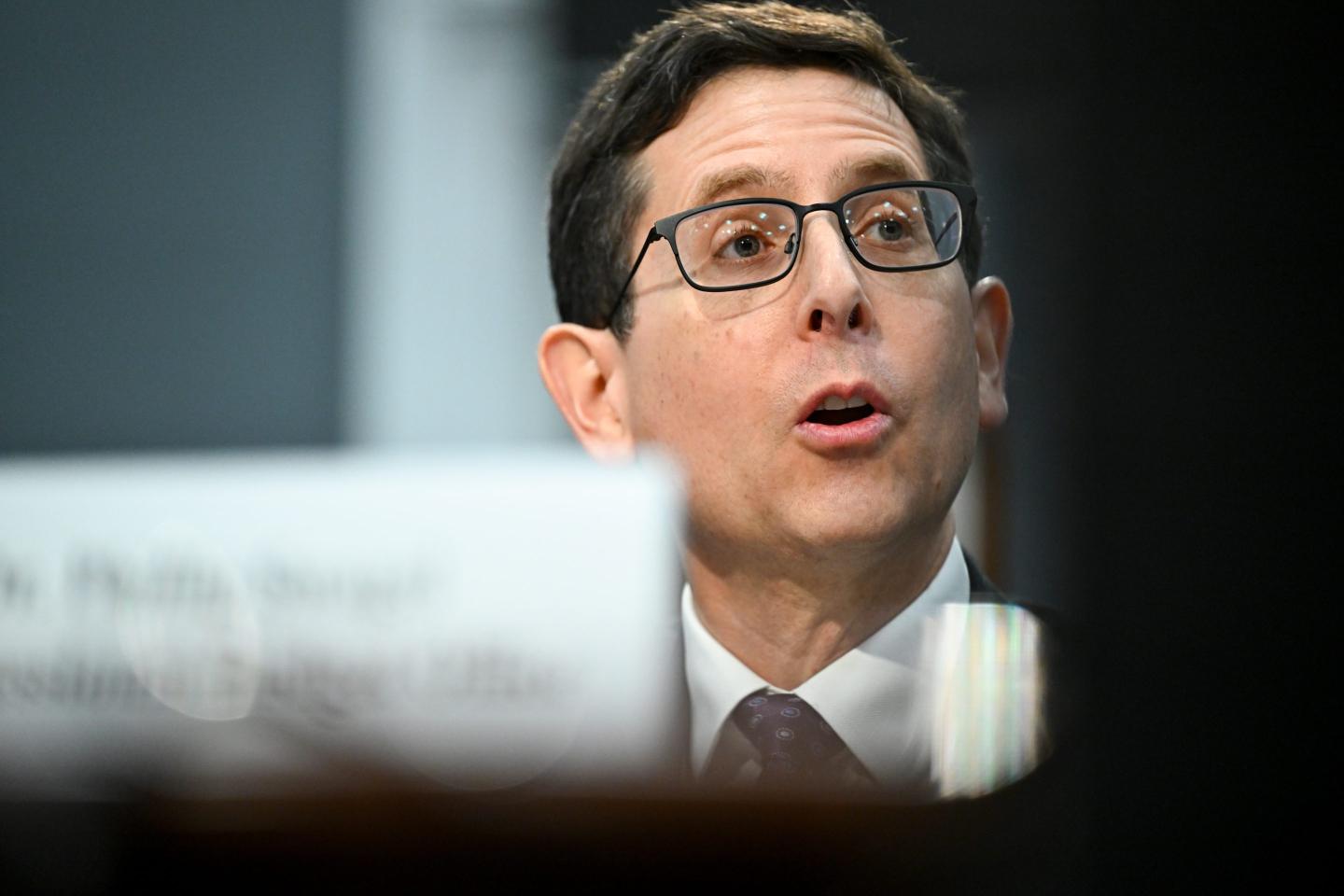
Photo of Phillip Swagel
Phillip Swagel, director of the Congressional Budget Office, during a budget hearing in Washington, D.C., on March 18, 2026. Graeme Sloan/Bloomberg - Getty Images

Phillip Swagel is an optimist, both by nature and when he looks at the U.S. economy.

This fact is perhaps at odds with what one might assume: Swagel is the director of the Congressional Budget Office (CBO), the nonpartisan agency that offers independent budgetary and economic analysis to Congress.

Very often—an inevitable occupational hazard—the subject of national debt, and the interest the U.S. Treasury pays to maintain it, is its central focus. The numbers are eye-watering: Public debt stands at more than $39 trillion. The interest expense on that borrowing now exceeds $1 trillion a year. Indeed, the latest budget update from the CBO highlights that the government—according to preliminary estimates—paid out nearly $530 billion between October 2025, when the fiscal year starts, and March 2026. This equates to more than $88 billion in interest payments a month, or more than $22 billion a week.

The CBO’s figures are routinely cited by policymakers, think tanks, and lobbyists as alarming evidence that the U.S. needs to find a more sustainable fiscal path or risk dire straits.

Recommended Video

Swagel doesn’t subscribe to the notion that the U.S. will face a crisis of its own making. His justification is simple: He was at the Treasury during the 2008 financial crisis, and joined the CBO months before the COVID pandemic began. He has watched as the U.S. economy, seemingly against all odds, has clawed its way out of economic crises before.

That’s not to say Swagel isn’t a staunch advocate of setting the U.S. on a more sustainable fiscal path. Rather, he trusts the people in power to do so when the time comes.

Why the optimism?

Among those concerned about national debt are notable names: JPMorgan Chase CEO Jamie Dimon, Federal Reserve Chairman Jerome Powell, and Bridgewater Associates founder Ray Dalio. Tesla CEO Elon Musk is also worried about federal spending and has endorsed a plan floated by Berkshire Hathaway founder Warren Buffett that would render members of Congress ineligible for reelection if they allow deficits to exceed 3% of GDP.

On the other hand, optimistic economists suggest that, despite the value of the debt, it’s not actually an issue: The bond market is holding steady, indicating a reliable market of buyers. Likewise, the U.S.’s own central bank buys huge swaths of the debt, meaning, in the simplest of layman’s terms, the economy can essentially print its own money. There are holes in this argument, not least the fact that Fed chairman nominee Kevin Warsh has suggested he would like to reduce the Fed’s balance sheet and may therefore be less inclined to finance borrowing.

Swagel’s positive outlook doesn’t rely on the argument that a crisis hasn’t happened yet, so therefore it never will: “[My optimism] is rooted in my experience,” Swagel tells Fortune in an exclusive interview in Washington, D.C. “First being at Treasury during the financial crisis and seeing very difficult times and the country coming together with an effective response—not saying it’s perfect, lots of controversy—but it was effective.”

He continued, “The second thing is policymakers are smart, they’re thoughtful. Interacting with members of Congress makes me optimistic. I know you read about all the squabbles…I’m completely aware of this, but the policymakers that are thinking about these things are thoughtful and effective. Not necessarily always effective at passing legislation, but that’s part of our political system. It was set up to make it difficult to pass legislation.”

Decisions on the horizon

Swagel’s optimism that Congress will be pushed into action will be tested sooner rather than later, likely at some point in the next six years, he told Fortune. This is partly due to the fact that, according to the Committee for a Responsible Federal Budget (CRFB), both Social Security and Medicare will become insolvent within that time period.

“Making progress to address the fiscal trajectory would be a positive for the U.S. economy,” Swagel said. “Credible steps would lead to lower interest rates that would make the subsequent adjustment easier; there is a reward to virtue. It’s a positive thing. We can’t go on [with] the scolding narrative. My sense is that members of Congress understand the fiscal situation. It’s not that every single one has looked at our one-pager of numbers and understands the debt to the third decimal point, but they understand something needs to be done.

“It doesn’t have to be done immediately, but at some point reasonably soon.”

Swagel is of the opinion that bond investors haven’t increased risk premiums not because they’re not worried about a fiscal crisis, but because they have priced in preventative action from Congress—in his mind “a vote of confidence that my optimism is not misplaced.”

“As a country, we face up to these problems. It’s not happening now, I’m not sure it’s going to happen in the rest of this year or even the next year, or the next two years. But we will face up to it, and the market in some sense expects us to, because otherwise interest rates would be higher,” he explained.

The Cheesecake Factory

The role of the CBO, to some extent, is to provide policymakers with their options if and when they do choose to take action on federal deficits. It’s a menu not unlike the Cheesecake Factory’s, Swagel says: large, inclusive of a range of modifications and options, and delivered without judgment.

“Right now it’s maybe a pick three, and you’re looking at a six- or seven-course menu,” joked Caleb Quakenbush, director of fiscal policy at the Bipartisan Policy Center, in an interview with Fortune. “The longer you delay, the more you’re gonna have to add to your tab, and those options become more expensive.”

Indeed, economists and analysts aren’t necessarily worried about the absolute level of government debt, rather the debt-to-GDP ratio. Depending on whom you ask, the debt-to-GDP ratio stands at around 122% of GDP at present. This measure demonstrates an economy’s spending versus its growth, and the risk associated with lending to a nation that isn’t growing fast enough to handle its spending. To rebalance that ratio, an economy could either cut spending or increase growth—the latter being by far the less painful option.

The growth option is becoming less feasible, Michael Peterson, CEO of fiscal think tank the Peter G. Peterson Foundation, told Fortune in an exclusive interview: “I think it requires government action because we’ve waited so long. We’ve added so many trillions, and the current deficit is so big at 6% that the level of growth you would need really exceeds what is feasible. 

“Growth needs to be a part of it, but it’s sort of a vicious cycle. The longer we delay, the more debt we have, the slower growth is going to be. The more we get this under control, I think the greater optimism there is, interest rates go down, more growth comes from that. It’s sort of a virtuous or vicious cycle depending on your policy response.”

Subscribe to Fortune Gulf Brief. Every Tuesday, this new newsletter delivers clear-eyed, authoritative intelligence on the deals, decisions, policies, and power shifts shaping one of the world’s most consequential regions, written for the people who need to act on it. Sign up here.
About the Author
Eleanor Pringle
By Eleanor PringleSenior Reporter, Economics and Markets
LinkedIn icon

Eleanor Pringle is an award-winning senior reporter at Fortune covering news, the economy, and personal finance. Eleanor previously worked as a business correspondent and news editor in regional news in the U.K. She completed her journalism training with the Press Association after earning a degree from the University of East Anglia.

See full bioRight Arrow Button Icon

Latest in Economy

Finance
Lorem ipsum dolor sit amet, consectetur adipiscing elit, sed do eiusmod tempor incididunt ut labore et dolore magna aliqua. Ut enim ad minim veniam
By Fortune Editors
October 20, 2025
Finance
Lorem ipsum dolor sit amet, consectetur adipiscing elit, sed do eiusmod tempor incididunt ut labore et dolore magna aliqua. Ut enim ad minim veniam
By Fortune Editors
October 20, 2025
Finance
Lorem ipsum dolor sit amet, consectetur adipiscing elit, sed do eiusmod tempor incididunt ut labore et dolore magna aliqua. Ut enim ad minim veniam
By Fortune Editors
October 20, 2025
Finance
Lorem ipsum dolor sit amet, consectetur adipiscing elit, sed do eiusmod tempor incididunt ut labore et dolore magna aliqua. Ut enim ad minim veniam
By Fortune Editors
October 20, 2025
Finance
Lorem ipsum dolor sit amet, consectetur adipiscing elit, sed do eiusmod tempor incididunt ut labore et dolore magna aliqua. Ut enim ad minim veniam
By Fortune Editors
October 20, 2025
Finance
Lorem ipsum dolor sit amet, consectetur adipiscing elit, sed do eiusmod tempor incididunt ut labore et dolore magna aliqua. Ut enim ad minim veniam
By Fortune Editors
October 20, 2025

Most Popular

Finance
Lorem ipsum dolor sit amet, consectetur adipiscing elit, sed do eiusmod tempor incididunt ut labore et dolore magna aliqua. Ut enim ad minim veniam
By Fortune Editors
October 20, 2025
Finance
Lorem ipsum dolor sit amet, consectetur adipiscing elit, sed do eiusmod tempor incididunt ut labore et dolore magna aliqua. Ut enim ad minim veniam
By Fortune Editors
October 20, 2025
Finance
Lorem ipsum dolor sit amet, consectetur adipiscing elit, sed do eiusmod tempor incididunt ut labore et dolore magna aliqua. Ut enim ad minim veniam
By Fortune Editors
October 20, 2025
Finance
Lorem ipsum dolor sit amet, consectetur adipiscing elit, sed do eiusmod tempor incididunt ut labore et dolore magna aliqua. Ut enim ad minim veniam
By Fortune Editors
October 20, 2025
Finance
Lorem ipsum dolor sit amet, consectetur adipiscing elit, sed do eiusmod tempor incididunt ut labore et dolore magna aliqua. Ut enim ad minim veniam
By Fortune Editors
October 20, 2025
Finance
Lorem ipsum dolor sit amet, consectetur adipiscing elit, sed do eiusmod tempor incididunt ut labore et dolore magna aliqua. Ut enim ad minim veniam
By Fortune Editors
October 20, 2025
Fortune Secondary Logo
Rankings
  • 100 Best Companies
  • Fortune 500
  • Global 500
  • Fortune 500 Europe
  • Most Powerful Women
  • World's Most Admired Companies
  • See All Rankings
  • Lists Calendar
Sections
  • Finance
  • Fortune Crypto
  • Features
  • Leadership
  • Health
  • Commentary
  • Success
  • Retail
  • Mpw
  • Tech
  • Lifestyle
  • CEO Initiative
  • Asia
  • Politics
  • Conferences
  • Europe
  • Newsletters
  • Personal Finance
  • Environment
  • Magazine
  • Education
Customer Support
  • Frequently Asked Questions
  • Customer Service Portal
  • Privacy Policy
  • Terms Of Use
  • Single Issues For Purchase
  • International Print
Commercial Services
  • Advertising
  • Fortune Brand Studio
  • Fortune Analytics
  • Fortune Conferences
  • Business Development
  • Group Subscriptions
About Us
  • About Us
  • Press Center
  • Work At Fortune
  • Terms And Conditions
  • Site Map
  • About Us
  • Press Center
  • Work At Fortune
  • Terms And Conditions
  • Site Map
  • Facebook icon
  • Twitter icon
  • LinkedIn icon
  • Instagram icon
  • Pinterest icon

Latest in Economy

Why oil’s not at $200 after the biggest supply shock in history
EnergyOil
Why oil’s not at $200 after the biggest supply shock in history
By Devika Krishna Kumar, Alex Longley, Yongchang Chin, Mia Gindis and BloombergJune 6, 2026
6 minutes ago
‘That’s the way life goes’: Trump tells Knicks fans who can’t afford tickets to ‘watch it on television’
Arts & EntertainmentDonald Trump
‘That’s the way life goes’: Trump tells Knicks fans who can’t afford tickets to ‘watch it on television’
By Michelle L. Price, Will Weissert and The Associated PressJune 6, 2026
34 minutes ago
Man holding his fists together.
InnovationElon Musk
Elon Musk bullet-proofed his $1 trillion ‘Mars-shot’ pay at SpaceX after the epic battle over his $56 billion moonshot at Tesla
By Amanda GerutJune 6, 2026
5 hours ago
broker
InvestingMarkets
Markets have worst day since October as tech stocks lead the way down, traders lose hope of rate cut
By Damian J. Troise, Alex Veiga and The Associated PressJune 5, 2026
16 hours ago
Tech stocks lead market bloodbath as fears of Fed rate hikes add to worries about the AI-fueled chip boom petering out
Investingtech stocks
Tech stocks lead market bloodbath as fears of Fed rate hikes add to worries about the AI-fueled chip boom petering out
By Jason MaJune 5, 2026
17 hours ago
Shoppers search for meat and pork product inside Walmart store
Economyfarming
The U.S. is still one of the world’s biggest meat producers. So why are Americans paying so much for beef?
By Tristan BoveJune 5, 2026
19 hours ago

Most Popular

AI CEOs from OpenAI, Anthropic, and Microsoft set aside their rivalry to warn Congress AI is making it too easy to design and create bioweapons
AI
AI CEOs from OpenAI, Anthropic, and Microsoft set aside their rivalry to warn Congress AI is making it too easy to design and create bioweapons
By Marco Quiroz-GutierrezJune 5, 2026
1 day ago
MacKenzie Scott's approach to her $26 billion giving spree was inspired by a book she read in college about writing
Success
MacKenzie Scott's approach to her $26 billion giving spree was inspired by a book she read in college about writing
By Sydney LakeJune 5, 2026
1 day ago
Social Security faces a 24% cut in 2032—that's a $345 billion hit to retirees nationwide, watchdog says
Economy
Social Security faces a 24% cut in 2032—that's a $345 billion hit to retirees nationwide, watchdog says
By Nick LichtenbergJune 5, 2026
1 day ago
Current price of oil as of June 5, 2026
Personal Finance
Current price of oil as of June 5, 2026
By Joseph HostetlerJune 5, 2026
1 day ago
Ohio city workers are covering automated license plate readers with trash bags as officials sound the alarm on 'egregious violations' of privacy
Cybersecurity
Ohio city workers are covering automated license plate readers with trash bags as officials sound the alarm on 'egregious violations' of privacy
By Sasha RogelbergJune 3, 2026
3 days ago
'Big Tech is desperate': Amazon engineers are calling out the tech giant for its $200 billion in data center spending after slashing 30,000 workers
Environment
'Big Tech is desperate': Amazon engineers are calling out the tech giant for its $200 billion in data center spending after slashing 30,000 workers
By Sasha RogelbergJune 5, 2026
1 day ago

© 2026 Fortune Media IP Limited. All Rights Reserved. Use of this site constitutes acceptance of our Terms of Use and Privacy Policy | CA Notice at Collection and Privacy Notice | Do Not Sell/Share My Personal Information
FORTUNE is a trademark of Fortune Media IP Limited, registered in the U.S. and other countries. FORTUNE may receive compensation for some links to products and services on this website. Offers may be subject to change without notice.