
• Home
  • Latest
  • Fortune 500
  • Finance
  • Tech
  • Leadership
  • Lifestyle
  • Rankings
  • Multimedia

New

Watch Fortune Daily, our new video show that brings you inside the Fortune newsroom and the boardroom

Watch Fortune Daily, our new video show that brings you inside the Fortune newsroom and the boardroom

Watch Fortune Daily, our new video show that brings you inside the Fortune newsroom and the boardroom

Watch Fortune Daily, our new video show that brings you inside the Fortune newsroom and the boardroom

Watch Fortune Daily, our new video show that brings you inside the Fortune newsroom and the boardroom

Watch Fortune Daily, our new video show that brings you inside the Fortune newsroom and the boardroom

Watch Fortune Daily, our new video show that brings you inside the Fortune newsroom and the boardroom

Watch Fortune Daily, our new video show that brings you inside the Fortune newsroom and the boardroom

Watch Fortune Daily, our new video show that brings you inside the Fortune newsroom and the boardroom

Watch Fortune Daily, our new video show that brings you inside the Fortune newsroom and the boardroom

Economynational debt

A world going broke: IMF says America’s $39 trillion national debt is actually a global problem—and AI may be the only rescue

Nick Lichtenberg
By
Nick Lichtenberg
Nick Lichtenberg
Business Editor
Down Arrow Button Icon
Nick Lichtenberg
By
Nick Lichtenberg
Nick Lichtenberg
Business Editor
Down Arrow Button Icon
April 16, 2026, 3:48 PM ET
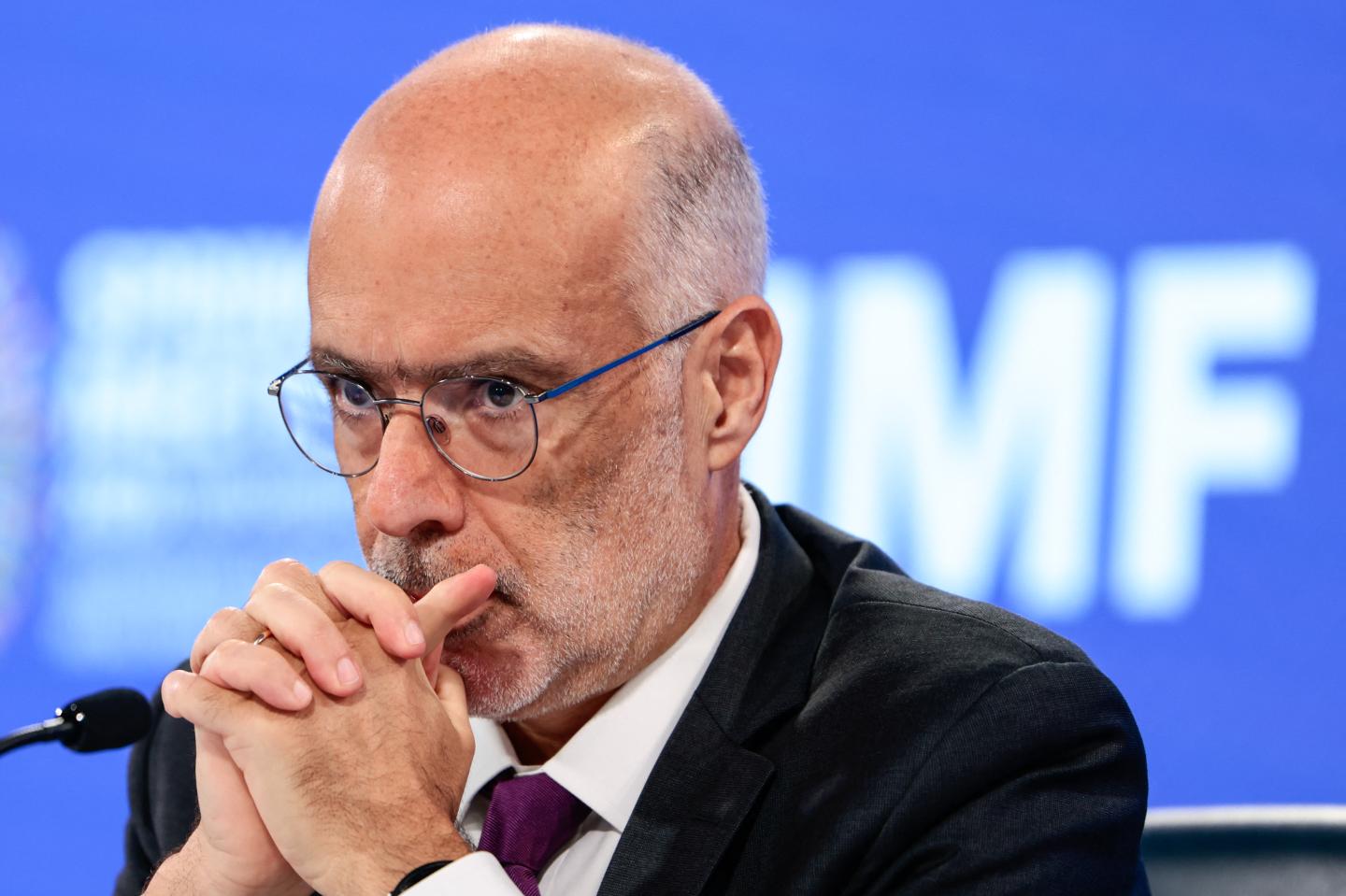
Photo of Rodrigo Valdés
The IMF’s Rodrigo Valdés speaks during a Fiscal Monitor press briefing in Washington, D.C., on April 15, 2026. Kent NISHIMURA / AFP via Getty Images
Add Fortune on Google for similar content.

America’s $39 trillion national debt has become a familiar political football—batted around in budget negotiations, invoked at congressional hearings, and largely ignored between elections. But what the International Monetary Fund laid out Wednesday is something more unsettling: The U.S. isn’t an outlier. It’s just the most visible symptom of a global disease.

Recommended Video

At the spring launch of its biannual Fiscal Monitor, IMF Fiscal Affairs Director Rodrigo Valdés opened with a stark framing: “The world economy is being tested again with the consequences of the war in the Middle East—and this is a world that has less degrees of freedom as public finances are more stretched in many, many countries.”

The fund projected global public debt will hit 99% of world GDP by 2028, breaching the 100% threshold sooner than previously forecast. Under stress scenarios representing the 95th percentile of plausible outcomes, that figure could spike to 121% within three years.

America’s tab keeps growing

The U.S. remains the marquee case study in fiscal dysfunction. Washington’s deficit narrowed slightly last year—from close to 8% to below 7% of GDP—partly boosted by tariff revenues flowing into federal coffers, but the improvement was fleeting. “Our forecast is that this deficit goes back to around 7.5% and stays there for the near future,” Valdés told reporters, with U.S. debt now on track to exceed 125% of GDP this year and potentially 142% by 2031.

The adjustment needed to simply stabilize—not reduce—that trajectory would require fiscal tightening of roughly 4 percentage points of GDP. “That is not minor, of course,” Valdés said. It would rank among the largest peacetime fiscal adjustments in modern American history. Already, warning signals are flickering in bond markets. The premium U.S. Treasuries once commanded over other advanced-economy debt is narrowing. “These are signs that markets are not as sanguine—as forgiving—as they were in the past,” Valdés said. “The more time passes, the more pressure you could face down the road.”

His message to Congress was direct: “This cannot wait forever.”

The whole world is overdrawn

Washington’s problem looks almost manageable next to the global picture. The fiscal gap—the distance between where countries’ primary balances actually sit and where they need to be to stabilize debt—has worsened by roughly one percentage point compared to the five years before COVID.

“This is not just a cyclical problem,” Valdés said flatly. “It basically reflects policy choices—permanently higher spending and lower revenues.” Real interest rates are now running some six percentage points above pre-pandemic levels, compounding the burden of every existing dollar of debt. Every year of delay makes the eventual reckoning more severe.

The energy trap making it worse

The ongoing Middle East conflict is adding a fresh dimension of fiscal temptation—and danger. As fuel and food prices climb, governments are reaching for a politically easy but economically toxic tool: broad-based energy subsidies and excise tax cuts. The IMF didn’t mince words.

“Broad-based energy subsidies or excise reductions are not the best tool,” Valdés said. “They distort price signals, are fiscally costly, regressive, and hard to unwind.” Worse, when half the world shields consumers from higher energy prices, the remaining half absorbs all the demand adjustment. “Domestic policies affect global prices,” Valdés warned—and IMF modeling suggests the spillover effect could effectively double the original price shock for countries that don’t subsidize.

Era Dabla-Norris, who leads the work on the Fiscal Monitor, noted governments’ response this time has been “much more restrained” than during the 2022 energy crisis, but cautioned that with fiscal space now “much more constrained,” the costs of reverting to old habits would be severe. The fund’s prescription: Protect people, not prices—targeted, temporary support for the most vulnerable, not blanket relief for everyone.

AI: The wild card that could change everything

In a briefing otherwise defined by grim arithmetic, artificial intelligence emerged as the closest thing to a lifeline. Dabla-Norris said AI could fundamentally transform how governments operate by boosting productivity, tightening tax administration, and improving delivery of health and education services: “It can be used to fundamentally reshape the way governments do their business.”

But the technology cuts both ways. AI concentrates wealth, disrupts labor markets, and could quietly hollow out the income tax and payroll tax bases that modern social contracts depend on. “Are our current tax systems—are our current social protection systems—fit for purpose?” Dabla-Norris asked, a question she said every government needs to urgently answer. “Because there’s a lot of uncertainty in the way AI will play out…what actual impact it will have on labor markets, what actual impact it will have on inequality. So the challenge for government is really to see whether their systems are adaptable and that they can meet the risks that it portends.”

For this story, Fortune journalists used generative AI as a research tool. An editor verified the accuracy of the information before publishing.

Fortune Daily breaks the traditional barrier between audience and newsroom. The show transforms Fortune’s trusted reporting into actionable, conversational, and entertaining insights for an emerging class of business leaders. Watch here.
About the Author
Nick Lichtenberg
By Nick LichtenbergBusiness Editor
LinkedIn icon

Nick Lichtenberg is business editor and was formerly Fortune's executive editor of global news.

See full bioRight Arrow Button Icon
Add Fortune on Google for similar content.

Latest in Economy

Finance
Lorem ipsum dolor sit amet, consectetur adipiscing elit, sed do eiusmod tempor incididunt ut labore et dolore magna aliqua. Ut enim ad minim veniam
By Fortune Editors
October 20, 2025
Finance
Lorem ipsum dolor sit amet, consectetur adipiscing elit, sed do eiusmod tempor incididunt ut labore et dolore magna aliqua. Ut enim ad minim veniam
By Fortune Editors
October 20, 2025
Finance
Lorem ipsum dolor sit amet, consectetur adipiscing elit, sed do eiusmod tempor incididunt ut labore et dolore magna aliqua. Ut enim ad minim veniam
By Fortune Editors
October 20, 2025
Finance
Lorem ipsum dolor sit amet, consectetur adipiscing elit, sed do eiusmod tempor incididunt ut labore et dolore magna aliqua. Ut enim ad minim veniam
By Fortune Editors
October 20, 2025
Finance
Lorem ipsum dolor sit amet, consectetur adipiscing elit, sed do eiusmod tempor incididunt ut labore et dolore magna aliqua. Ut enim ad minim veniam
By Fortune Editors
October 20, 2025
Finance
Lorem ipsum dolor sit amet, consectetur adipiscing elit, sed do eiusmod tempor incididunt ut labore et dolore magna aliqua. Ut enim ad minim veniam
By Fortune Editors
October 20, 2025

Most Popular

Finance
Lorem ipsum dolor sit amet, consectetur adipiscing elit, sed do eiusmod tempor incididunt ut labore et dolore magna aliqua. Ut enim ad minim veniam
By Fortune Editors
October 20, 2025
Finance
Lorem ipsum dolor sit amet, consectetur adipiscing elit, sed do eiusmod tempor incididunt ut labore et dolore magna aliqua. Ut enim ad minim veniam
By Fortune Editors
October 20, 2025
Finance
Lorem ipsum dolor sit amet, consectetur adipiscing elit, sed do eiusmod tempor incididunt ut labore et dolore magna aliqua. Ut enim ad minim veniam
By Fortune Editors
October 20, 2025
Finance
Lorem ipsum dolor sit amet, consectetur adipiscing elit, sed do eiusmod tempor incididunt ut labore et dolore magna aliqua. Ut enim ad minim veniam
By Fortune Editors
October 20, 2025
Finance
Lorem ipsum dolor sit amet, consectetur adipiscing elit, sed do eiusmod tempor incididunt ut labore et dolore magna aliqua. Ut enim ad minim veniam
By Fortune Editors
October 20, 2025
Finance
Lorem ipsum dolor sit amet, consectetur adipiscing elit, sed do eiusmod tempor incididunt ut labore et dolore magna aliqua. Ut enim ad minim veniam
By Fortune Editors
October 20, 2025
Fortune Secondary Logo
Rankings
  • 100 Best Companies
  • Fortune 500
  • Global 500
  • Fortune 500 Europe
  • Most Powerful Women
  • World's Most Admired Companies
  • See All Rankings
  • Lists Calendar
Sections
  • Finance
  • Fortune Crypto
  • Features
  • Leadership
  • Health
  • Commentary
  • Success
  • Retail
  • Mpw
  • Tech
  • Lifestyle
  • CEO Initiative
  • Asia
  • Politics
  • Conferences
  • Europe
  • Newsletters
  • Personal Finance
  • Environment
  • Magazine
  • Education
Customer Support
  • Frequently Asked Questions
  • Customer Service Portal
  • Privacy Policy
  • Terms Of Use
  • Single Issues For Purchase
  • International Print
Commercial Services
  • Advertising
  • Fortune Brand Studio
  • Fortune Analytics
  • Fortune Conferences
  • Business Development
  • Group Subscriptions
About Us
  • About Us
  • Press Center
  • Work At Fortune
  • Terms And Conditions
  • Site Map
  • About Us
  • Press Center
  • Work At Fortune
  • Terms And Conditions
  • Site Map
  • Facebook icon
  • Twitter icon
  • LinkedIn icon
  • Instagram icon
  • TikTok icon
  • YouTube icon

Latest in Economy

bessent
CommentaryU.S. Department of the Treasury
Bessent’s Yen gamble is a warning sign — buckle up
By Steve H. Hanke and Roger KopplAugust 4, 2026
32 minutes ago
Federal Reserve Chair Kevin Warsh speaks during a news conference at Federal Reserve Headquarters on July 29, 2026 in Washington, DC.
EconomyFed
Kevin Warsh told Wall Street he’d be sharing less—Goldman Sachs fears a void of Fed facts will only amplify misinformation and instability
By Eleanor PringleAugust 4, 2026
2 hours ago
jobs
EconomyJobs
Why a measly 100,000 job openings is normal for the Trump economy
By Paul Wiseman and The Associated PressAugust 4, 2026
2 hours ago
JPMorgan Chase, Accenture and others are teaming up on a new venture to standardize how AI token use is measured
AICFO Daily
JPMorgan Chase, Accenture and others are teaming up on a new venture to standardize how AI token use is measured
By Sheryl EstradaAugust 4, 2026
5 hours ago
t
EconomyWhite House
Trump called his own housing bill a ‘yawn.’ Now he’s heading for a west coast tour with a 32% approval rating on the economy
By Darlene Superville and The Associated PressAugust 4, 2026
5 hours ago
m
Retailearnings
McDonald’s U.S. sales growth stalls to 0.8% as gas prices bite
By Michelle Chapman and The Associated PressAugust 4, 2026
5 hours ago

Most Popular

How Zohran Mamdani's pied-à-terre tax exposed an epidemic of 'ghost cars' instead
Personal Finance
How Zohran Mamdani's pied-à-terre tax exposed an epidemic of 'ghost cars' instead
By Catherina GioinoAugust 4, 2026
11 hours ago
Bars, bowling alleys, and movie theaters cost too much to run and visit. Americans have run out of places to hang out and we're paying with our health
North America
Bars, bowling alleys, and movie theaters cost too much to run and visit. Americans have run out of places to hang out and we're paying with our health
By Catherina GioinoAugust 2, 2026
2 days ago
Wall Street bulls are starting to admit the earnings bubble is real—and the 60/40 portfolio may be the first casualty
Investing
Wall Street bulls are starting to admit the earnings bubble is real—and the 60/40 portfolio may be the first casualty
By Nick LichtenbergAugust 3, 2026
1 day ago
Current price of oil as of August 3, 2026
Personal Finance
Current price of oil as of August 3, 2026
By Joseph HostetlerAugust 3, 2026
1 day ago
Electric air taxis are finally ready for takeoff
Magazine
Electric air taxis are finally ready for takeoff
By Alexei OreskovicAugust 3, 2026
1 day ago
The Iran war already has a winner: The world’s largest shipbroker notching record earnings from the 'exceptional volatility' in the Strait of Hormuz
Energy
The Iran war already has a winner: The world’s largest shipbroker notching record earnings from the 'exceptional volatility' in the Strait of Hormuz
By Sasha RogelbergAugust 3, 2026
23 hours ago

© 2026 Fortune Media IP Limited. All Rights Reserved. Use of this site constitutes acceptance of our Terms of Use and Privacy Policy | CA Notice at Collection and Privacy Notice | Do Not Sell/Share My Personal Information
FORTUNE is a trademark of Fortune Media IP Limited, registered in the U.S. and other countries. FORTUNE may receive compensation for some links to products and services on this website. Offers may be subject to change without notice.